
Cotton Sterol Carrier Protein Gene and Its Application
A carrier protein and gene technology, which is applied in the field of genetic engineering to achieve the effects of increasing the content of sucrose, improving the quality of cotton fiber, and the test steps being simple and easy to implement.
Patent Information
- Authority / Receiving Office
- CN · China
- Patent Type
- Patents(China)
- Current Assignee / Owner
- Publication Date
- 2017-08-11
Smart Images

Figure 1 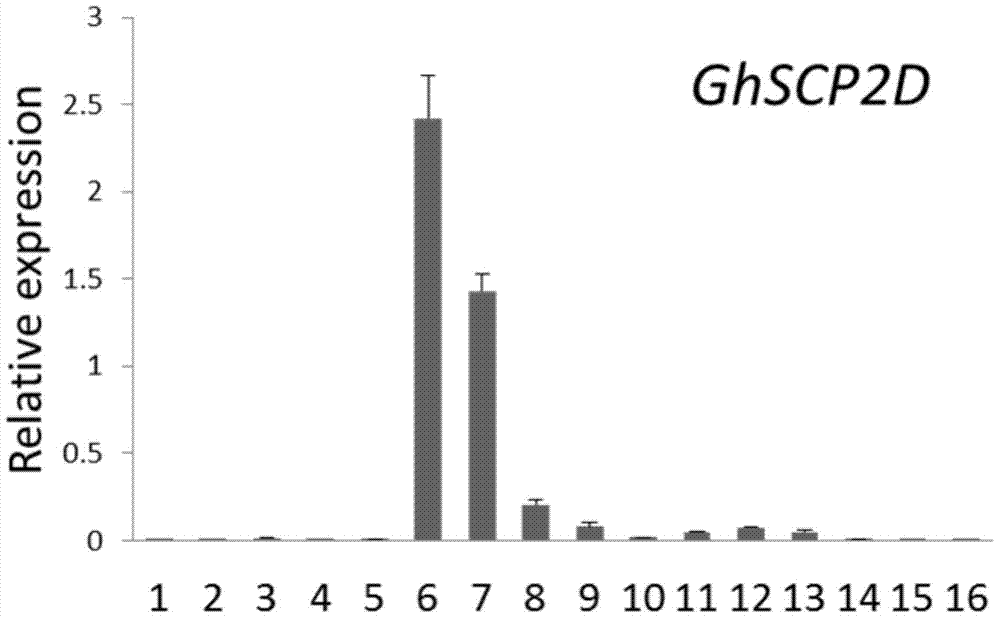
Figure 2 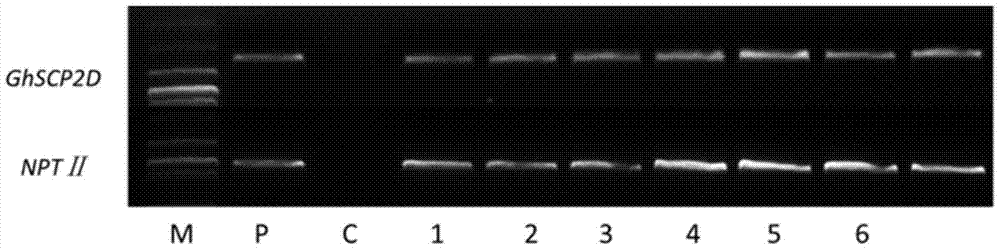
Figure 3
Abstract
Description
Technical field
[0001] The invention belongs to the field of genetic engineering and relates to cotton sterol carrier protein genes and applications thereof.
[0002] technical background
[0003] Cotton is an important economic crop in the world, and the natural fiber produced is an important raw material for the textile industry. Due to the continuous acceleration of the development of the textile industry, more neat cotton fibers are required to meet various needs, coupled with the enhancement of people's health awareness and the improvement of living standards, the requirements for the improvement of cotton fiber quality are becoming more urgent.
[0004] In the past 10 years, cotton breeding has shifted from focusing on external quality to focusing on internal quality. At present, in addition to conventional breeding methods at home and abroad, genetic engineering is gradually used to genetically improve cotton fiber quality. The development of this work firstly depends on the ...
Examples
Embodiment 1
[0033] Example 1 Obtaining the full-length sequence of cotton sterol carrier protein:
[0034] In this experiment, the multiclass method of SAM (Significant Analysis of Microarray) software was used to analyze the signal intensity of 10,902 genes in different periods on 28k cotton chips, and 6,186 differentially expressed genes (q-value≤5%) were obtained. The average highest signal intensity value and the second signal value of the 11 periods of the differentially expressed genes in 6,186 periods were used t-test method (P <0.05) and the 1.5-fold difference standard screening, and finally 192 specific expression genes were obtained. Among them, there is a CDS sequence 28k_178_A11, which is differentially expressed abnormally at different stages of fiber development. Based on this CDS sequence, we designed primers to amplify the full-length ORF and genomic sequence of the gene from upland cotton. The primers used for amplification are shown in Table 1.
[0035] Table 1: Primers us...
Embodiment 2
[0037] Example 2 Preliminary bioinformatics analysis of cotton sterol carrier protein
[0038] Preliminary analysis of bioinformatics found that the ORF inferred amino acid sequence of 28k_178_A11 was compared with the amino acid sequence of Arabidopsis sterol carrier protein gene (AtSCP2) by BLAST (http: / / www.ncbi.nlm.nih.gov / blast) It has high homology (77%) and is named GhSCP2D. Research on fiber development shows that sugar transportation and metabolism play a crucial role in fiber development. Based on this, we speculate that the sterol carrier protein gene GhSCP2D in cotton is closely related to cotton fiber development.
[0039] In the NCBI website CD Search (http: / / www.ncbi.nlm.nih.gov / Structure / cdd / wrpsb.cgi), predictions of the conserved domains of the gene revealed that GhSCP2D has a complete sterol carrier protein domain. The signal peptide predicted on the peroxisome signal peptide prediction website (http: / / mendel.imp.ac.at / mendeljsp / sat / pts1 / PTS1predictor.jsp) foun...
Embodiment 3
[0040] Example 3 Quantitative RT-PCR analysis of cotton sterol carrier protein gene
[0041] Design specific primers:
[0042] F2: 5'-AAGGAGATGTTATCAAAGGTGAAT-3' (SEQ ID NO. 5)
[0043] R2: 5'-AACCCCTCATAAAAGCAACC-3' (SEQ ID NO. 6)
[0044] Quantitative RT-PCR detection showed that the gene was not expressed in roots, stems, leaves, cotyledons and floral organs, but was differentially expressed at different stages of fiber development ( figure 1 ), the expression begins at the beginning of the fiber (3 days before flowering), and then the expression level gradually increases. The expression level is highest during the rapid fiber elongation period (5 and 10 days after flowering), and then the expression level gradually decreases.