
Network data transmission method and device
A network data transmission and data volume technology, applied in the field of communication, can solve problems affecting normal business communication, lack of information at the receiving end, etc.
- Summary
- Abstract
- Description
- Claims
- Application Information
AI Technical Summary
Problems solved by technology
Method used
Image

Examples
Embodiment Construction
[0052] The embodiments of the present invention will be described in detail below in conjunction with the accompanying drawings. It should be understood that the embodiments described below are only used to illustrate and explain the present invention, and are not intended to limit the present invention.
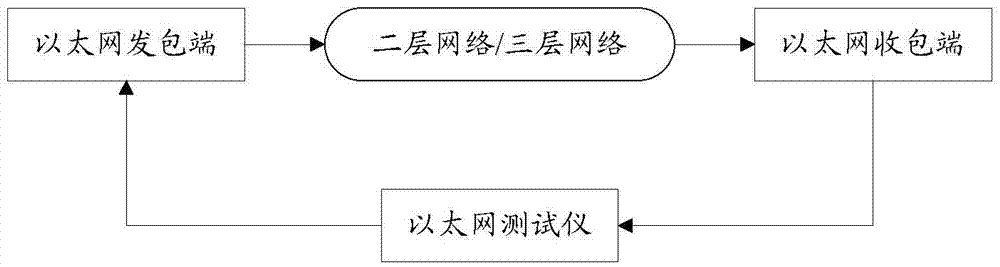
[0053] The network data transmission method provided by the embodiment of the present invention is applied to an end-to-end asynchronous transmission network, such as image 3 shown. In end-to-end asynchronous transmission Ethernet, when sending and receiving packets between two network nodes, that is, one network node is the sending end, the other network node is the receiving end, and the intermediate network node forwards the message. The sending end is fully loaded with a fixed packet sending rate, for example, V, and the sending end sends Ethernet packets with a fixed frame length. If the packet sending time is T, the total number of packets sent by the sending end is Q...
PUM
 Login to View More
 Abstract
Description
Claims
Application Information
 Login to View More