
Sulfur-containing phenol formaldehyde resin and preparation method thereof
A technology of sulfur phenolic resin and phenolic resin, which is applied in the field of sulfur-containing phenolic resin and its preparation, and can solve the problems of no functionality
Patent Information
- Authority / Receiving Office
- CN · China
- Patent Type
- Applications(China)
- Current Assignee / Owner
- Publication Date
- 2016-04-20
- Estimated Expiration
- Not applicable · inactive patent
Smart Images

Figure 1 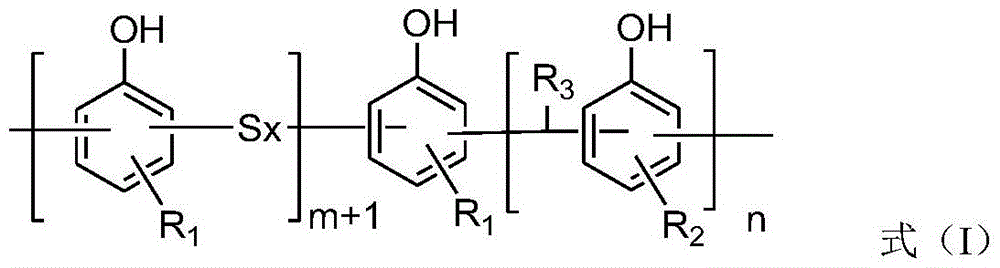
Figure 2 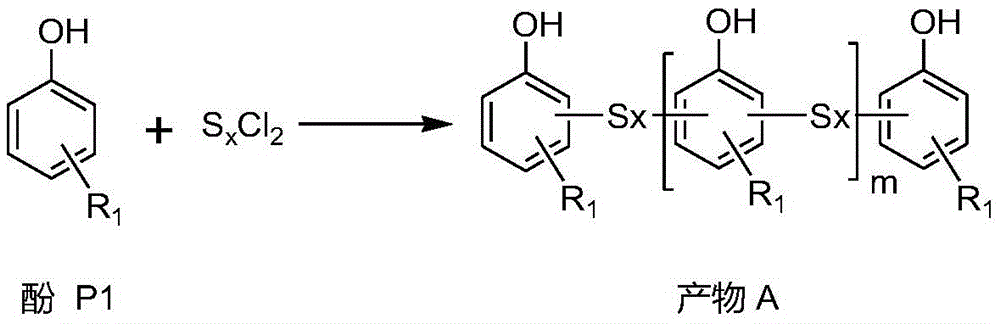
Figure 3
Abstract
Description
technical field
[0001] The invention relates to a phenolic resin and its preparation method and application, in particular to a sulfur-containing phenolic resin and its preparation method and application. Background technique
[0002] In 1872, German chemist A. Baeyer first discovered that phenol and aldehyde could be condensed in the presence of acid to obtain an amorphous brown-red intractable resinous product (Huang Farong, edited by Jiao Yangsheng. Phenolic resin and its application. Chemical Industry Press). From then on, people began to study phenolic resins, and constantly optimized the preparation process, and constantly modified phenolic resins to meet the needs of practical applications. Phenolic resins are mainly used in rubber, plastics, coatings, adhesives, inks, synthetic fibers, anti-corrosion and high-temperature resistant materials, semiconductor materials and other fields. The development and research work on phenolic resins revolves around reinforcement,...
Examples
preparation example Construction
[0046] 1. Preparation of sulfur-containing phenolic resin
[0047] 1.1 Raw materials and reagents
[0048] Table 1
[0049] raw material name
source
phenol
Sinopharm Group
Sinopharm Group
Styrenated phenol
Sinopharm Group
PTBP
Sinopharm Group
PTOP
Sinopharm Group
Sulfur monochloride (S 2 Cl 2 )
Sinopharm Group
[0050] 1.2 Instruments and equipment
[0051] Table 2
[0052] model and name
manufacturer
CS-580 Elemental Analyzer
Elter, Germany
Agilent 7890A Gas Chromatograph
AGILENT TECHNOLOGIES
FP900 calorific value analyzer
METTLER TOLEDO
[0053] 1.3 Analysis and Testing
[0054] (1) Free phenol content test: test the free phenol content of the product according to ISO8974-2002.
[0055] (2) Sulfur content test: test the sulfur content according to GBT4497.1-2010.
Embodiment 1
[0058] Embodiment 1, the preparation of phenol disulfide
[0059]
[0060] Add 56.5g of 0.6mol phenol liquid and 17.0g of toluene to a 250mL four-necked flask equipped with a temperature control device, a stirring device and a distillation device. The air in the reactor was replaced by nitrogen gas, and the temperature was controlled at 80°C. Slowly add 40.5g0.3molS dropwise within 2h under the protection of nitrogen 2 Cl 2 liquid. The tail gas of the distillation unit is passed into 10% sodium hydroxide solution to neutralize the hydrogen chloride gas produced by the reaction. S 2 Cl 2 After the liquid was added dropwise, the mixture was stirred and reacted at 90° C. for 2 h under the protection of nitrogen. In the state of distillation, the reaction temperature was raised for distillation, and when the temperature rose to 120°C, the distillation was carried out under reduced pressure for 30 minutes, and the product A phenol disulfide was finally obtained as a browni...
Embodiment 2-8
[0061] The preparation of embodiment 2-8, alkylphenol disulfide
[0062] Repeat the steps of Example 1, change the phenol in the reaction raw material into cresol (MP), p-tert-butylphenol (PTBP), p-tert-octylphenol (PTOP), styrenated phenol (SP), or the above alkyl A mixture of phenols. Change the S in the reaction raw material 2 Cl 2 The amount of liquid, based on the amount of alkylphenol, use 50%-60% S 2 Cl 2 Liquid experiments were performed to prepare Product A alkylphenol disulfide monomers or oligomers. Select toluene as reaction solvent, take alkylphenol as the basis of weight, use 20%-30% toluene to carry out experiments, solvent toluene is added in the reactor together with reaction raw material alkylphenol, other feed intake and its reaction conditions are constant, The obtained product is as follows, and the specific raw material consumption and product index are shown in Table 3.
[0063]
[0064] table 3
[0065]
[0066] Note: Examples 6, 7, and 8 a...