
Method for generating reliability information for decoding channel of radio receiver and corresponding radio receiver
A radio receiver, channel decoding technology, applied to the transmitter/receiver shaping network, other decoding technologies, encoding, etc., can solve the problems of large calculations, memory requirements, and different states, so as to save power and reduce Difficulty of implementation, effect of saving computing power
- Summary
- Abstract
- Description
- Claims
- Application Information
AI Technical Summary
Problems solved by technology
Method used
Image

Examples
Embodiment Construction
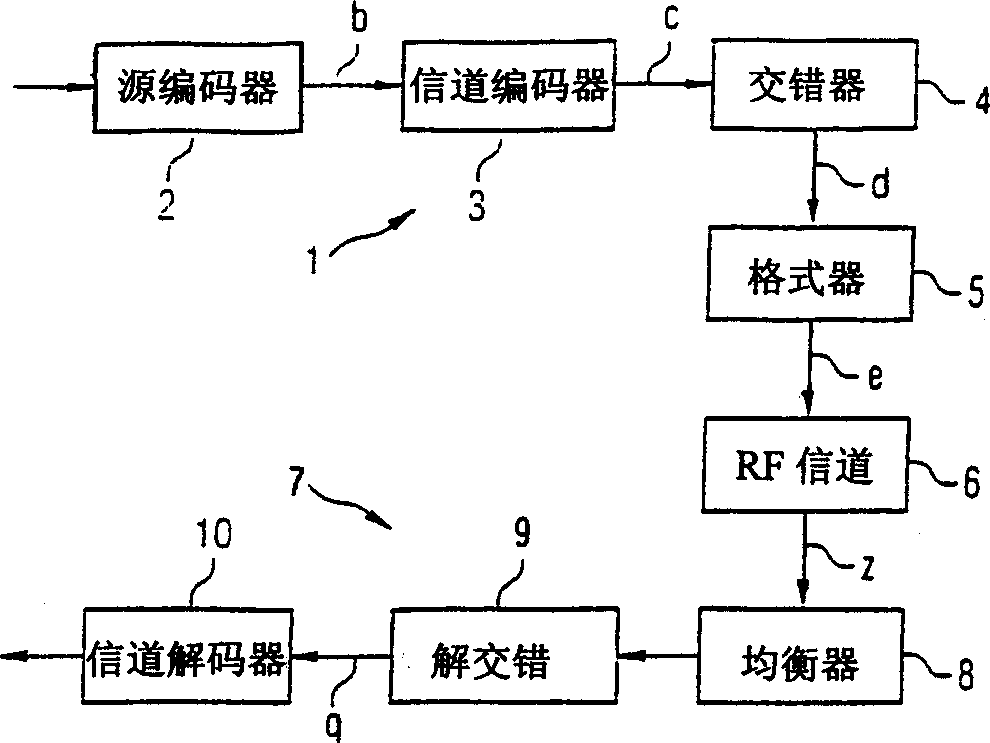
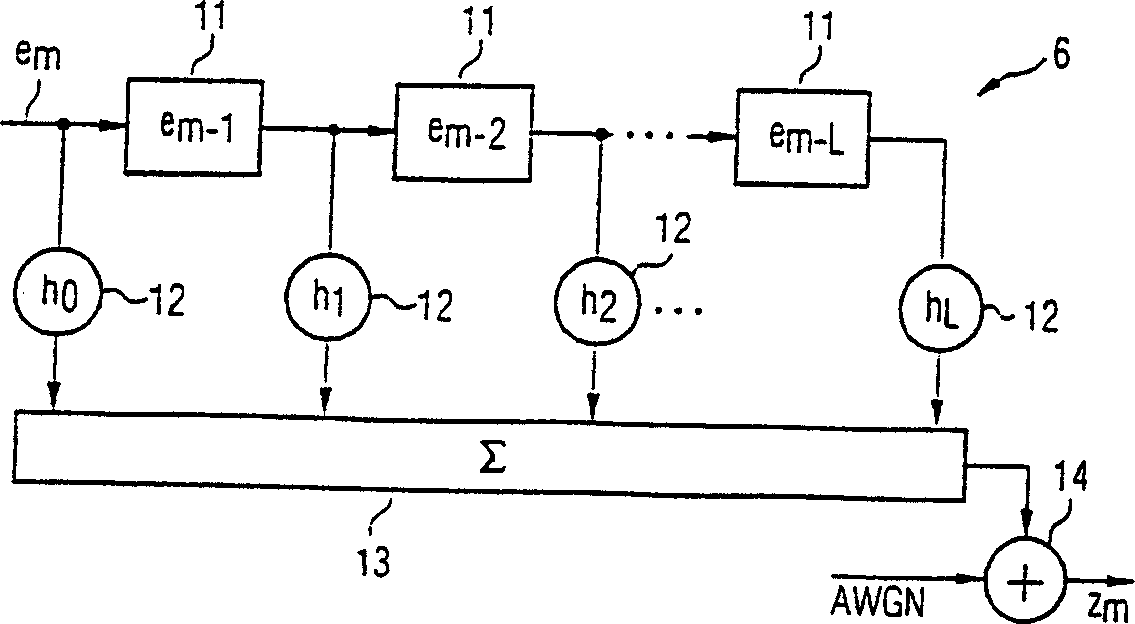
[0017] Relevant theoretical explanations which form the basis of the present invention can be found in the documents cited above, namely "Optimum and Sub-optimum Detection of Coded Data Disturbed by Time-Varying Intersymbol Interference" by Wolfgang Koch and Alfred Baier, 1990 IEEE, with particular reference to figure 1 The transmission model of the mobile radio system shown in figure 1 A mobile radio transmitter 1 and a mobile radio receiver 7 communicating with each other via a channel 6 are shown in .
[0018] In the transmitter 1, the information to be sent, such as speech information, is first converted into a digital signal by a source coder 2, that is, a sequence of symbols '1' and '0', and the source code data word or data vector b Form output, a single symbol or symbol has the value '1' or '0' in each case. The channel encoder 3 maps each data word into a code word C, and uses an interleaver 4 to replace, ie interleave, these symbols. Ideally interleaving is perform...
PUM
 Login to View More
 Abstract
Description
Claims
Application Information
 Login to View More