

Multi-pass distributed data shuffle
a distributed data and shuffle technology, applied in the direction of instruments, input/output to record carriers, memory adressing/allocation/relocation, etc., can solve the problems of increasing the number of sinks, data may no longer fit in a limited number of sinks, and the shuffle operation cannot scale as easily to accommodate additional sinks
- Summary
- Abstract
- Description
- Claims
- Application Information
AI Technical Summary
Benefits of technology
Problems solved by technology
Method used
Image



Examples
Embodiment Construction
Overview
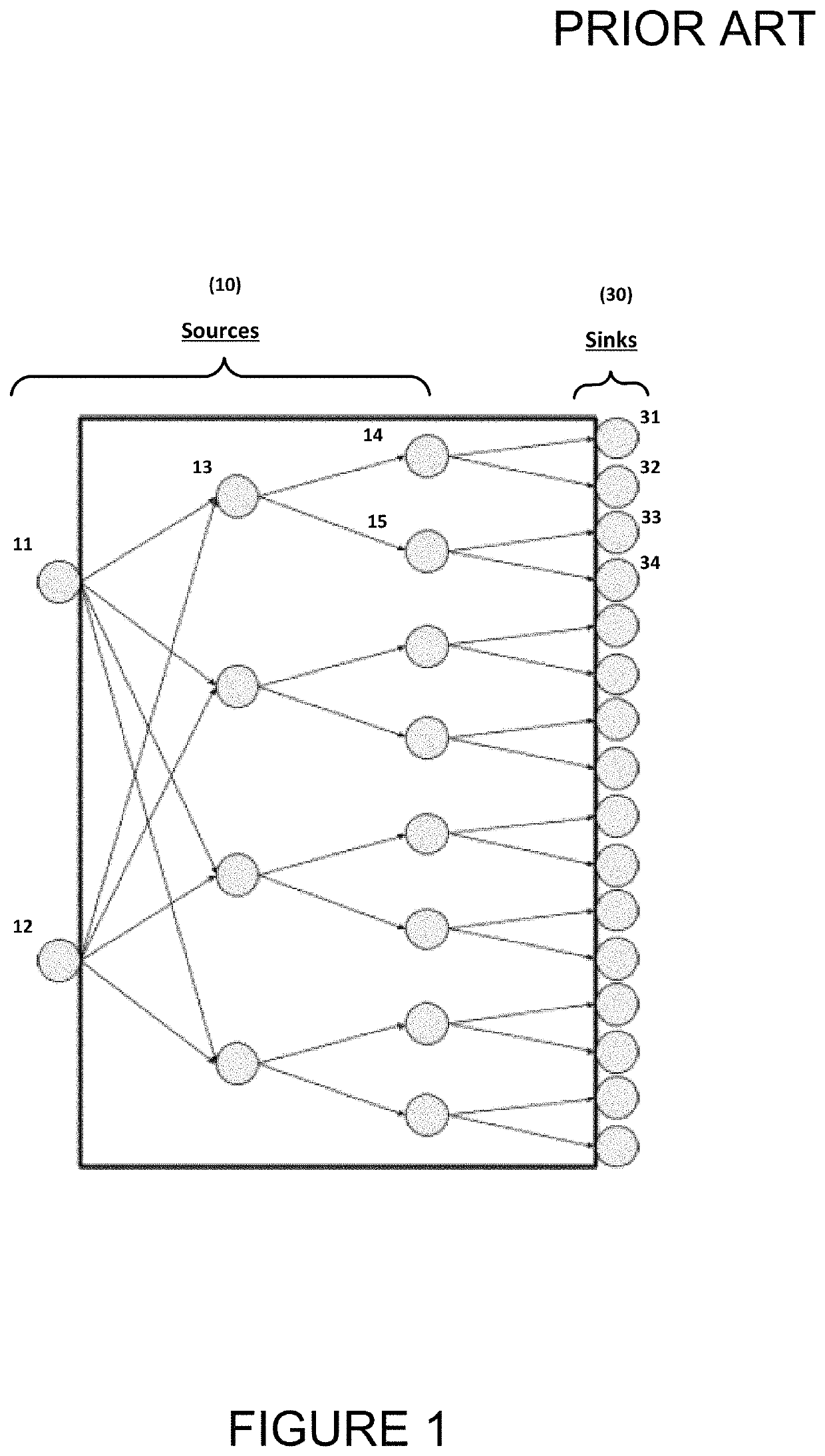
[0029]In order to scale the shuffle operations with the increasing number of sinks, the present disclosure divides the shuffle operations into multiple passes. In this manner, the number of sources that are read by each sink is reduced, thus alleviating the amount of overhead of the shuffle operations for each sink. Multi-pass shuffle operations can be implemented in different ways and each implementation may improve efficiency in a different manner.
[0030]In some implementations, at least one pass of a multi-pass shuffle may be a “sink split.” In a sink split data from each given source is distributed among multiple sinks, but each sink reads data from only one source. Sink splitting in one pass of the multi-pass shuffle may allow the other passes of the multi-pass shuffle to be executed using fewer sinks.
[0031]For example, if it is desired to distribute data from 100,000 sources to 100,000 sinks, the data may first be passed to 1,000 sinks, and then the data of each of the ...
PUM
 Login to View More
 Abstract
Description
Claims
Application Information
 Login to View More