
Method for estimating coverage of Web search engines
a technology for web search engines and coverage, applied in the field of search engines, can solve the problems of unreliable estimates, poor way to measure relative coverage of public search engines, and often contradictory studies
- Summary
- Abstract
- Description
- Claims
- Application Information
AI Technical Summary
Problems solved by technology
Method used
Image

Examples
Embodiment Construction
The Web
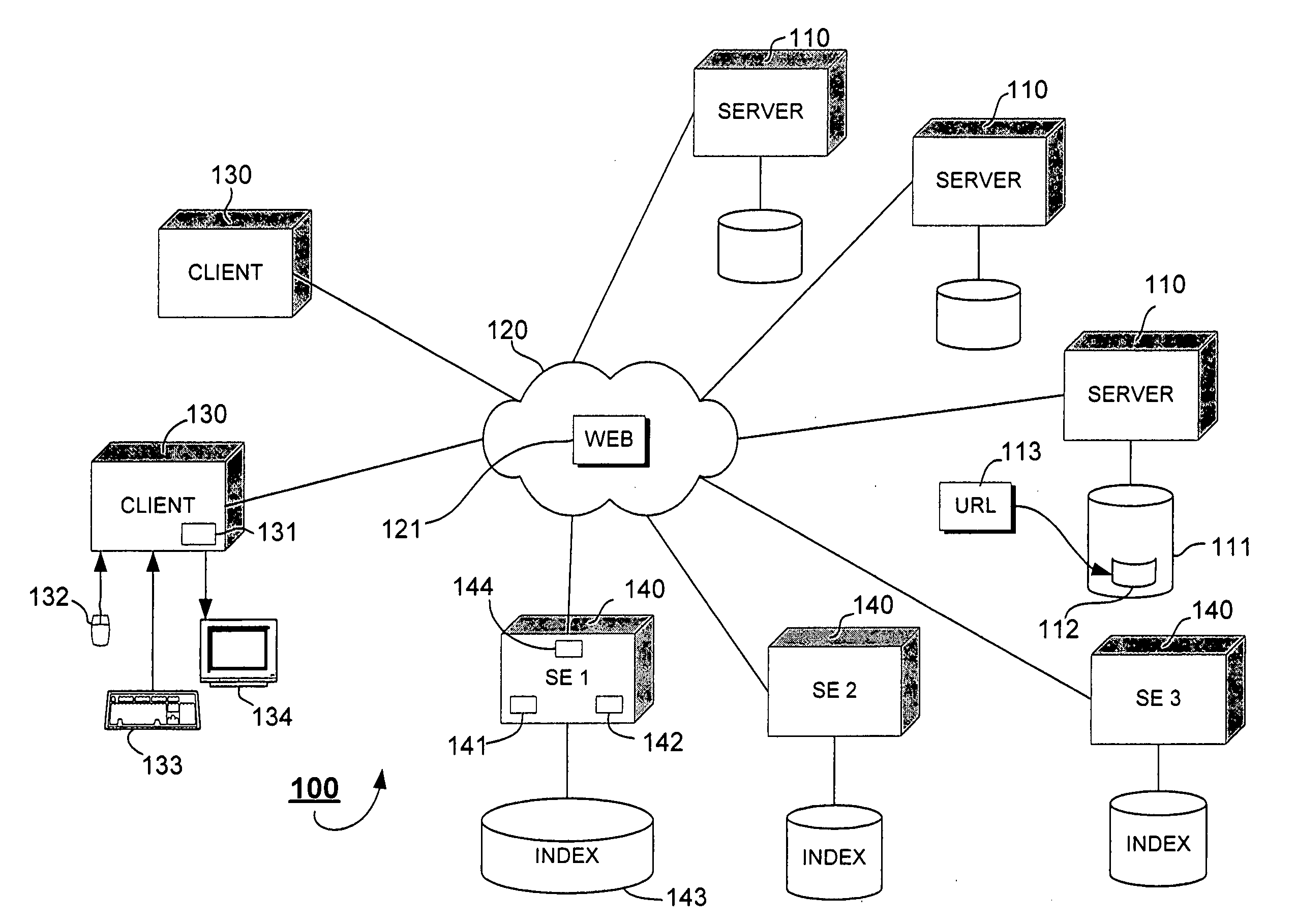
FIG. 1 shows an arrangement 100 which uses the Web coverage estimation method of the invention. A plurality of computers 110, 130, and 140 are connected to each other by a communications network 120, for example, the Internet. The Internet includes an application level interface called the World-Wide-Web (Web 121). Server computers 110 maintain multimedia content 111, for example, HTML Web pages 112. The location of any page 112 is specified by its Universal Resource Locator (URL) 112.
Client computers 130 typically are lap-tops, personal computers, or workstations having input / output (I / O) devices such as a mouse 132, a keyboard, and a monitor 134. Usually, each client 130 is also equipped with a Web browser 131 such as the Netscape Navigator™, or the Microsoft Internet Explorer™. The application level browser executes under an operating system such Unix™, NT™, or Windows™.
During operation of the arrangement 100, users of the clients 130 desire to access content 111 of ...
PUM
 Login to View More
 Abstract
Description
Claims
Application Information
 Login to View More