[0010] Function modules or elements of the aforementioned type can relate, for example, to relatively small technological objects, e.g. pumps, valves or clamps. When developing a new
automation solution a project engineer can resort to the use of said elements, which are stored in the
library of the system. He can thus reuse elements that have already been developed in the past for further solutions. This leads to a reduction in the
engineering overhead arising in the course of the development of an automation solution.
[0013] As a rule a single project
library exists for a project. If elements or, as the case may be, technological objects from different global libraries or other sources are included in the project library, a
substructure can be generated for example automatically by the user or even by the system by creating library folders for the elements from the different sources. This helps the user in navigating through the project library. In addition, this avoids conflicts in the naming of different library elements.
[0015] A further advantageous embodiment of the invention is characterized in that the library is embodied in such a way that its structure can be specified by a user. This enables the user in the course of his
engineering process to make use of a library with a structure that is optimally tailored to his purposes. A user can structure the library for his project in such a way that the relevant and related elements for his purposes are stored in corresponding folders. This facilitates the user's work within the framework of engineering projects.
[0016] A further advantageous embodiment of the invention is characterized in that the library has folders and / or subsets for storing specific elements, in particular elements of different origin. This allows the user to easily perform a structuring in such a way that the elements are copied into subsets or folders according to whether they originate from different global libraries or are even of some other origin. This enables an advantageous grouping of the elements. Equally it is possible that an element in the library can be subdivided further into “subelements” which represent different aspects, for example for control, for HMI or for diagnostics. In this way “subtypes”, as it were, can be formed which are in each case instantiated in individual projects without the whole element having to be instantiated.
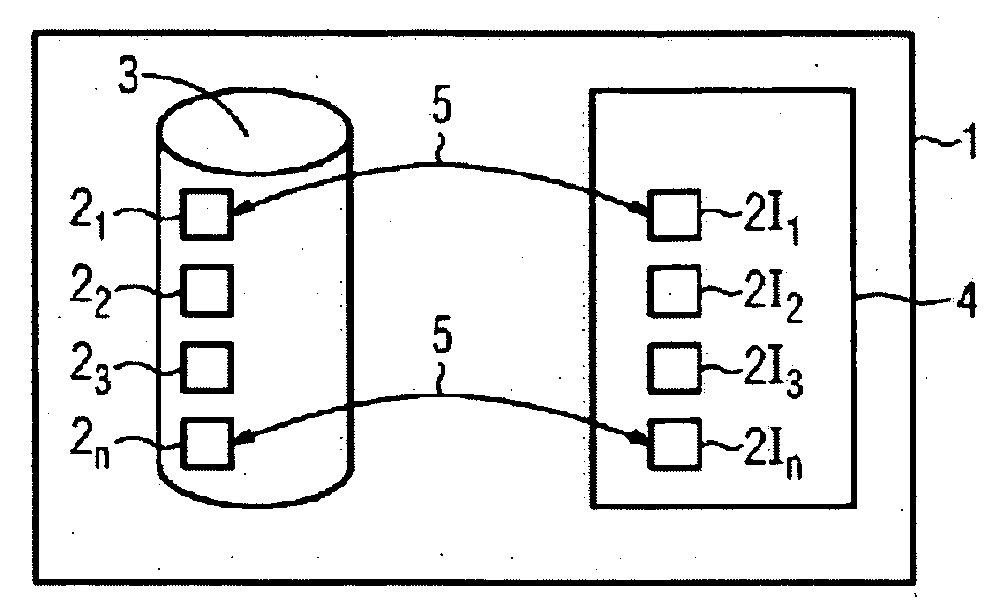
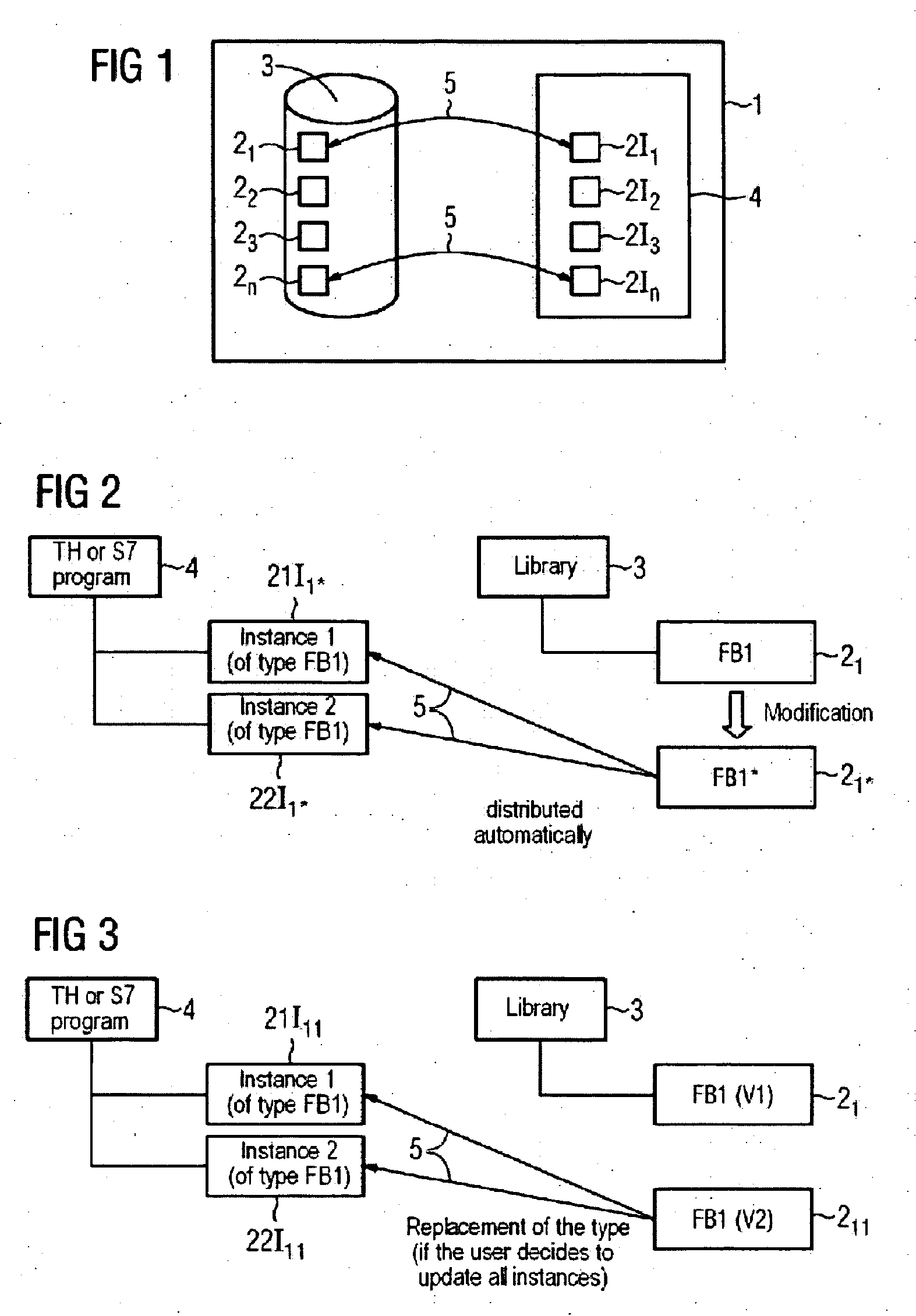
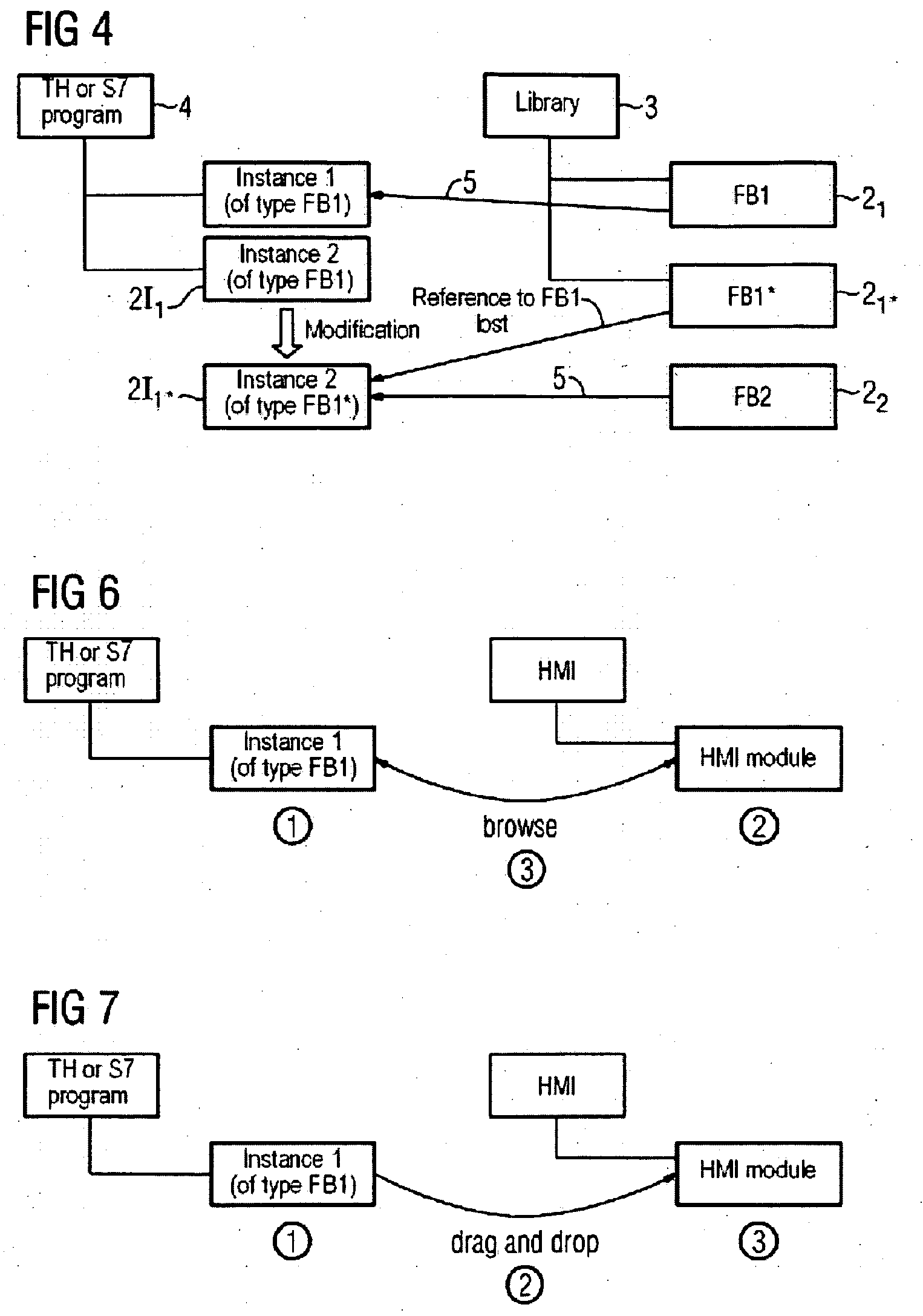
[0018] A further advantageous embodiment of the invention is characterized in that third means are provided for updating the exemplars of an element when the element has been modified and / or replaced. This enables all exemplars or, as the case may be, instances of a type to be updated if the source, that is to say the type in the project library, changes. In this case the update can be performed automatically when an element or, as the case may be, the type is modified or replaced. However, the update can also be performed such that it can only be executed by a user when an element has been updated. In this case, when an element is updated in the project library, the user is asked whether or not he would like to update the exemplars or, as the case may be, instances derived from the element or, as the case may be, type. The update can also be extended here only to individual instances or, as the case may be, exemplars. This affords the user of the system a maximum of flexibility in updating reusable function modules.
[0021] A further advantageous embodiment of the invention is characterized in that the system is embodied as an engineering system for automation systems. In particular in the environment in which solutions are developed for automation systems it is evident that a great deal of time, effort and expense is required for the development of individual partial solutions or, as the case may be, technological objects. A particularly useful approach here is to make use of already existing elements, which results in a significant reduction in development costs.


 Login to View More
  Login to View More