[0017] It is a principal
advantage of the present invention to provide a pari-mutual wagering
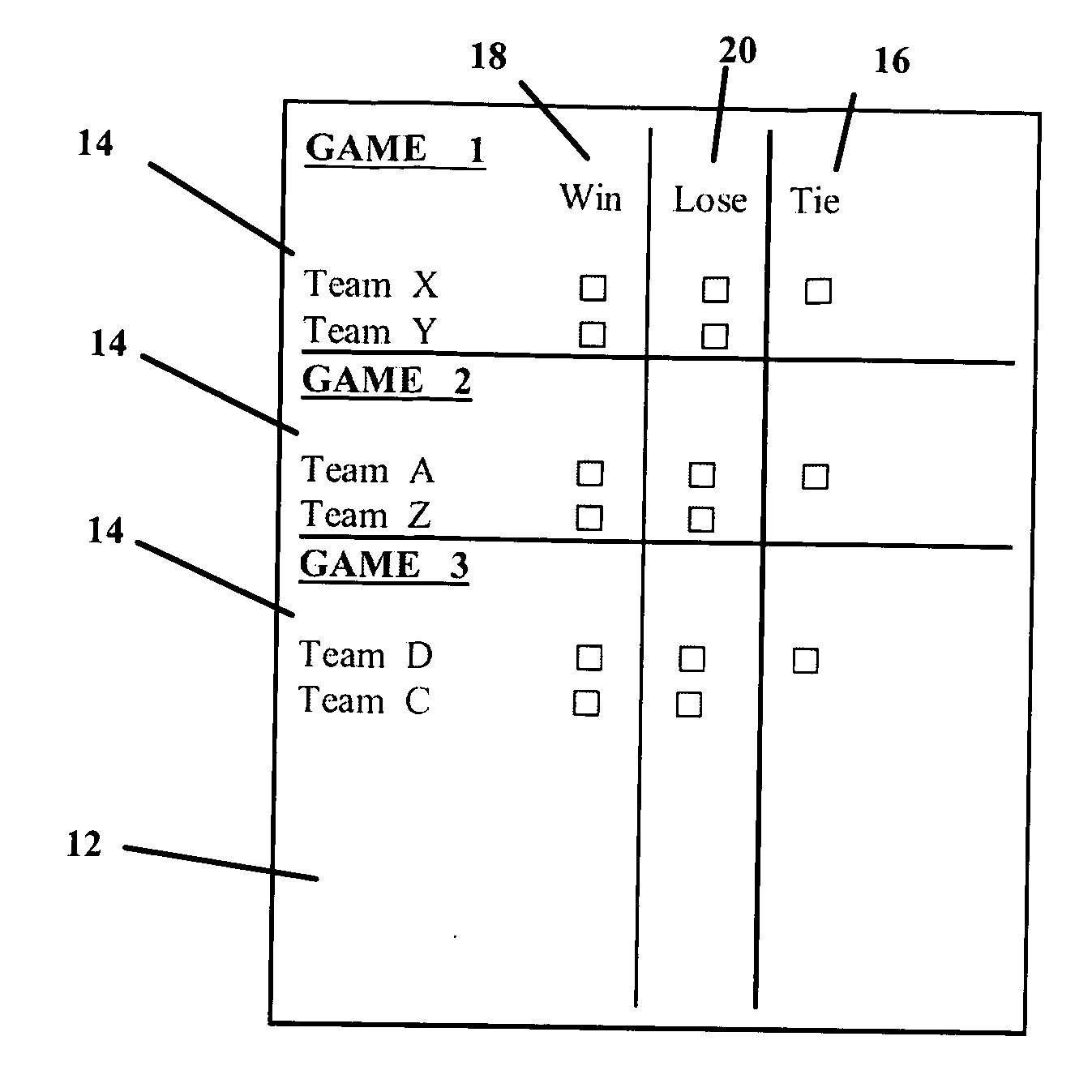
system that allows for the betting on the occurrence of a tie of a sporting event at the end of regulation time as one of three outcomes. The bettor can bet upon one of the participants in the event to win, one to lose, or, that both will tie, at cessation of regulation play.
[0018] In betting on the three outcomes, the bettor can be provided with options to bet upon sporting events of the same sport or sporting events that are mixed as to sports. Further, bettors can be provided with the ability to bet on such sporting events, in mixed sports or the same sport over a defined number of dates where different games on different dates are wagered upon by bettors in the
pool as to an outcome. The more events included in the
pool on which bettors bet for a win, loss, or tie, the more potential for obscure outcomes and very large winnings by the small number of bettors with the most correct prediction of outcomes.
[0019] The betting options offered by the house and on which it holds bets upon which the house retains a percentage are infinite in the number and types of sports event combinations that can be combined. Further, the options can include multiple meetings on multiple dates of teams in one sport or multiple meetings on multiple dates of pairings of teams of different sports. Or, the wagering could provide for multiple teams of different sports on the same date or multiple teams playing the same sport on the same date. Further, in another
scenario of the method herein noted above, the game may be played for fun by groups or a family or in an office pool, both of which would employ a points system to award the most points to the most-correct bettor on a plurality of sporting events at the end of regulation time.
[0020] The wagering options for all such pooled bettor wagering offered would include a win by one of the participants in any one event, a loss by one of the two participants in any one event, and a tie of both participants of any one event. However, the win, loss, or tie would be determined at the end of regulation play and prior to any overtime play between the two participants in any one event in sports that provide for overtime play to determine an ultimate winner.
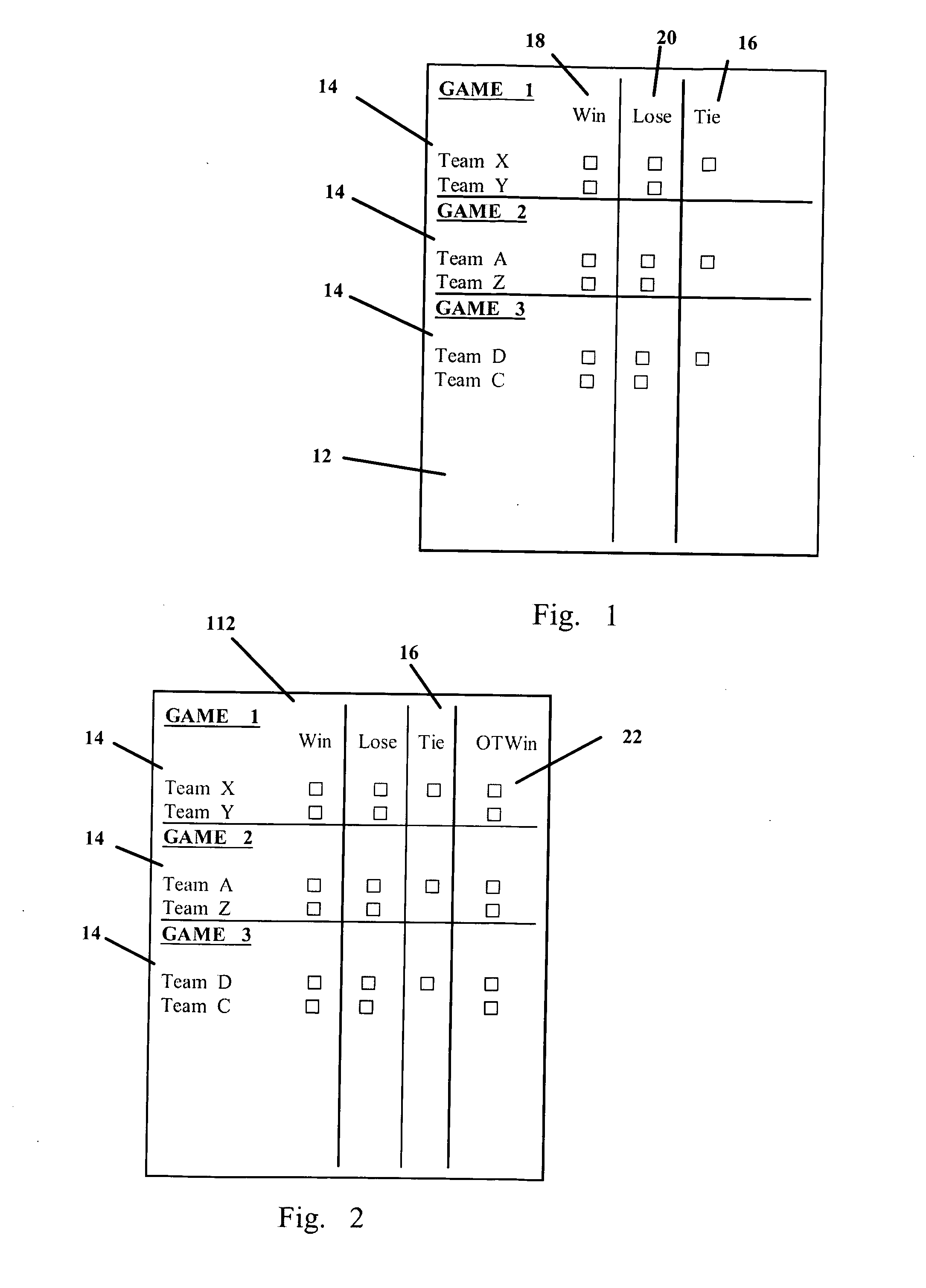
[0021] Still further, a fourth outcome can be provided for wagering in such events. This would be the ultimate outcome if overtime occurs in the contest. In this instance the wagerers would be betting on the outcome of the game at the end of overtime as to a win, loss, or tie by the participants and the outcome of overtime play in the event of a tie. Providing for wagering on both the tie and the ultimate outcome in the event of a tie can certainly provide for obscure outcomes, especially where a large pool of bettors is betting upon a plurality of different sporting events. If the sporting events are in a plurality of different sports and / or on a plurality of different dates, the provision of wagering on both the tie at the end of regulation and the outcome at the end of overtime on some games that reach that stage, along with the normal win, loss, or tie for other games that do not enter overtime, creates the possibility of huge payouts for the few bettors getting the ultimate outcome correctly.
[0022] Additionally, the system described above would be an excellent method for running a state or private lottery where winners conventionally pick a plurality of random numbers in any given contest and participate in winnings from the pool of bets based on the
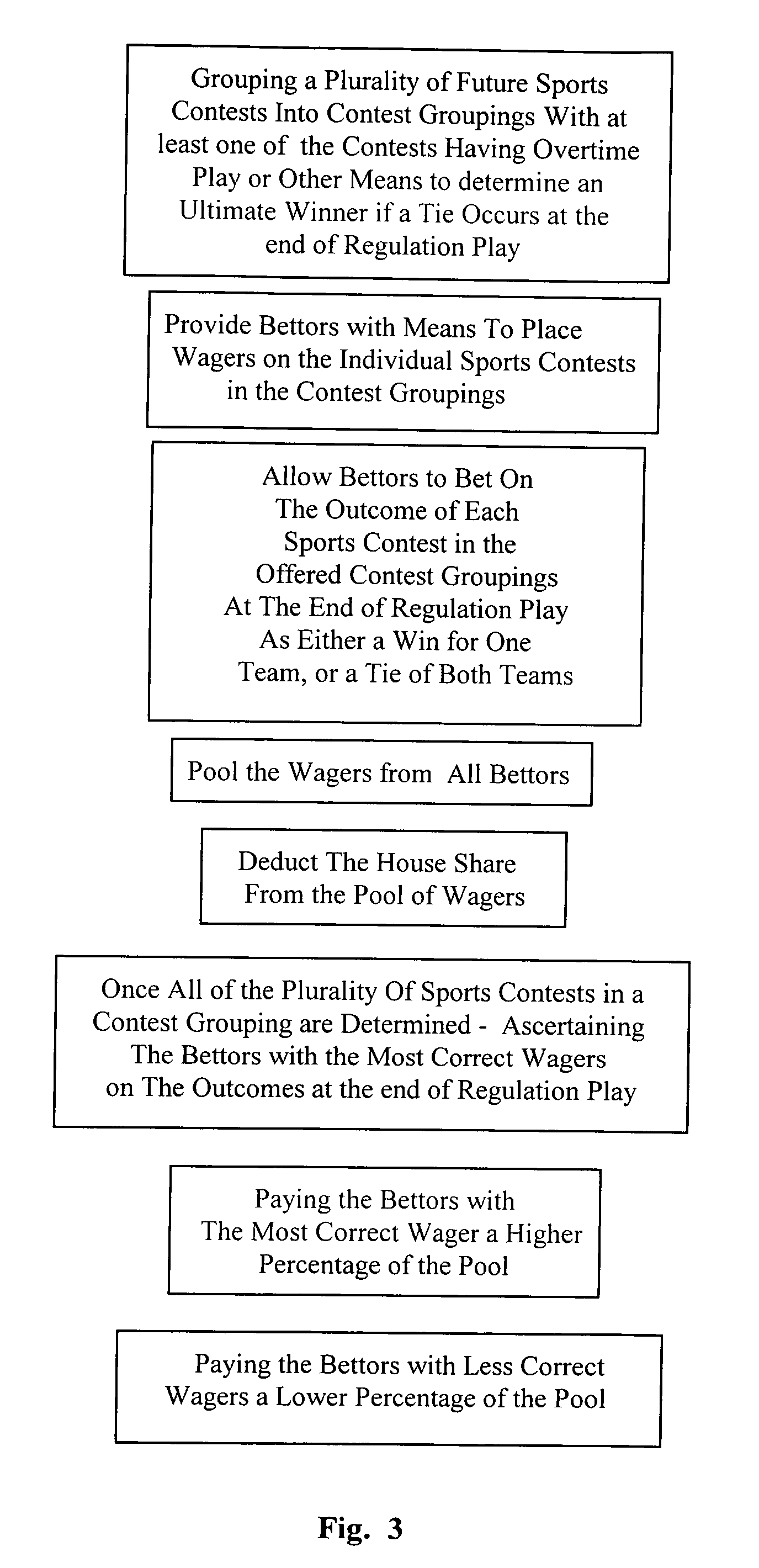
correctness of their chosen numbers in that contest. Using the method disclosed herein, a plurality of sporting events can be chosen for betting upon in a given contest and wagers from bettors taken based upon the winner, the loser, or tie at the end of regulation. The bettors with the most correct bets as to the three potential outcomes for individual events in the plurality of sports events included in a given contest would win a larger percentage of the pool of wagers. Bettors with less correct predictions would consequently win smaller amounts of the wagered money. The house which determines the sporting events included in a given contest would, of course, take its set share of the pool of wagers on that contest.


 Login to View More
  Login to View More