
Heterocyclic Derivatives and Their Use as Stearoyl-Coa Desaturase Inhibitors
a technology of desaturase inhibitors and heterocyclic derivatives, which is applied in the direction of drug compositions, metabolic disorders, cardiovascular disorders, etc., can solve the problems that known modulators of delta-9 desaturase activity are not useful in treating diseases and disorders linked to scd1 biological activity, and achieve effective modulation of triglyceride level, prevent and/or diagnose, and treat. and/or prevent the effect of diseas
Patent Information
- Authority / Receiving Office
- US · United States
- Patent Type
- Applications(United States)
- Current Assignee / Owner
- Publication Date
- 2008-08-07
- Estimated Expiration
- Not applicable · inactive patent
Smart Images
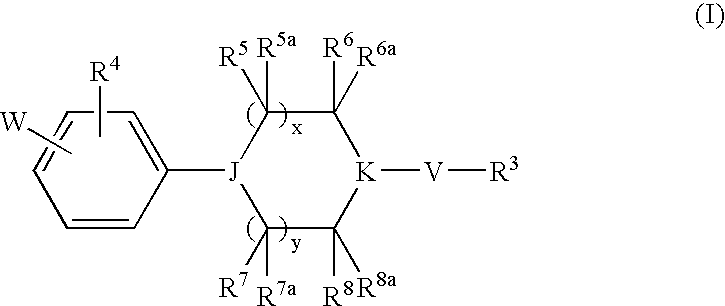
Figure 1 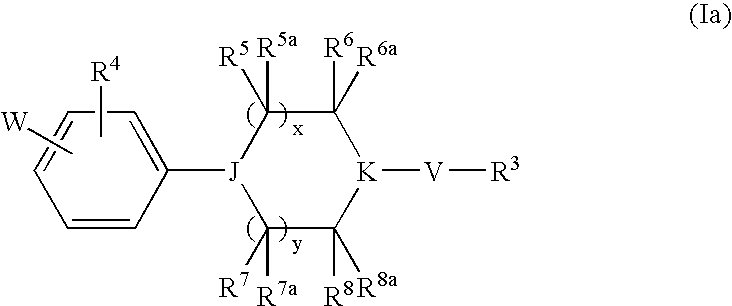
Figure 2 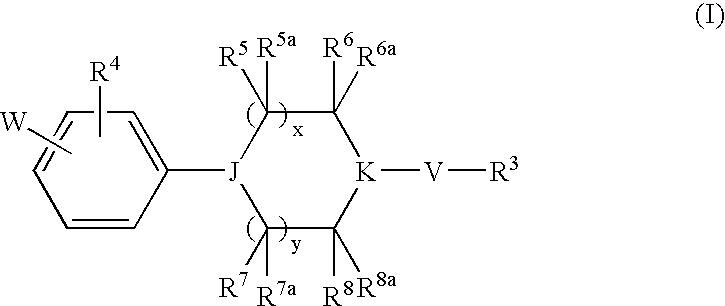
Figure 3
Abstract
Description
FIELD OF THE INVENTION
[0001] The present invention relates generally to the field of inhibitors of stearoyl-CoA desaturase, such as heterocyclic derivatives, and uses for such compounds in treating and / or preventing various human diseases, including those mediated by stearoyl-CoA desaturase (SCD) enzymes, preferably SCD1, especially diseases related to elevated lipid levels, cardiovascular disease, diabetes, obesity, metabolic syndrome and the like.BACKGROUND OF THE INVENTION
[0002] Acyl desaturase enzymes catalyze the formation of double bonds in fatty acids derived from either dietary sources or de novo synthesis in the liver. Mammals synthesize at least three fatty acid desaturases of differing chain length specificity that catalyze the addition of double bonds at the delta-9, delta-6, and delta-5 positions. Stearoyl-CoA desaturases (SCDs) introduce a double bond in the C9-C10 position of saturated fatty acids. The preferred substrates are palmitoyl-CoA (16:0) and stearoyl-CoA (18:0...
Examples
preparation 1
Synthesis of 2-cyclopropylethylamine
[0307]Concentrated sulfuric acid (20.66 mL) was added dropwise to a vigorously stirred suspension of lithium aluminium hydride (764.4 mmol) in 800 mL of anhydrous ethyl ether (40 mL) at 0° C. for at least 2 hour period. The reaction mixture was warmed to ambient temperature and stirred for 1 hour, and a solution of cyclopropylacetonitrile (246.5 mmol) in 100 mL of anhydrous ethyl ether was added dropwise. The resulting mixture was heated to reflux for 2 hours, then cooled to 0° C., cautiously quenched with crushed ice. A solution of 38 g of NaOH in 350 mL of water was added, and the organic layer was decanted from the resulting aluminium hydroxide precipitate. The precipitate was washed thoroughly with ethyl ether (3×600 mL). All ethereal extracts were combined, dried over anhydrous Na2SO4 and the solvent was distilled off to afford 172.5 mmol of 2-cyclopropylethylamine as a colorless liquid (bp ˜100-108° C.). Yield 70%.
preparation 2
Synthesis of piperazin-1-yl-(2-trifluoromethylphenyl)methanone
[0308]A. To a stirred solution of 1-Boc-piperazine (1.960 g, 10.50 mmol) and diisopropylethylamine (2.714 g, 21 mmol, 3.63 mL) in dichloromethane (50 mL) was added 2-trifluoromethylbenzoyl chloride (2.086 g, 10.00 mmol) dropwise. The resulting mixture was stirred at ambient temperature for 1 minute and then quenched with water (25 mL). The organic phase was separated and washed with H2O, brine, dried over MgSO4 and then concentrated in vacuo to afford product 4-(2-trifluoromethylbenzoyl)-piperazine-1-carboxylic acid tert-butyl ester as pale yellow solid. Yield 95%, 3.575 g.
[0309]B. A solution of 4-(2-trifluoromethylbenzoyl)piperazine-1-carboxylic acid tert-butyl ester (10 mmol) in 50 mL of 1:4 mixture of trifluoroacetic acid and dichloromethane was stirred at ambient temperature for 10 minutes. After concentration in vacuo the residue was dissolved in dichloromethane (100 mL) and washed sequentially with 1 N NaOH (10 mL),...
example 1
Synthesis of n-(2-cyclopropylethyl)-4-[4-(2-trifluoromethyl-benzoyl)piperazin-1-yl]benzamide
[0311]To a solution of 4-bromobenzoyl chloride (0.600 g, 2.700 mmol) in dichloromethane (20 mL) was added 2-cyclopropylethylamine (0.270 g, 3.28 mmol) at 0° C. The mixture was stirred at ambient temperature for 12 hours, then washed sequentially with diluted HCl solution and NaHCO3. The organic phase was separated, dried and concentrated. The residue was purified by column chromatography and recrystallization from ethyl acetate and hexane to afford 4-chloro-N-(2-cyclopropylethyl)benzamide.
[0312]A mixture of 4-chloro-N-(2-cyclopropylethyl)benzamide (0.677 g, 2.500 mmol), piperazin-1-yl-(2-trifluoromethylphenyl)methanone (0.770 g, 3.000 mmol), BINAP (0.046 g, 0.075 mmol), potassium tert-butoxide (0.392 g, 3.500 mmol), Pd2(dba)3 (0.022 g, 0.025 mmol) and 1,4-dioxane (20 mL) was refluxed under nitrogen atmosphere for 18 hours. The reaction mixture was then cooled and filtered through a celite cak...