
Phosphoric acid esters, their preparation and use
a technology of phosphoric acid and esters, which is applied in the field of phosphoric acid esters of polyethermodified alkyl alcohols, can solve problems such as visible tread marks
- Summary
- Abstract
- Description
- Claims
- Application Information
AI Technical Summary
Benefits of technology
Problems solved by technology
Method used
Image

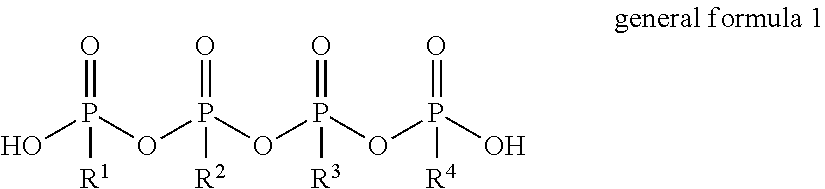
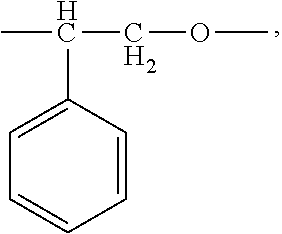
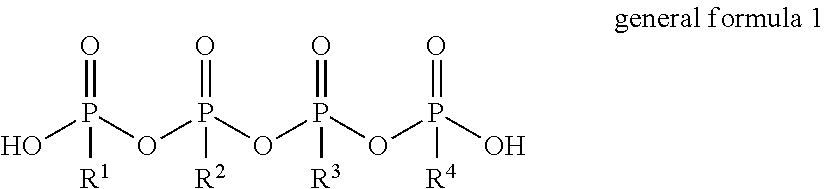
Examples
examples
Preparation of Phosphoric Acid Esters (According to the Invention)
[0102]EX2010 / 27
[0103]591.5 g (3.0 mol) of lauryl / myristyl alcohol and 21.4 g (0.31 mol) of potassium methylate were placed in a reactor and a vacuum was applied. After careful flushing with high-purity nitrogen, the mixture was heated to 115° C. and 1209 g (10 mol) of styrene oxide were added over the course of 15 minutes and under a vacuum of −0.8 bar. After a further 3 hours, the addition of the styrene oxide was complete, detectable from a residual content of styrene oxide which, according to GC, was <0.1% by weight. Then, 1478 g (33.5 mol) of ethylene oxide were metered into the reactor at a rate such that the internal temperature of 120° C. and the pressure of 6 bar were not exceeded. After introducing all of the ethylene oxide, the temperature was kept at 115° C. until a constant manometer pressure indicated the end of the post-reaction. Finally, the unreacted residual monomers were removed in vacuo at 80-90° C....
formulation examples
[0125]Formulation examples are given below in tabular form, including the respective amount, expressed in % by weight, based on the total formulation, using the following raw materials:[0126]TEGOTENS SD 100—Sorbitan sesquioctanoate, Evonik Industries AG[0127]Rewopol D 510 NC—Ethylhexyl sulphate, 40%, Evonik Industries AG Laureth 10, Evonik Industries AG[0128]Rewopol CC 40 B—Cationic / nonionic blend, Evonik Industries AG[0129]Tegotens DO—Decamine oxide, 30%, Evonik Industries AG[0130]Rewocare TS 35—Anionic blend, Evonik Industries AG[0131]Rewoquat CQ 100—Cationic / nonionic blend, Evonik Industries AG[0132]Rewoteric AM KSF 40—Cocoamphodipropionate, 40%, Evonik Industries AG[0133]TEGO Polish Additive WE 50—Emulsion of avocado oil, Evonik Industries AG[0134]TEGO Polish Additive ASL 60—Emulsion of a silicone oil, Evonik Industries AG[0135]Rewopol SC 200—Amphoteric / nonionic blend, Evonik Industries AG[0136]Rewopol SB DO 75—Diisooctyl sulphosuccinate, 75%, Evonik Industries AG[0137]Rewopol N...
PUM
| Property | Measurement | Unit |
|---|---|---|
| pressure | aaaaa | aaaaa |
| temperature | aaaaa | aaaaa |
| pressure | aaaaa | aaaaa |
Abstract
Description
Claims
Application Information
 Login to View More