
Methods for treating an object with chlorine dioxide
a technology of chlorine dioxide and object, which is applied in the field of treating objects with chlorine dioxide gas, can solve the problems that chlorine dioxide in rinse water solutions offers little removal of organisms on the surface of racs, and achieve the effect of reducing chlorine containing residues
- Summary
- Abstract
- Description
- Claims
- Application Information
AI Technical Summary
Benefits of technology
Problems solved by technology
Method used
Image

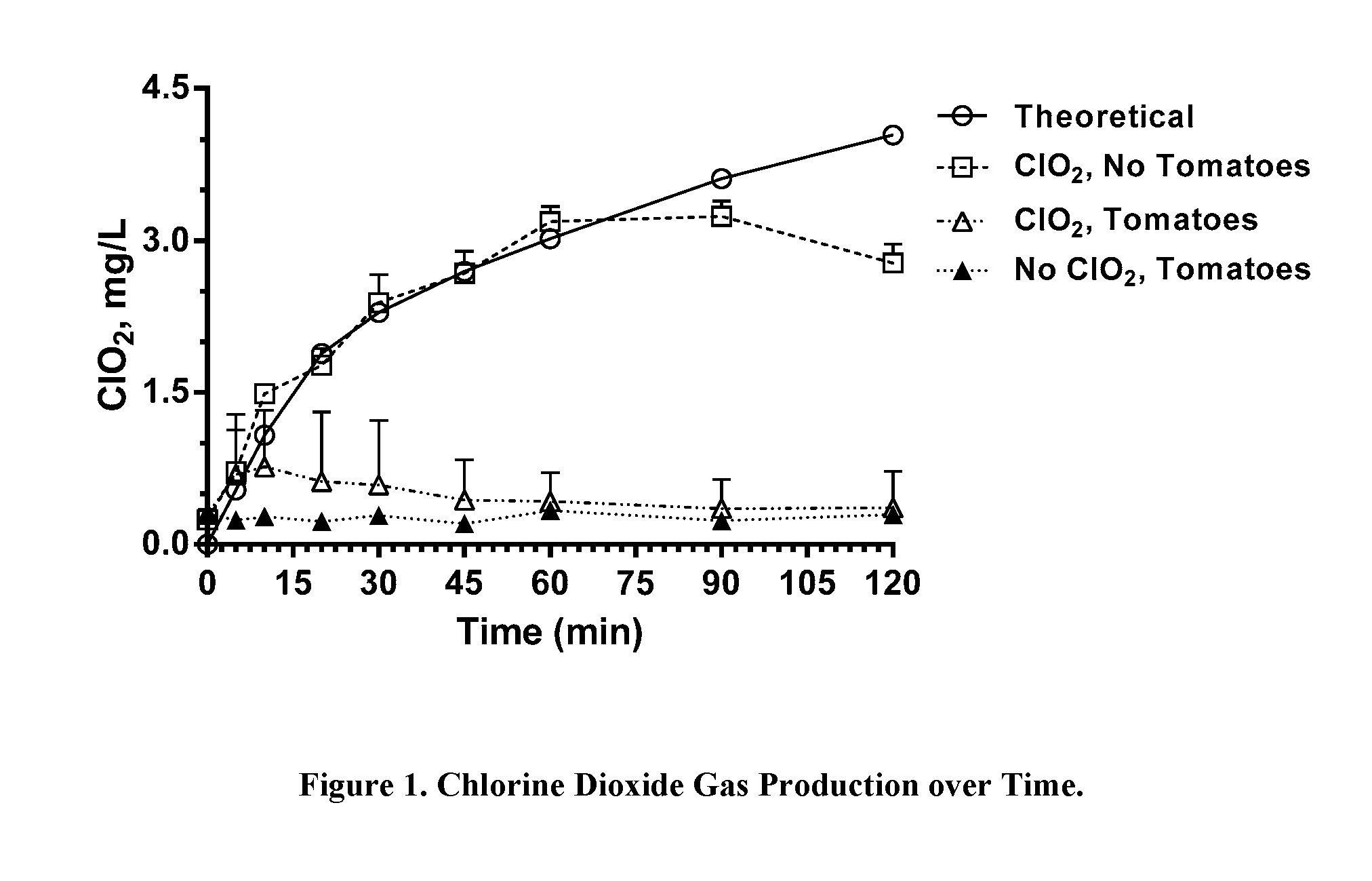
Examples
example 1
Gas Chamber Studies Confirmed Chlorine Dioxide by-Products are Influenced by Light
example 1a
[0035]Chlorine dioxide gas was generated within sealed 1 quart (0.95L) glass canning jars for a period of two hours during which half of the jars were exposed to ambient light (fluorescent lighting in laboratory; estimated light intensity, 900 Lux) , and half were shielded from light by an aluminum foil wrap. The chlorine dioxide was generated within the jars from a two part dry mixture of particles within gas permeable TYVEK sachets. At the end of the two hour exposure period, the jars were unsealed, the sachets removed, and unreacted C102 vented to a hood. Residues on the walls of each jar were quantitatively recovered by washing the walls sequentially with 4-50 mL aliquots of nanopure water and combining the aliquots with additional water to bring the total volume to 250 mL. These washings were analyzed by ion chromatography for chlorate and perchlorate ions.
[0036]Based on reaction profiling of these particle mixtures, the weights of the particles provided within the TYVEK sachet...
example 1b
[0038]Conditions are identical to those in Example la, except that ClO2 was generated from a two-part liquid phase mixture consisting of a sodium chlorite solution and a hydrochloric acid solution placed within TYVEK sachets. Based on reaction profiling, the volumes and concentrations of the two solutions were adjusted so that, upon reacting, a total of 1.6 mg of C102 would have been produced in each jar during the 2 hour period. Table lb shows the concentration of perchlorate and chlorate (both as sodium salts) in recovered wash water. Each value represents the average and standard deviation of 4 replicate experiments.
TABLE 1bEffect of light on production of chlorate and perchloratewith 1.6 mg ClO2 produced from liquid reagent mixture.ConditionLightDarkPerchlorate (μg / L)438 ± 98NDRChlorate (μg / L)2733 ± 267*LOQ = limit of quantification
PUM
 Login to View More
 Abstract
Description
Claims
Application Information
 Login to View More