Folding saw

a folding saw and saw blade technology, applied in the field of saws, can solve the problems of finger damage, edge damage, and other problems, and achieve the effect of overcoming these defects

US6463663B1Inactive Publication Date: 2002-10-15KANZAWA SEIKO
11 Cites 23 Cited by

Patent Information

Authority / Receiving Office
US · United States
Current Assignee / Owner
Publication Date
2002-10-15
Estimated Expiration
Not applicable · inactive patent

Smart Images

  • Figure 1
    Figure 1
  • Figure 2
    Figure 2
  • Figure 3
    Figure 3
Patent Text Reader

Abstract

A folding saw in which either the edge of the blade, the handle or both are curved, to prevent the edge of the blade from being exposed when blade is folded so that the saw can be handled safely. The protective cover in which the edge of the blade can be nestled is placed inside the housing groove of the handle having a semi-U-shaped cross section for housing the blade. The protective cover is retractable with respect to the housing groove, and when the blade is folded, projects out of the housing groove and covers the edge, which may be exposed. The protective cover is preferably energized by a spring so that it covers the edge whenever the blade is folded.
Need to check novelty before this filing date? Find Prior Art

Description

BACKGROUND OF THE INVENTION1. Field of the InventionThe present invention relates to a handsaw that can be folded into a handle (hereinafter referred to as a "folding saw"). In more particular, the present invention relates to a saw in which the blade is pivotally attached by its base end to the top end of a handle having a U-shaped cross section and can be revolved to-be folded-into the handle when not in use so as to be used as a pruning saw, a gardening saw or as a crafting saw.2. Prior ArtA conventional folding saw has a straight blade pivotally attached by its base end to the top end of a straight handle. When the blade is folded into the handle, the edge is completely housed within the handle. Recently, however, as shown in FIGS. 15(a) and 15(b) saws having a concavely curved blade A and a concavely curved edge B have come into widespread use for pruning trees. Such saws having a concavely curved blade edge are generally called curved saws. Compared with a conventional saw wit...

Examples

Embodiment Construction

Preferred embodiments of the present invention will now be described with reference to the accompanying drawings.

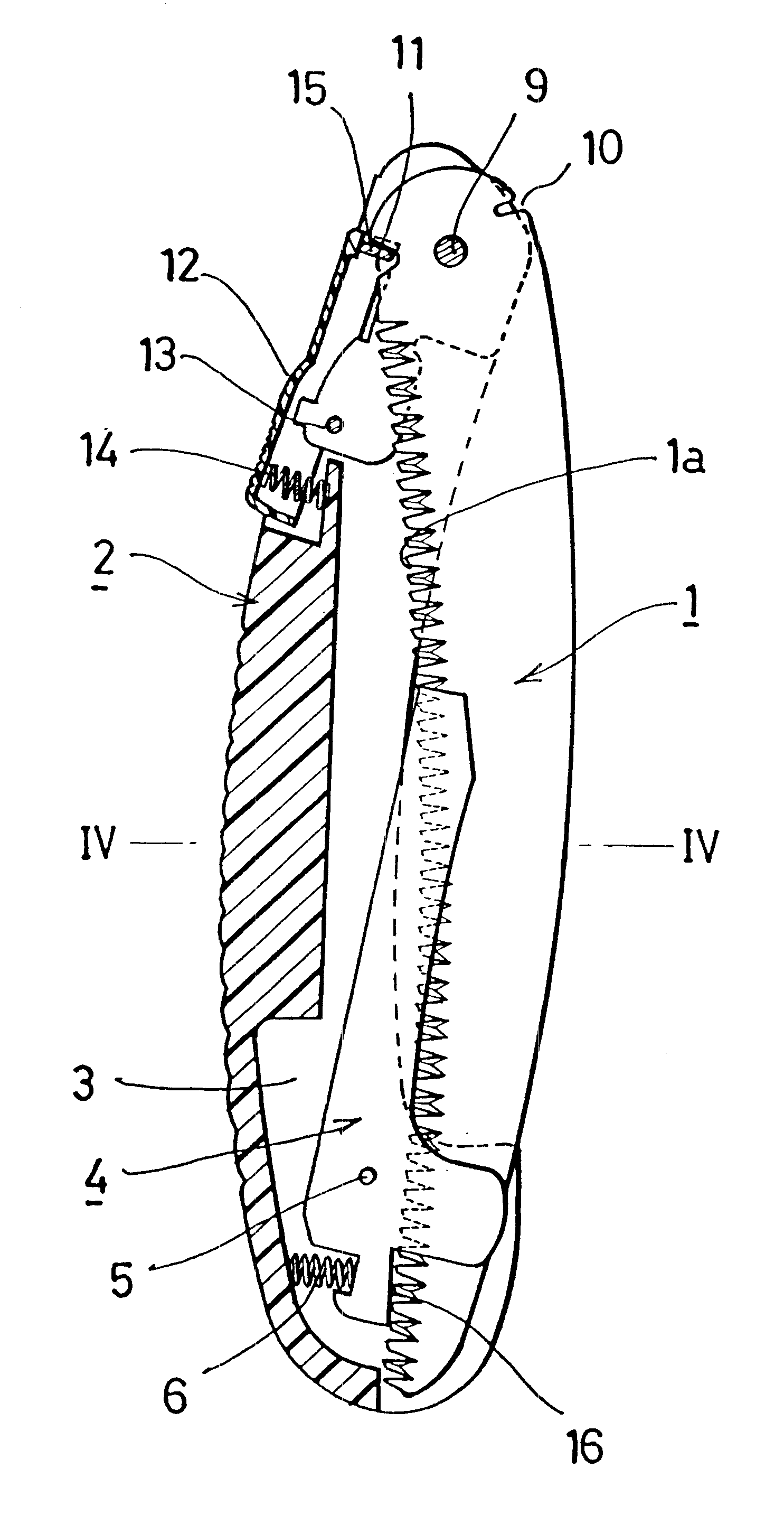
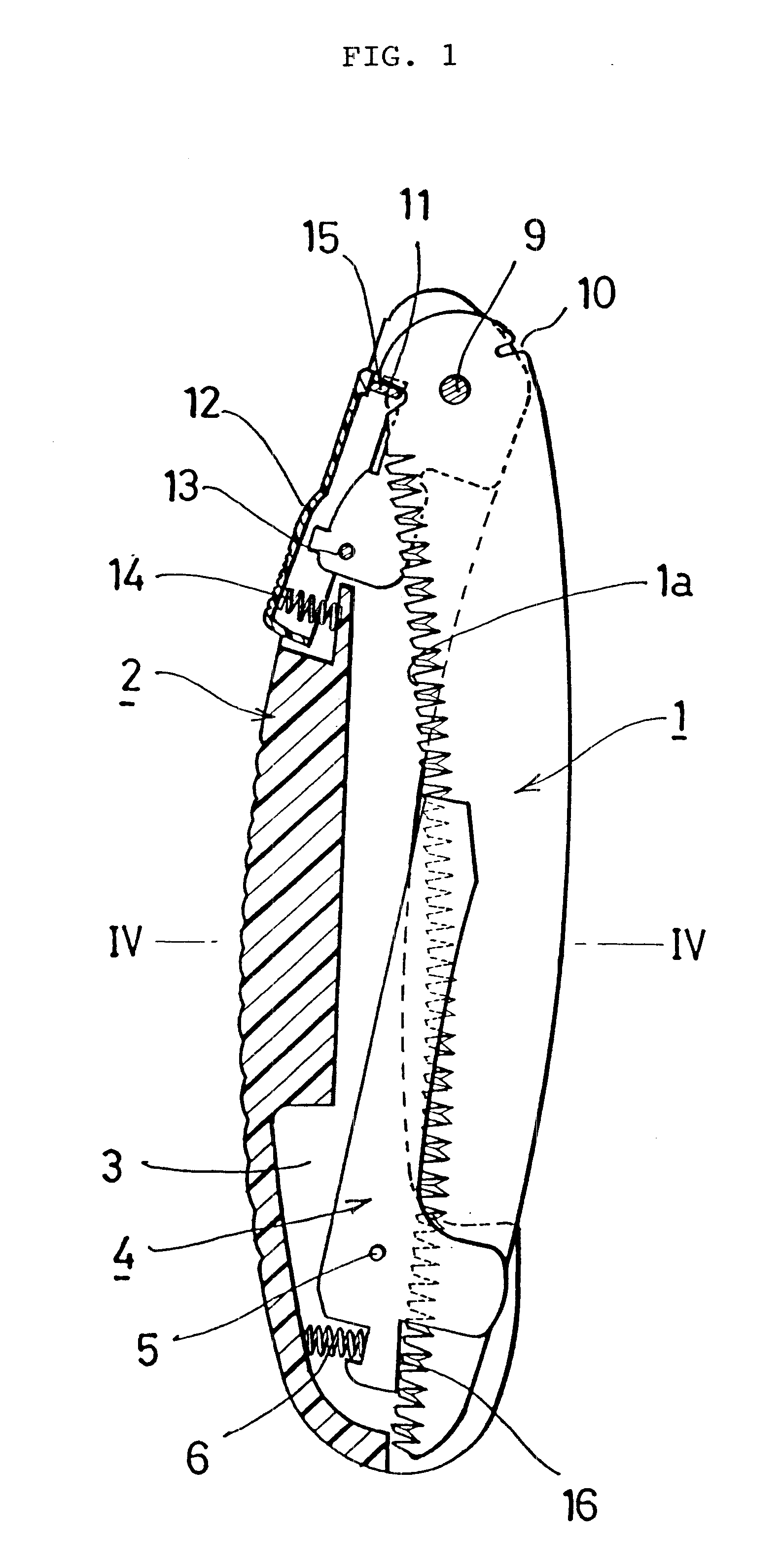
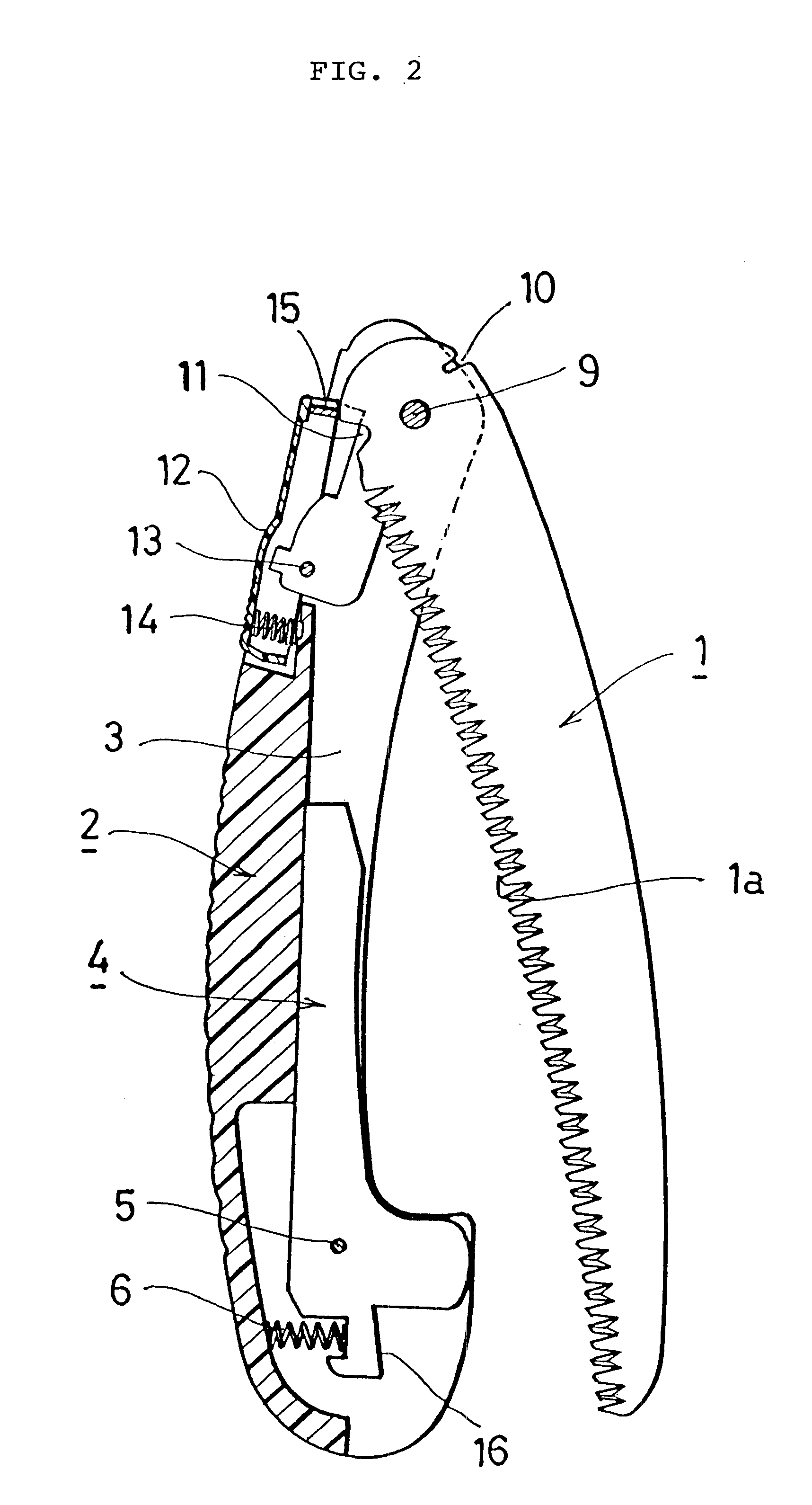
In the embodiments shown in FIGS. 1 to 5, a concavely curved blade 1 is pivotally supported by a pivot 9 at the top end of a concavely curved handle 2. When the blade 1 is revolved and folded, the edge 1a of the blade 1 is housed within the housing groove 3 of the handle 2 having a semi-U-shaped cross section. At the base end of the blade 1, two cuts 10, 11 are formed on the circular arc centered around the pivot 9. A stopper 12 is provided on the handle 2. The stopper 12 engages the cuts 10, 11 to hold the blade 1 in a folded condition as shown in FIG. 1 and in a ready-to-cut condition as shown in FIG. 3, respectively. The stopper 12 is pivotally supported by a pivot 13 and energized by a spring 14 so that a claw 15 at its tip engages either of the cuts 10, 11. This foldable saw can be carried, stored or otherwise handled with its blade folded.

Inside the housing groove 3...