
Over-the-wire interlock attachment/detachment mechanism
a technology of over-the-wire interlocking and attachment mechanism, which is applied in the field of over-the-wire interlocking attachment/detachment mechanism, can solve the problems of difficult to advance over a medical implant device, require skilled manipulation, and be particularly difficult to remove medical implants from the hear
- Summary
- Abstract
- Description
- Claims
- Application Information
AI Technical Summary
Benefits of technology
Problems solved by technology
Method used
Image

Examples
Embodiment Construction
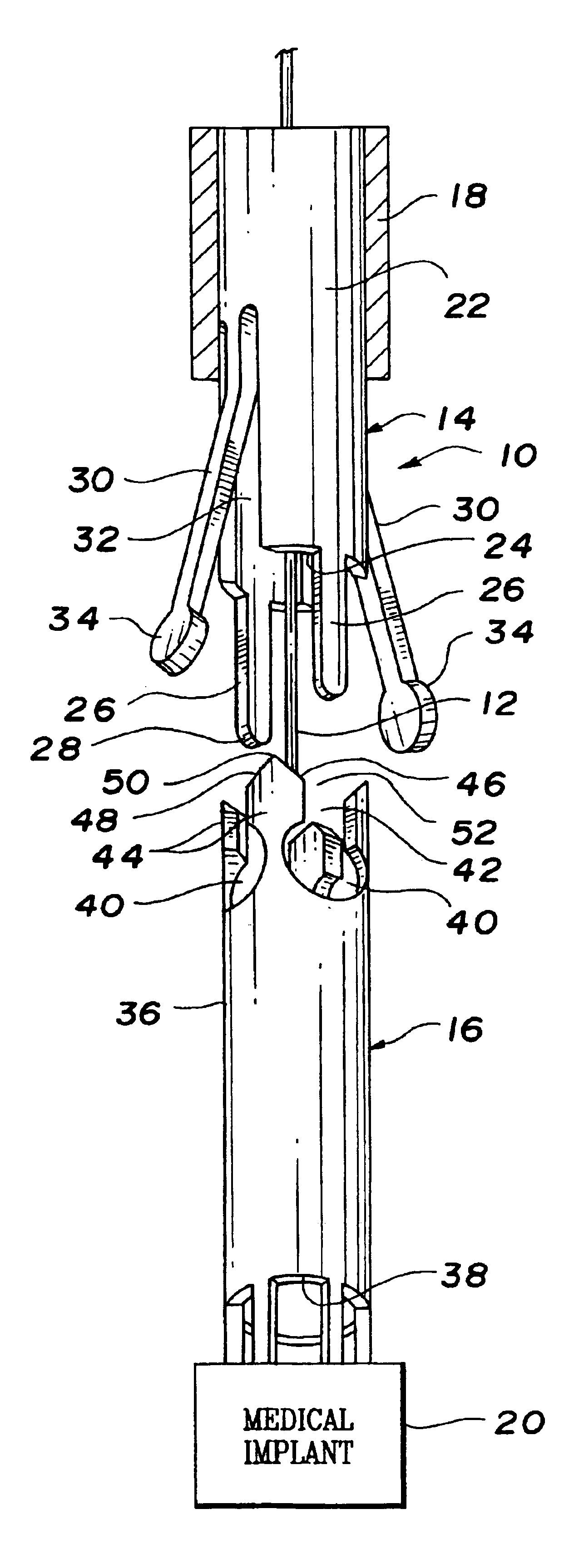
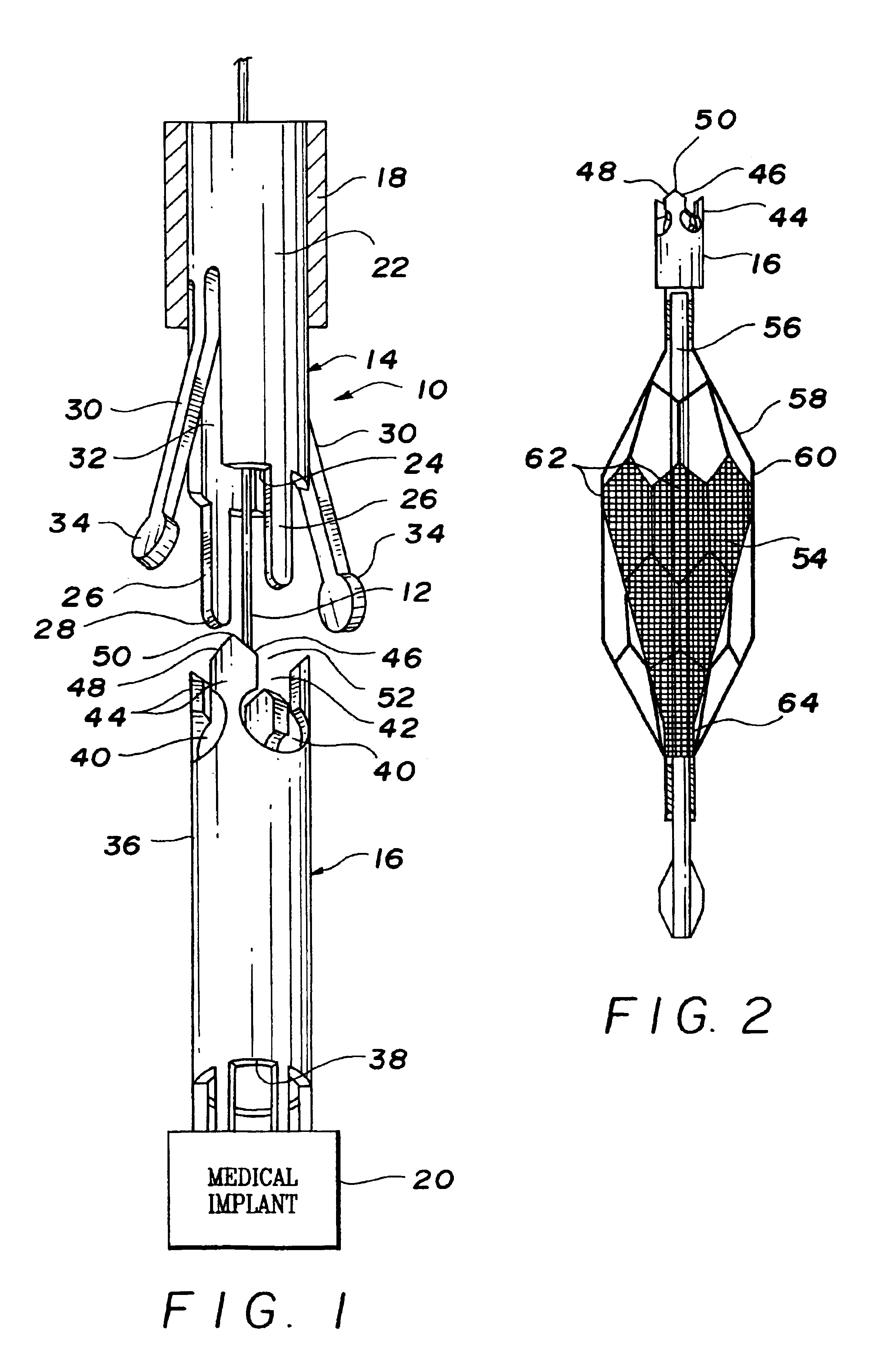
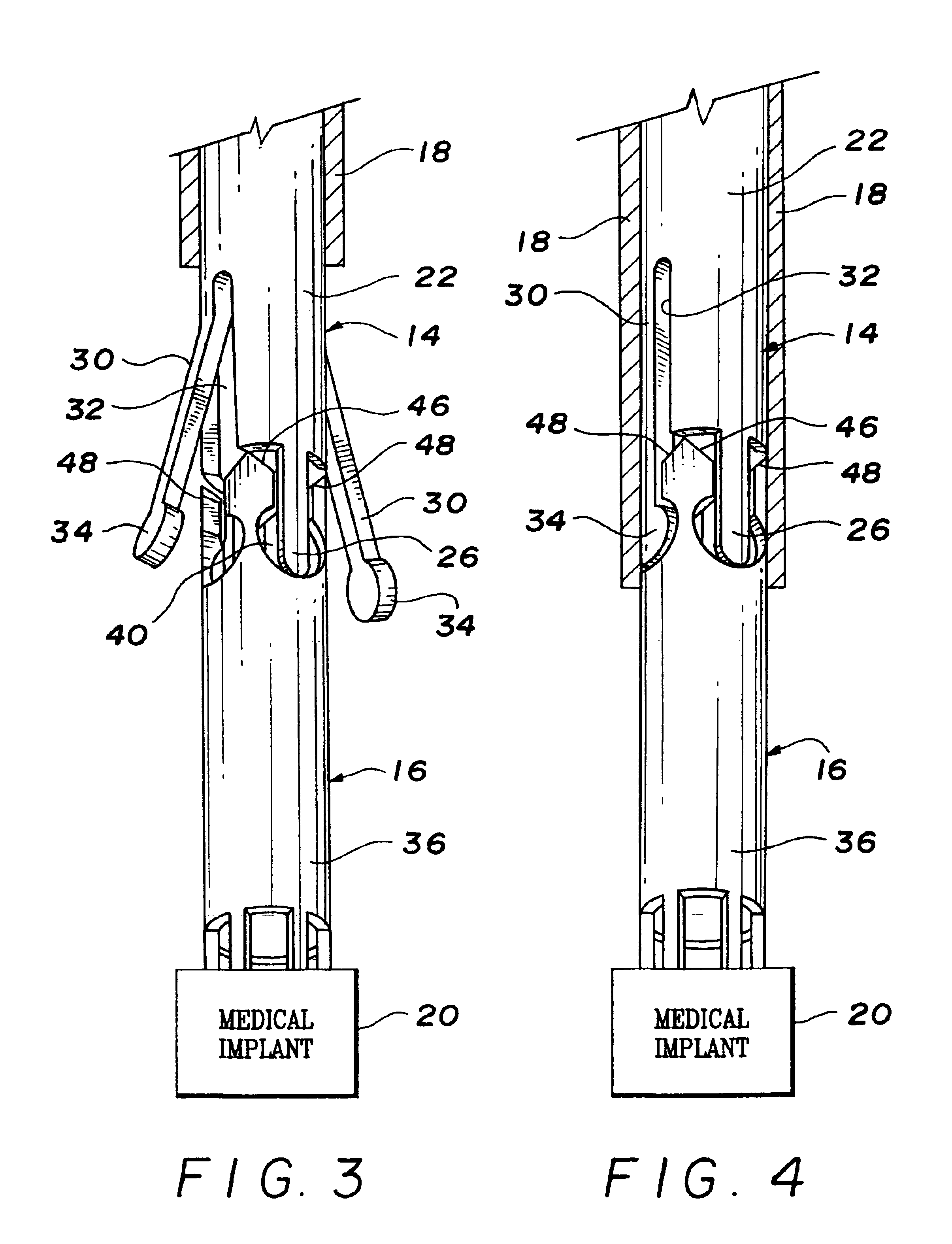
[0020]Referring to FIG. 1, the over-the-wire interlock attachment / detachment mechanism of the present invention indicated generally at 10 is adapted for movement along a conventional guidewire 12 such as a 0.014″ guidewire. The over-the-wire interlock attachment / detachment mechanism includes a male locking section 14, a female lock receiving section 16, and a tubular sheath 18 dimensioned to slide over the male and female sections. Preferably, the female section 16 is secured to an implantable medical device 20 such as a septal occluder, a filter or stent to be released in the heart or a blood vessel or other vessel of the human body or to be retrieved or repositioned within the heart or vessel.
[0021]The male locking section 14 includes a tubular body 22 which defines an open ended central chamber 24 through which the guidewire 12 passes. Projecting outwardly from the forward end of the tubular body 22 are one or more elongate guide fingers 26. These guide fingers are straight, elon...
PUM
 Login to View More
 Abstract
Description
Claims
Application Information
 Login to View More