
Method and an installation for obtaining carbon bodies from carbon-precursor bodies
a technology of carbon precursors and carbon bodies, applied in the direction of material analysis, instruments, phase/state change investigation, etc., can solve the problem of inability to use sensors, and achieve the effect of saving costs and duration
- Summary
- Abstract
- Description
- Claims
- Application Information
AI Technical Summary
Benefits of technology
Problems solved by technology
Method used
Image

Examples
Embodiment Construction
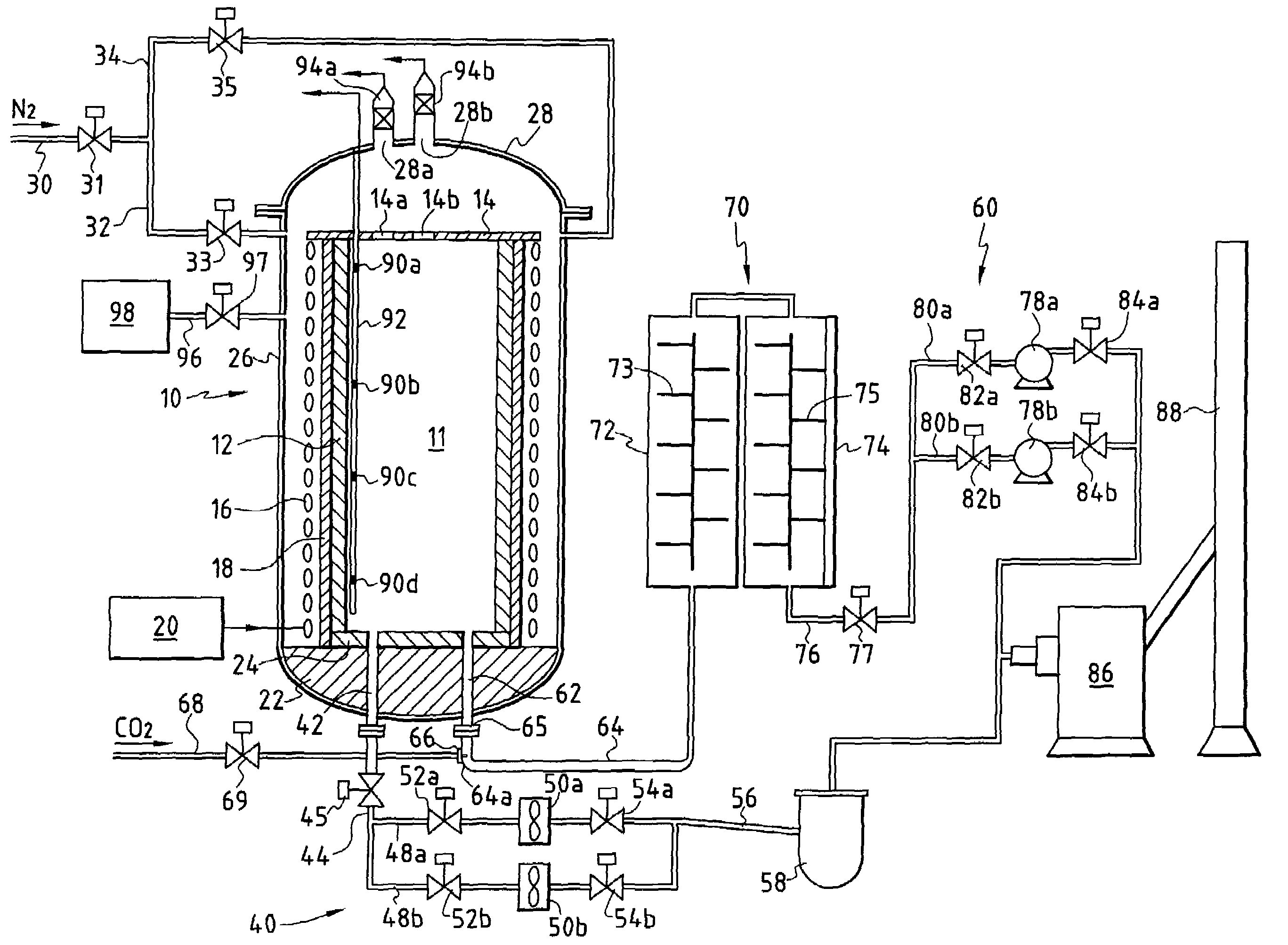
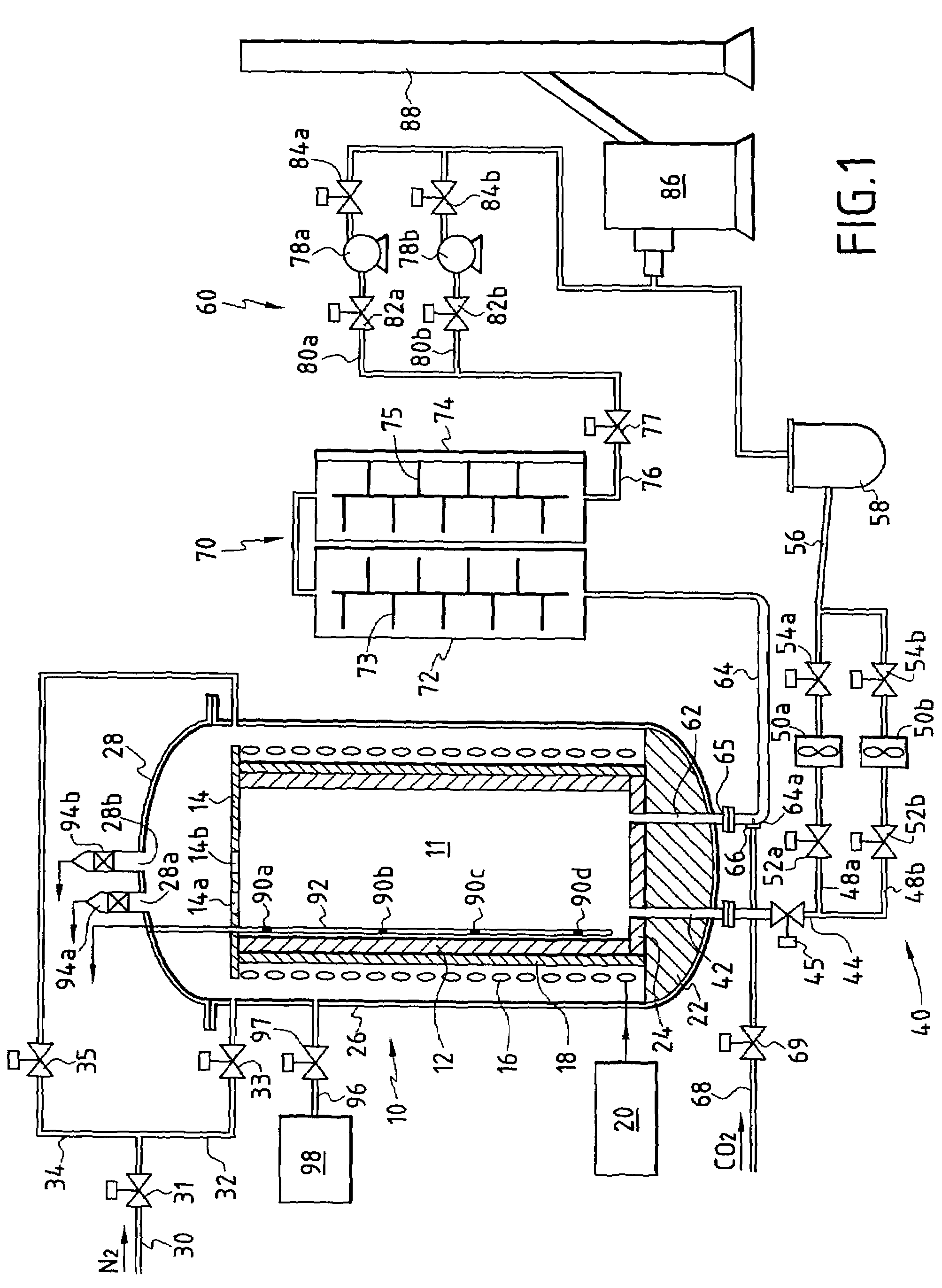
[0046]FIG. 1 is a highly diagrammatic representation of an oven 10 comprising a susceptor 12 in the form of a vertical axis cylinder defining the sides of a volume or enclosure 11 for filling with bodies (not shown) made of a carbon-precursor material, for example pieces of fabric made of preoxidized PAN fiber. The susceptor is surmounted by a cover 14.
[0047]The susceptor 12, which is made of graphite for example, is heated by inductive coupling with an induction coil 16 which surrounds the susceptor, with thermal insulation 18 being interposed between them. The induction coil is powered by a control circuit 20 which delivers electricity as a function of the heating requirements of the oven.
[0048]The induction coil can be subdivided into a plurality of sections along the vertical dimension of the oven. Each section is individually powered with electricity so as to define different heating zones within the oven, in which zones temperature can be regulated independently.
[0049]The bott...
PUM
| Property | Measurement | Unit |
|---|---|---|
| temperature | aaaaa | aaaaa |
| temperature | aaaaa | aaaaa |
| temperature | aaaaa | aaaaa |
Abstract
Description
Claims
Application Information
 Login to View More