Planisphere clock

a technology of timepieces and spheres, applied in mechanical clocks, instruments, horology, etc., can solve the problem that many timepieces may not accurately reflect the tim

US7518956B1Inactive Publication Date: 2009-04-14TRIDENT DESIGN
8 Cites 7 Cited by

Patent Information

Authority / Receiving Office
US · United States
Current Assignee / Owner
Publication Date
2009-04-14
Estimated Expiration
Not applicable · inactive patent

Smart Images

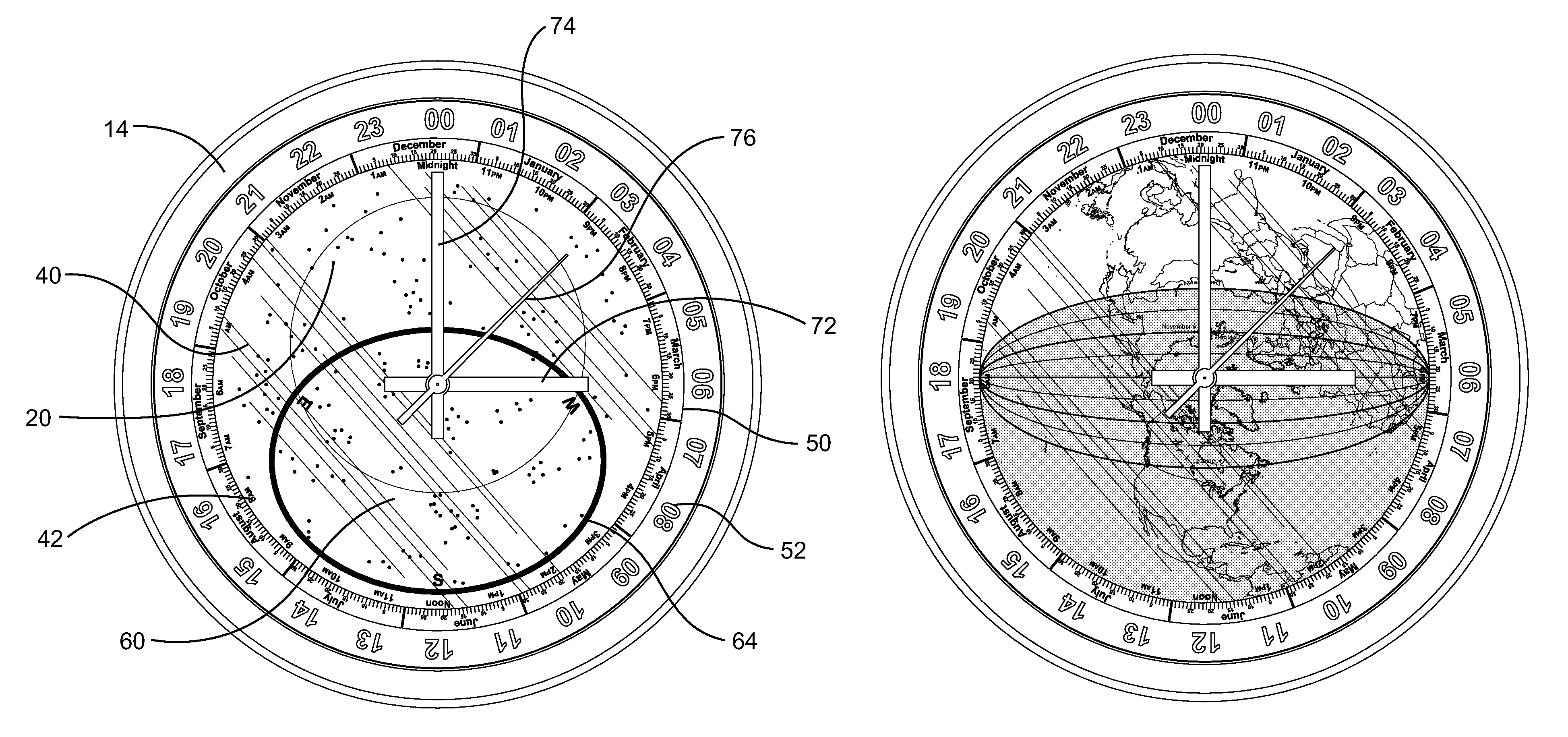
  • Figure 1
    Figure 1
  • Figure 2
    Figure 2
  • Figure 3
    Figure 3
Patent Text Reader

Abstract

A timepiece for displaying a planisphere and indicating a portion of the planisphere. Another exemplary embodiment is a clock that displays both sidereal and solar time, while indicating a portion of the planisphere at a particular time. Another exemplary embodiment of the timepiece includes an adjustment feature that allows a user to adjust the portion of the planisphere indicated to a particular geographic location. An exemplary embodiment may contain a celestial or terrestrial planisphere. As a result, an exemplary embodiment of the timepiece may provide valuable information about the planisphere at any particular sidereal or solar time.
Need to check novelty before this filing date? Find Prior Art

Description

[0001] This application claims the benefit of U.S. Provisional Application No. 60 / 722,181, filed Sep. 30, 2005, which is hereby incorporated by reference in its entirety.BACKGROUND AND SUMMARY OF THE INVENTION

[0002] The present invention relates generally to a planisphere timepiece that may visually display sidereal time and / or solar time.

[0003] Time may be measured in different ways. Sidereal time, also known as “star time”, is the measurement of time based on the apparent motion of the stars due to the rotation of the earth or any other celestial body. A sidereal day lasts from when a distant star appears on an observer's celestial meridian until it next appears on the observer's celestial meridian. Sidereal time is useful in the field of astronomy. For example, star coordinates are often written in sidereal time. In particular, sidereal time equals the right ascension of any point on the celestial sphere of the sky that crosses a meridian at a given moment. For this reason, sidereal...

Examples

Embodiment Construction

[0031]One exemplary embodiment of the present invention is a timepiece with a timing movement and a face that is able to indicate a portion of the planisphere. In some embodiments the timepiece may be a clock, where the clock is able to indicate a portion of a planisphere and display solar time. In other embodiments the timepiece is a clock which indicates a portion of the planisphere, displays both solar and sidereal time, and has an adjustability feature that is able to calibrate the relative portion of the planisphere indicated to a particular geographical location.

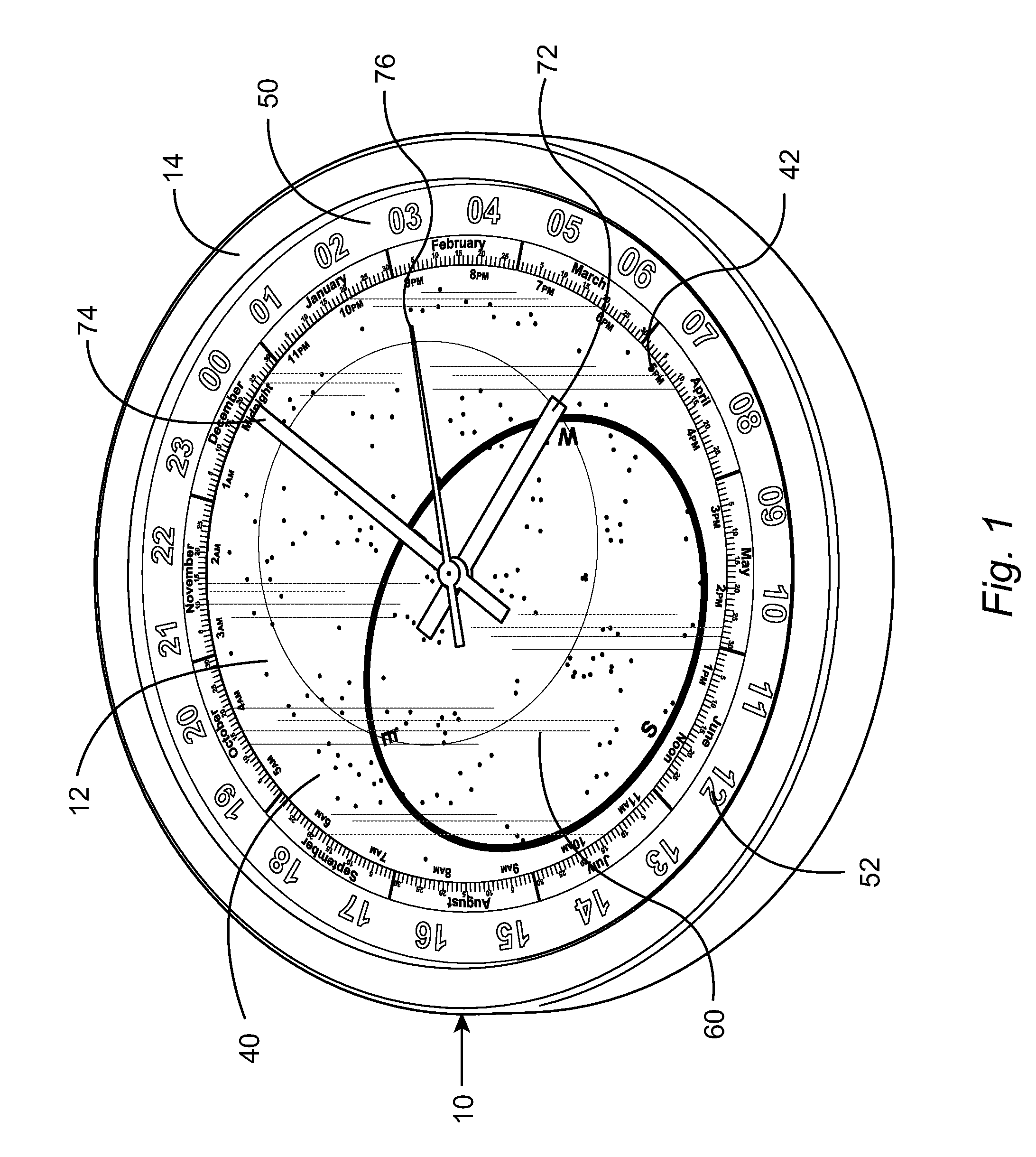
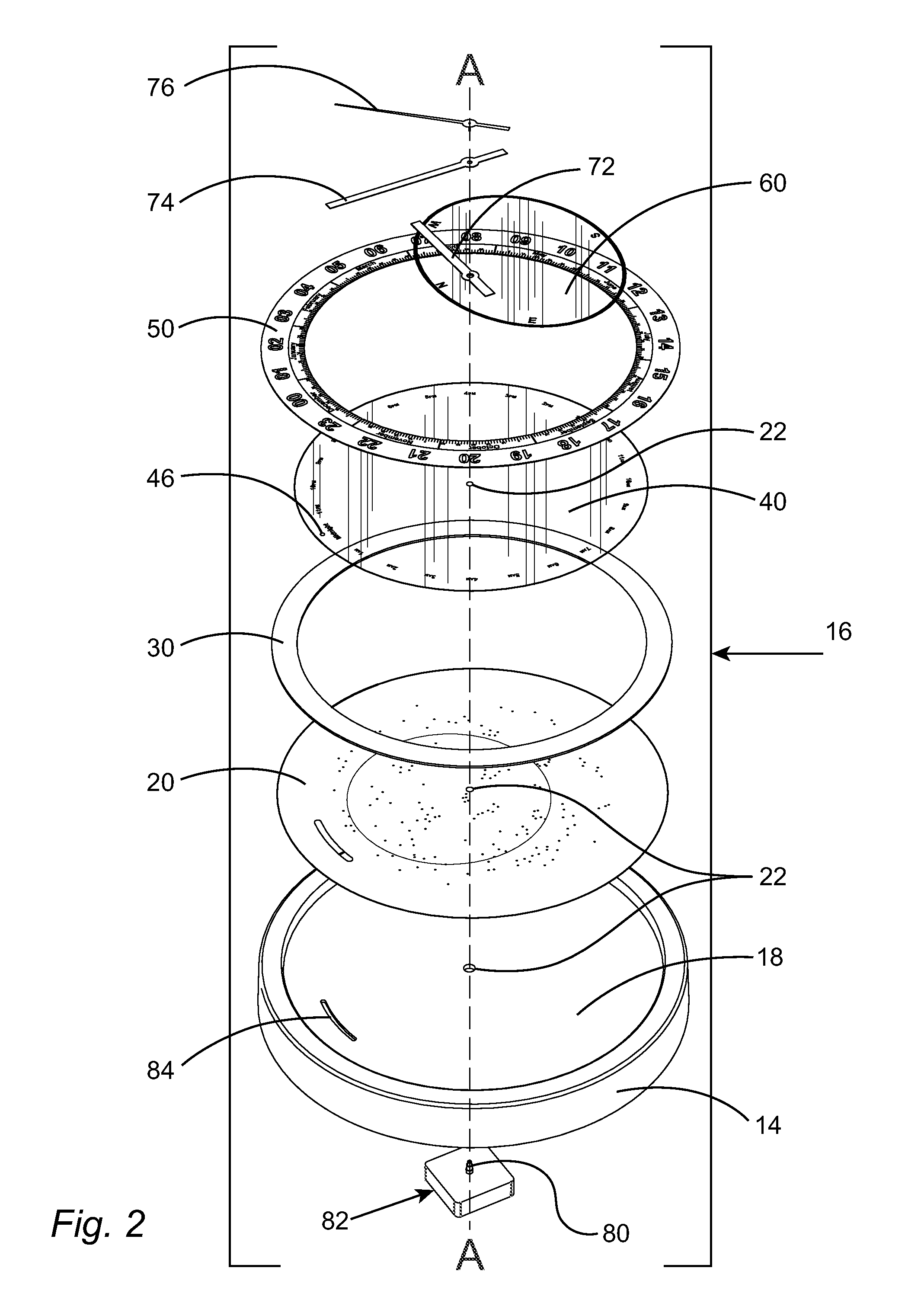
[0032]FIGS. 1 and 2 are top perspective and exploded views, respectively, of an exemplary embodiment where the timepiece of the present invention is a clock 10. As shown in these figures, the clock 10 of the present invention may be comprised of a clock face 12, which may optionally be contained within a clock case 14. The clock face 12 may provide visual information to the user regarding time and the positioning of th...