
Intermittent electrical stimulation
a technology of electrical stimulation and electrical stimulation, applied in the field of electrical stimulation of the vagus nerve, can solve the problems of poor force gradation, muscle fatigue, and cardiac efficiency reduction, and achieve the effect of reducing the side effects of current application and reducing the heart rate of the subj
- Summary
- Abstract
- Description
- Claims
- Application Information
AI Technical Summary
Benefits of technology
Problems solved by technology
Method used
Image

Examples
Embodiment Construction
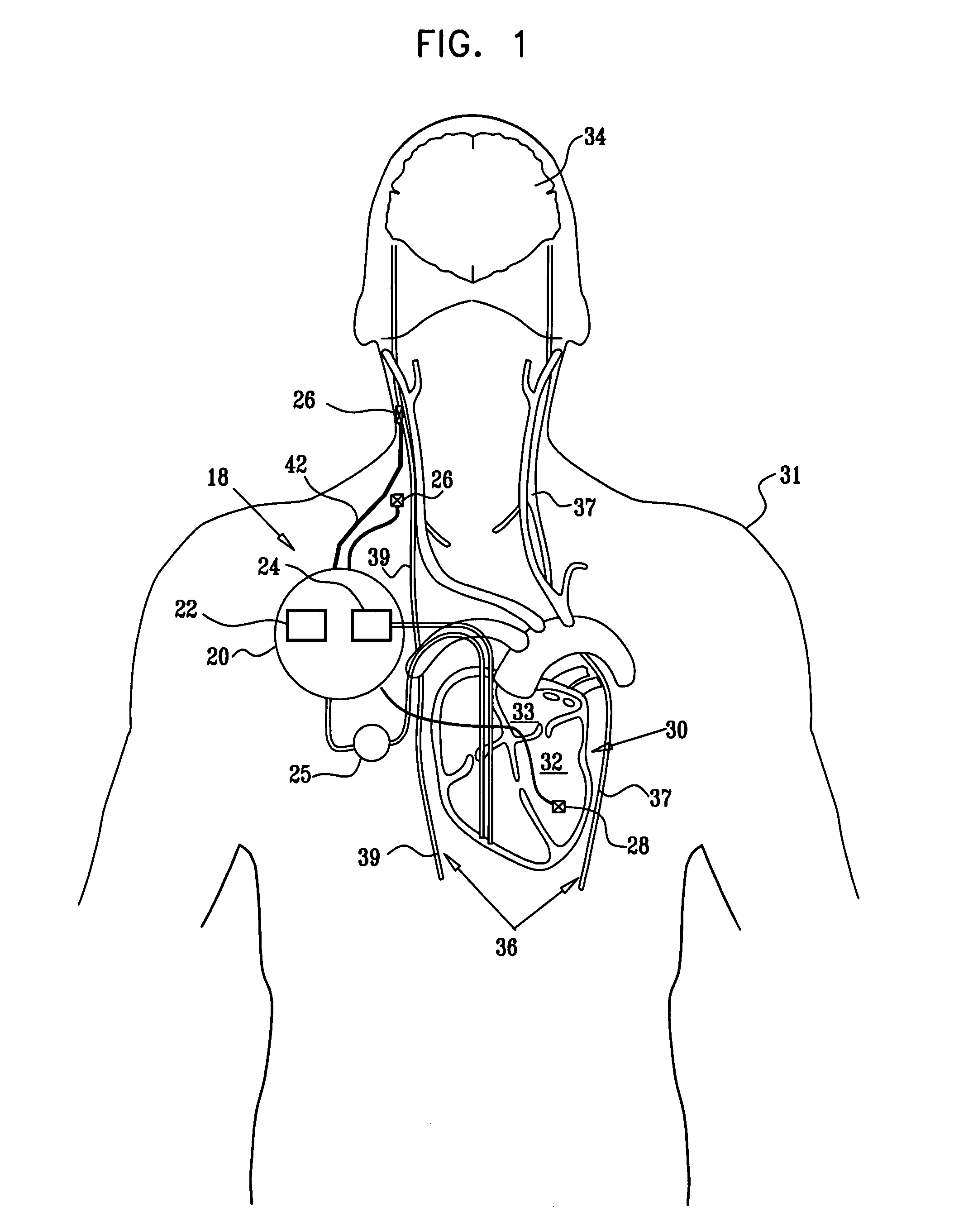
[0627]FIG. 1 is a block diagram that schematically illustrates a vagal stimulation system 18 comprising a multipolar electrode device 26, in accordance with an embodiment of the present invention. Electrode device 26 is applied to a portion of a vagus nerve 36 (a left vagus nerve 37 and / or a right vagus nerve 39), which innervates a heart 30 of a subject 31. Alternatively, electrode device 26 is applied to an epicardial fat pad, a pulmonary vein, a carotid artery, a carotid sinus, a coronary sinus, a vena cava vein, a right ventricle, or a jugular vein (configurations not shown). Typically, system 18 is utilized for treating a heart condition such as heart failure and / or cardiac arrhythmia. Vagal stimulation system 18 further comprises an implantable or external control unit 20, which typically communicates with electrode device 26 over a set of leads 42. Typically, control unit 20 drives electrode device 26 to (i) apply signals to induce the propagation of efferent nerve impulses t...
PUM
 Login to View More
 Abstract
Description
Claims
Application Information
 Login to View More