Supercharge Your Innovation With Domain-Expert AI Agents!

Pattern-forming method, and radiation-sensitive composition

a radiation-sensitive composition and pattern-forming technology, applied in the field of pattern-forming methods and radiation-sensitive compositions, can solve problems such as difficulty in fine pattern formation

Active Publication Date: 2015-05-19
JSR CORPORATIOON
View PDF41 Cites 0 Cited by
  • Summary
  • Abstract
  • Description
  • Claims
  • Application Information

AI Technical Summary

Problems solved by technology

This technique utilizes a possible increase of an optical contrast in the case in which an organic solvent is used, whereby formation of a fine pattern is enabled, contrary to the case in which an aqueous alkali solution is used as a developer solution for forming a trench pattern or hole pattern, accompanied by a poor optical contrast leading to a difficulty in formation of a fine pattern.

Method used

the structure of the environmentally friendly knitted fabric provided by the present invention; figure 2 Flow chart of the yarn wrapping machine for environmentally friendly knitted fabrics and storage devices; image 3 Is the parameter map of the yarn covering machine
View more

Image

Smart Image Click on the blue labels to locate them in the text.
Viewing Examples
Smart Image
  • Pattern-forming method, and radiation-sensitive composition
  • Pattern-forming method, and radiation-sensitive composition
  • Pattern-forming method, and radiation-sensitive composition

Examples

Experimental program
Comparison scheme
Effect test

synthesis example 1

[0214]A monomer solution was prepared by dissolving 12.9 g (50 mol %) of the compound (M-1) and 17.1 g (50 mol %) of the compound (M-2) in 60 g of 2-butanone, and further adding 1.3 g dimethylazobisisobutyronitrile thereto. On the other hand, a 200 mL three-necked flask charged with 30 g of 2-butanone was purged with nitrogen for 30 minutes, and thereafter the reaction vessel was heated to 80° C. with stirring. The monomer solution prepared beforehand was added dropwise using a dropping funnel over 3 hrs. The time when dropwise addition was started was assumed to be a start time point of polymerization and the polymerization reaction was carried out for 6 hours. After completion of the polymerization, the polymerization solution was cooled to no greater than 30° C. by water-cooling and the polymerization solution was charged into 600 g of methanol. The white powder precipitated was filtered off. Thus resultant white powder was washed twice with 150 g of methanol in the state of slur...

synthesis example 2

[0215]A monomer solution was prepared by dissolving 11.6 g (50 mol %) of the compound (M-1) and 18.4 g (50 mol %) of the compound (M-3) in 60 g of 2-butanone, and further adding 1.1 g dimethylazobisisobutyronitrile thereto. On the other hand, a 200 mL three-necked flask charged with 30 g of 2-butanone was purged with nitrogen for 30 minutes, and thereafter the reaction vessel was heated to 80° C. with stirring. The monomer solution prepared beforehand was added dropwise using a dropping funnel over 3 hrs. The time when dropwise addition was started was assumed to be a start time point of polymerization and the polymerization reaction was carried out for 6 hours. After completion of the polymerization, the polymerization solution was cooled to no greater than 30° C. by water-cooling and the polymerization solution was charged into 600 g of methanol. The white powder precipitated was filtered off. Thus resultant white powder was washed twice with 150 g of methanol in the state of slur...

synthesis example 3

[0216]A monomer solution was prepared by dissolving 12.2 g (50 mol %) of the compound (M-1), 14.8 g (46 mol %) of the compound (M-2) and 3.0 g (4 mol %) of the compound (M-4) in 60 g of 2-butanone, and further adding 1.3 g dimethylazobisisobutyronitrile thereto. On the other hand, a 200 mL three-necked flask charged with 30 g of 2-butanone was purged with nitrogen for 30 minutes, and thereafter the reaction vessel was heated to 80° C. with stirring. The monomer solution prepared beforehand was added dropwise using a dropping funnel over 3 hrs. The time when dropwise addition was started was assumed to be a start time point of polymerization and the polymerization reaction was carried out for 6 hours. After completion of the polymerization, the polymerization solution was cooled to no greater than 30° C. by water-cooling and the polymerization solution was charged into 600 g of a 1:1 mixed solvent of isopropyl alcohol and hexane. The white powder precipitated was filtered off. Thus r...

the structure of the environmentally friendly knitted fabric provided by the present invention; figure 2 Flow chart of the yarn wrapping machine for environmentally friendly knitted fabrics and storage devices; image 3 Is the parameter map of the yarn covering machine
Login to View More

PUM

PropertyMeasurementUnit
thicknessaaaaaaaaaa
thicknessaaaaaaaaaa
temperatureaaaaaaaaaa
Login to View More

Abstract

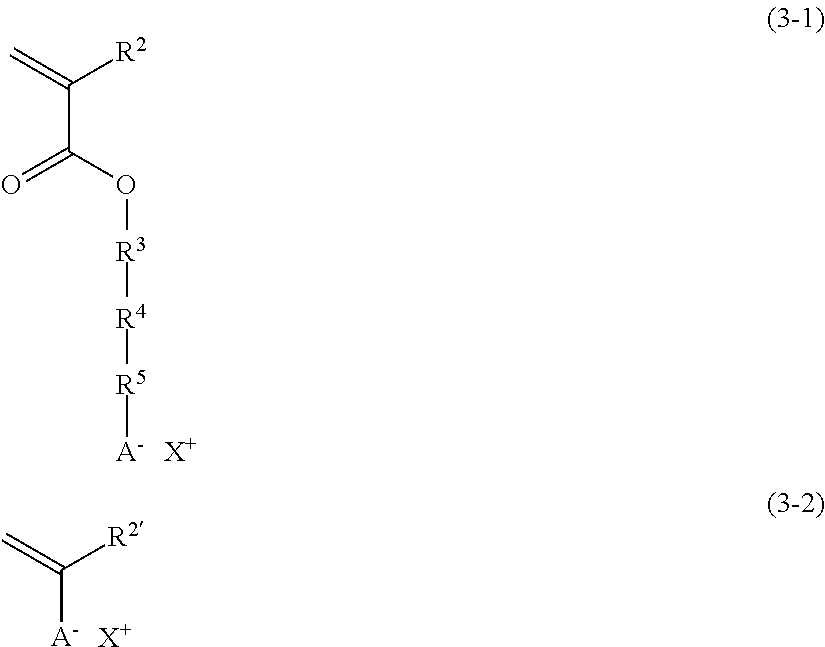
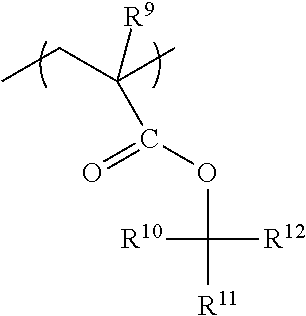
A pattern-forming method includes providing a resist film on a substrate using a radiation-sensitive composition. The resist film is exposed. The exposed resist film is developed using a developer solution. The developer solution includes no less than 80% by mass of an organic solvent. The radiation-sensitive composition includes at least two components including a first polymer and a radiation-sensitive acid generator. The first polymer includes a structural unit having an acid-labile group. One or more components of the radiation-sensitive composition have a group represented by a formula (1). A− represents —N−—SO2—RD, —COO−, —O− or —SO3−. —SO3− does not directly bond to a carbon atom having a fluorine atom. RD represents a linear or branched monovalent hydrocarbon group, or the like. X+ represents an onium cation.—A−X+  (1)

Description

CROSS-REFERENCE TO RELATED APPLICATIONS[0001]The present application is a continuation application of International Application No. PCT / JP2011 / 073974, filed Oct. 18, 2011, which claims priority to Japanese Patent Application No. 2010-237767, filed Oct. 22, 2010. The contents of these applications are incorporated herein by reference in their entirety.BACKGROUND OF THE INVENTION[0002]1. Field of the Invention[0003]The present invention relates to a pattern-forming method, and a radiation-sensitive composition.[0004]2. Discussion of the Background[0005]Chemically amplified type radiation-sensitive compositions for use in microfabrication by lithography generate an acid upon irradiation with a visible light, ultraviolet rays, etc., at light-exposed sites, and a chemical reaction that proceeds with the acid that serves as a catalyst allows the difference in dissolution rates in developer solutions to be produced between the light-exposed sites and light-unexposed sites, thereby enabling...

Claims

the structure of the environmentally friendly knitted fabric provided by the present invention; figure 2 Flow chart of the yarn wrapping machine for environmentally friendly knitted fabrics and storage devices; image 3 Is the parameter map of the yarn covering machine
Login to View More

Application Information

Patent Timeline
no application Login to View More
Patent Type & Authority Patents(United States)
IPC IPC(8): G03F7/004C08F12/30G03F7/027C08F220/10G03F7/039G03F7/11G03F7/20G03F7/32
CPCG03F7/027C08F220/10G03F7/0045G03F7/0046G03F7/0397G03F7/11G03F7/2041G03F7/325Y10S430/114Y10S430/115G03F7/0047G03F7/038G03F7/0382G03F7/0392H01L21/027C07C381/12C08F220/24G03F7/30
Inventor SAKAKIBARA, HIROKAZUHORI, MASAFUMIFURUKAWA, TAIICHIITO, KOJI
Owner JSR CORPORATIOON
Features
  • R&D
  • Intellectual Property
  • Life Sciences
  • Materials
  • Tech Scout
Why Patsnap Eureka
  • Unparalleled Data Quality
  • Higher Quality Content
  • 60% Fewer Hallucinations
Social media
Patsnap Eureka Blog
Learn More