Supercharge Your Innovation With Domain-Expert AI Agents!

Variable magnification optical system and imaging apparatus

a magnification optical system and variable magnification technology, applied in the field of variable magnification optical systems and imaging apparatuses, can solve the problems of low optical performance of optical systems, heavy weight, and weak negative refractive power of second lens groups, and achieve excellent optical performance, light weight of optical systems, and small size of optical systems

Inactive Publication Date: 2015-06-30
FUJIFILM CORP
View PDF12 Cites 0 Cited by
  • Summary
  • Abstract
  • Description
  • Claims
  • Application Information

AI Technical Summary

Benefits of technology

This configuration allows for excellent optical performance with a small size and light weight, reducing spherical aberration and astigmatism fluctuations during magnification changes, while maintaining a compact design and minimizing the diameter of the first lens group.

Problems solved by technology

Therefore, there is a drawback that the weight becomes heavy.
On the contrary, if the size of such an optical system is tried to be reduced, the negative refractive power of the second lens group becomes too strong.
Therefore, there is a drawback that the optical performance of the optical system becomes lower.
Therefore, it is impossible to solve the aforementioned problems.
However, the diameter of the first lens group is large, and the weight is heavy.

Method used

the structure of the environmentally friendly knitted fabric provided by the present invention; figure 2 Flow chart of the yarn wrapping machine for environmentally friendly knitted fabrics and storage devices; image 3 Is the parameter map of the yarn covering machine
View more

Image

Smart Image Click on the blue labels to locate them in the text.
Viewing Examples
Smart Image
  • Variable magnification optical system and imaging apparatus
  • Variable magnification optical system and imaging apparatus
  • Variable magnification optical system and imaging apparatus

Examples

Experimental program
Comparison scheme
Effect test

Embodiment Construction

);

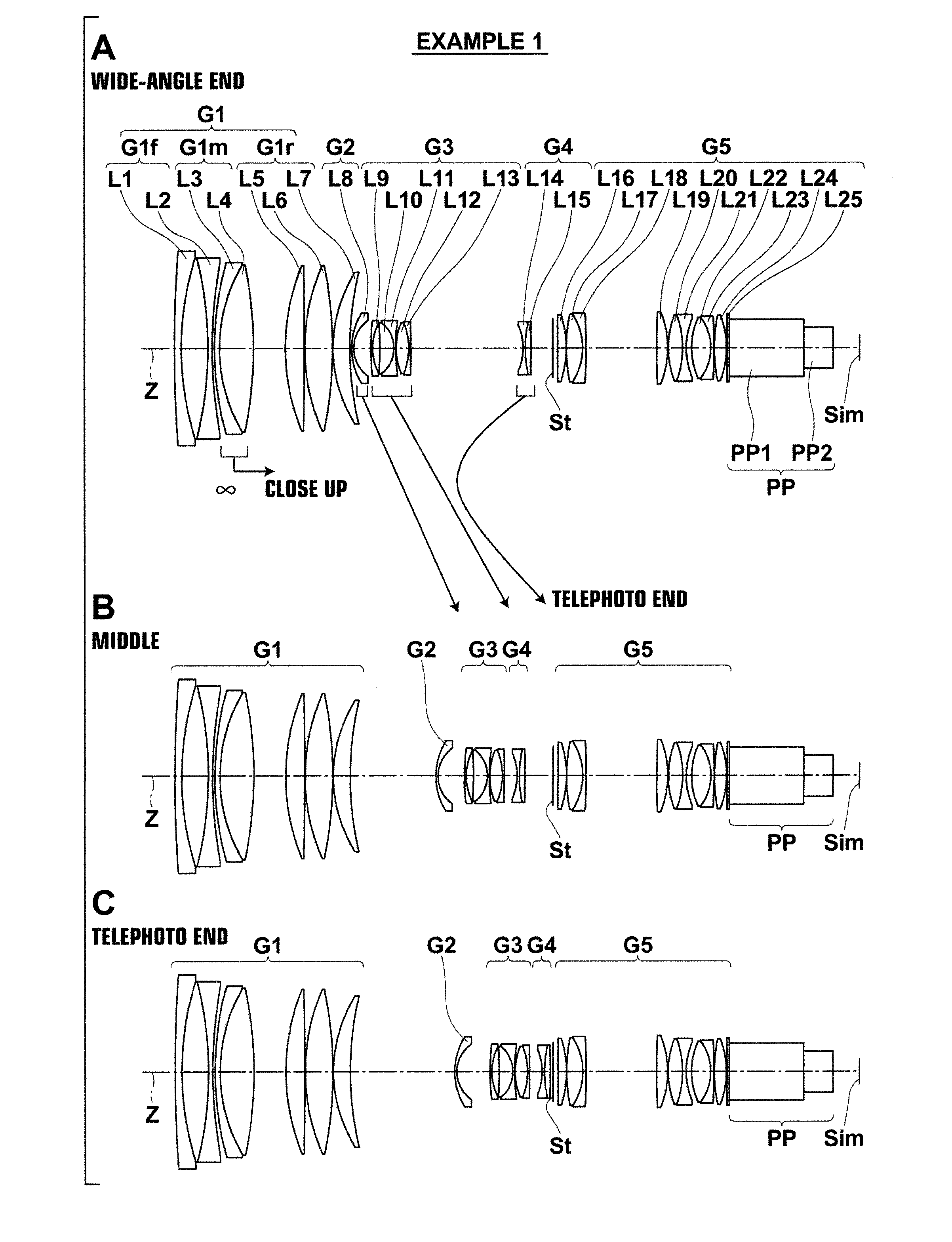
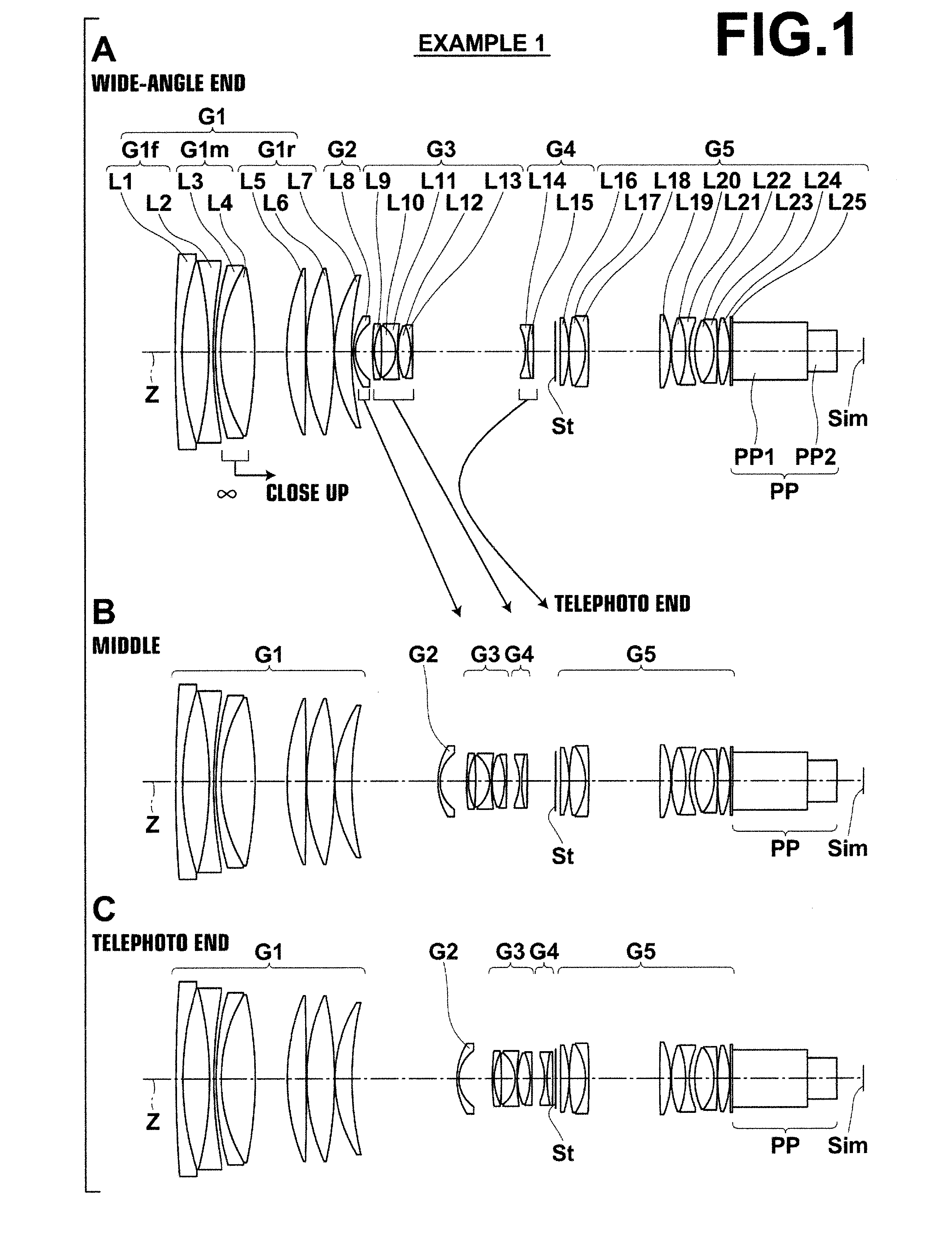
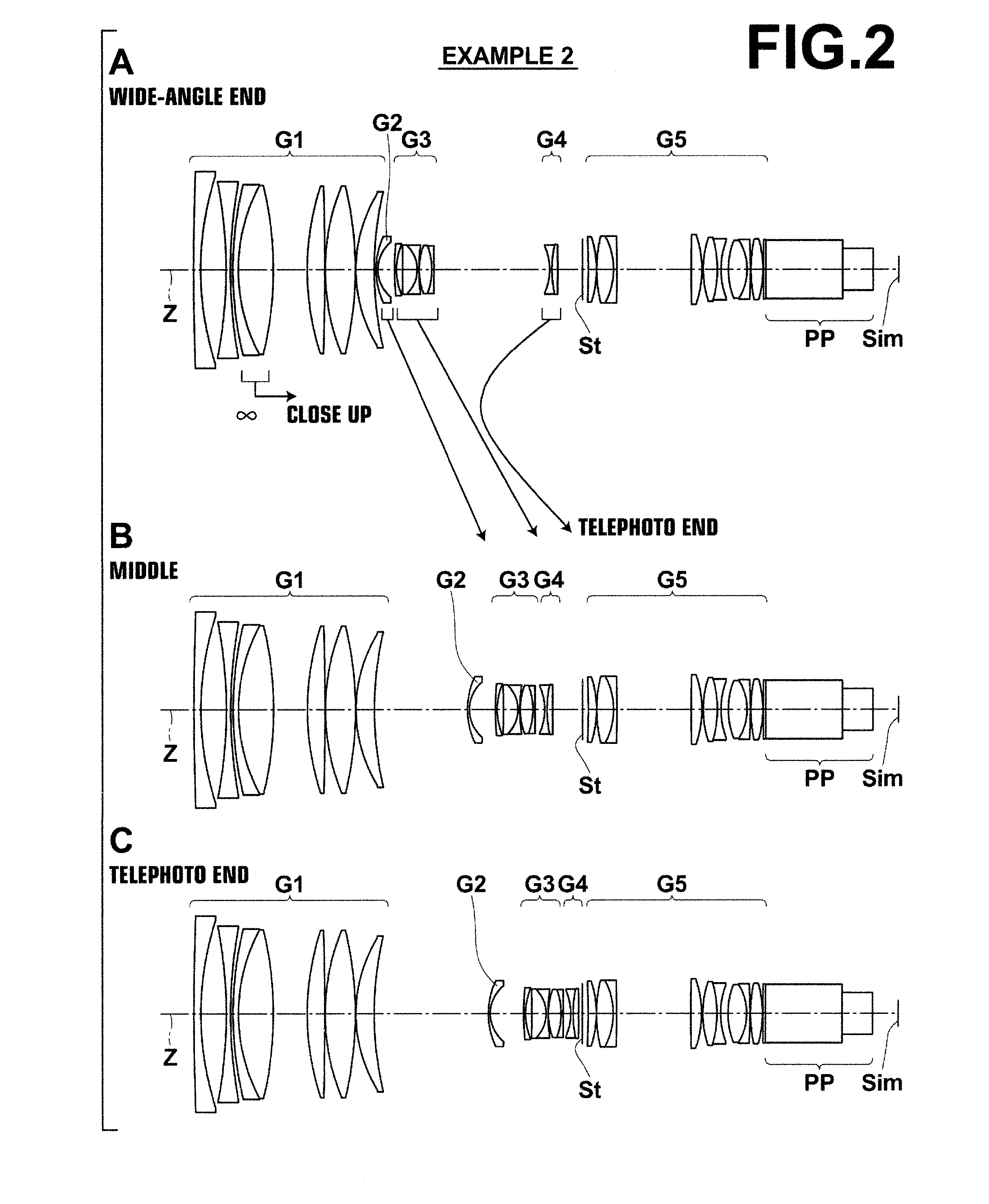
[0031]FIG. 2, Sections A through C are cross sections illustrating the lens structure of a variable magnification optical system in Example 2 of the present invention;

[0032]FIG. 3, Sections A through C are cross sections illustrating the lens structure of a variable magnification optical system in Example 3 of the present invention;

[0033]FIG. 4, Sections A through C are cross sections illustrating the lens structure of a variable magnification optical system in Example 4 of the present invention;

[0034]FIG. 5, Sections A through C are cross sections illustrating the lens structure of a variable magnification optical system in Example 5 of the present invention;

[0035]FIG. 6, Sections A through C are cross sections illustrating the lens structure of a variable magnification optical system in Example 6 of the present invention;

[0036]FIG. 7, Sections A through L are aberration diagrams of the variable magnification optical system in Example 1 of the present invention;

[0037]FIG. 8, Sect...

the structure of the environmentally friendly knitted fabric provided by the present invention; figure 2 Flow chart of the yarn wrapping machine for environmentally friendly knitted fabrics and storage devices; image 3 Is the parameter map of the yarn covering machine
Login to View More

PUM

No PUM Login to View More

Abstract

A variable-magnification optical-system substantially consists of a first-lens-group having positive-refractive-power, a second-lens-group having negative-refractive-power, a third-lens-group having negative-refractive-power, a fourth-lens-group having negative-refractive-power, an aperture-stop, and a fifth-lens-group having positive-refractive-power in this order from an object-side along an optical-axis. The second-lens-group, third-lens-group and fourth-lens-group move when magnification is changed from a wide-angle-end to a telephoto-end. The first-lens-group substantially consists of a 1f-th lens-group having negative-refractive-power, a 1m-th lens-group having positive-refractive-power and a 1r-th lens-group substantially consisting of a 1r1-th lens having positive-refractive-power with its strong convex-surface facing the object-side, a biconvex 1r2-th lens and a convex meniscus 1r3-th lens with its convex-surface facing the object-side, and the 1r-th lens-group having positive-refractive-power as a whole in this order from the object-side. The 1f-th lens-group substantially consists of a concave meniscus-lens with its convex-surface facing the object-side and a negative-lens in this order from the object-side.

Description

CROSS REFERENCE TO RELATED APPLICATIONS[0001]This application is a continuation of PCT / JP2012 / 005430 filed on Aug. 29, 2012, which claims foreign priority to Japanese Application No. 2011-187420 filed on Aug. 30, 2011. The entire contents of each of the above applications are hereby incorporated by reference.BACKGROUND OF THE INVENTION[0002]1. Field of the Invention[0003]The present invention relates to a variable magnification optical system and an imaging apparatus. In particular, the present invention relates to a variable magnification optical system usable in a video camera, an electronic still camera and the like, and appropriate especially for a surveillance camera, and also to an imaging apparatus including the variable magnification optical system.[0004]2. Description of the Related Art[0005]Conventionally, variable magnification optical systems for CCTV (Closed-circuit Television) were developed, as optical systems for imaging apparatuses, such as a video camera, an electr...

Claims

the structure of the environmentally friendly knitted fabric provided by the present invention; figure 2 Flow chart of the yarn wrapping machine for environmentally friendly knitted fabrics and storage devices; image 3 Is the parameter map of the yarn covering machine
Login to View More

Application Information

Patent Timeline
no application Login to View More
Patent Type & Authority Patents(United States)
IPC IPC(8): G02B15/15G02B13/00G02B15/14G02B13/18G02B15/17
CPCG02B15/14G02B13/009G02B13/18G02B15/17G02B15/145117
Inventor IKEDA, SHINKICHICHO, MICHIO
Owner FUJIFILM CORP
Features
  • R&D
  • Intellectual Property
  • Life Sciences
  • Materials
  • Tech Scout
Why Patsnap Eureka
  • Unparalleled Data Quality
  • Higher Quality Content
  • 60% Fewer Hallucinations
Social media
Patsnap Eureka Blog
Learn More