
Methods for treating Filoviridae virus infections
a technology of filoviridae virus and treatment method, which is applied in the field of methods and compounds for treating filoviridae virus infections, can solve the problems of affecting the survival rate of patients, and affecting the survival rate of patients. , the effect of reducing the number of patients
- Summary
- Abstract
- Description
- Claims
- Application Information
AI Technical Summary
Benefits of technology
Problems solved by technology
Method used
Image

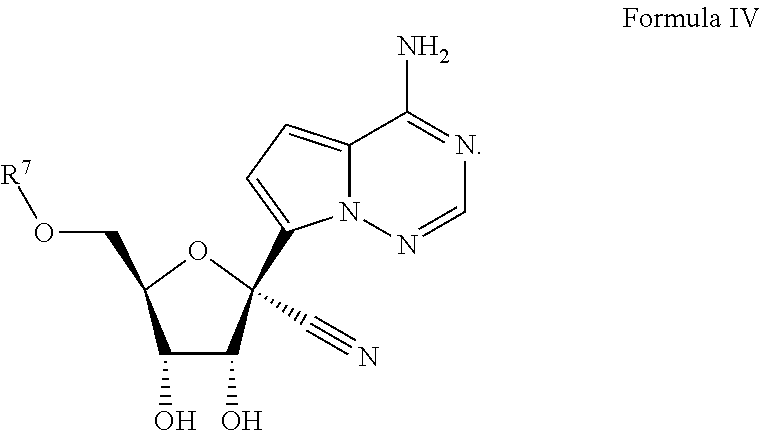
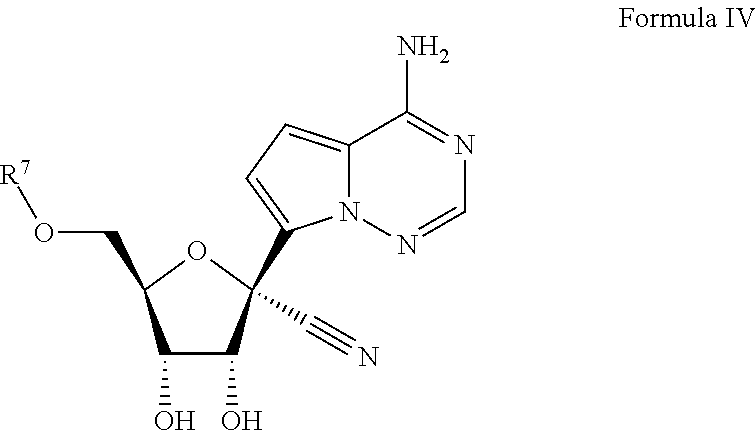
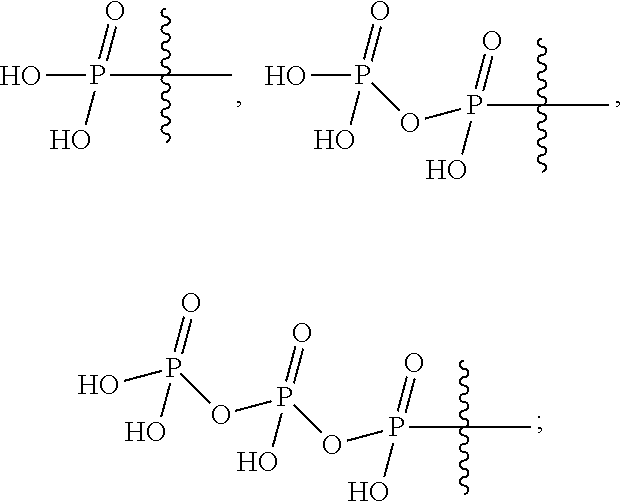
Examples
example 1
(2S)-ethyl 2-(chloro(phenoxy)phosphorylamino)propanoate (Chloridate A)
[0395]
[0396]Ethyl alanine ester hydrochloride salt (1.69 g, 11 mmol) was dissolved in anhydrous CH2Cl2 (10 mL) and the mixture stirred with cooling to 0° C. under N2 (g). Phenyl dichlorophosphate (1.49 mL, 10 mmol) was added followed by dropwise addition of Et3N over about 10 min. The reaction mixture was then slowly warmed to RT and stirred for about 12 h. Anhydrous Et2O (50 mL) was added and the mixture stirred for about 30 min. The solid that formed was removed by filtration, and the filtrate concentrated under reduced pressure. The residue was subjected to silica gel chromatography eluting with 0-50% EtOAc in hexanes to provide intermediate A. 1H NMR (300 MHz, CDCl3) δ 7.39-7.27 (m, 5H), 4.27 (m, 3H), 1.52 (m, 3H), 1.32 (m, 3H). 31P NMR (121.4 MHz, CDCl3) δ 8.2, 7.8.
example 2
(2S)-2-ethylbutyl 2-(chloro(phenoxy)phosphorylamino)propanoate (Chloridate B)
[0397]
[0398]The 2-ethylbutyl alanine chlorophosphoramidate ester B was prepared using the same procedure as chloridate A except substituting 2-ethylbutyl alanine ester for ethyl alanine ester. The material is used crude in the next reaction. Treatment with methanol or ethanol forms the displaced product with the requisite LCMS signal.
example 3
(2S)-isopropyl 2-(chloro(phenoxy)phosphorylamino)propanoate (Chloridate
[0399]
[0400]The isopropyl alanine chlorophosphoramidate ester C was prepared using the same procedure as chloridate A except substituting isopropyl alanine ester for the ethyl alanine ester.
[0401]The material is used crude in the next reaction. Treatment with methanol or ethanol forms the displaced product with the requisite LCMS signal.
PUM
 Login to View More
 Abstract
Description
Claims
Application Information
 Login to View More