

Household water purifying process and system
A treatment method and water purification technology, applied in the field of water treatment, can solve the problems of easy pollution of reverse osmosis membranes, etc., and achieve the effects of reducing the probability of microbial contamination, good promotion value, good economic benefits and social benefits
Patent Information
- Authority / Receiving Office
- CN · China
- Patent Type
- Patents(China)
- Current Assignee / Owner
- Publication Date
- 2009-09-02
Smart Images
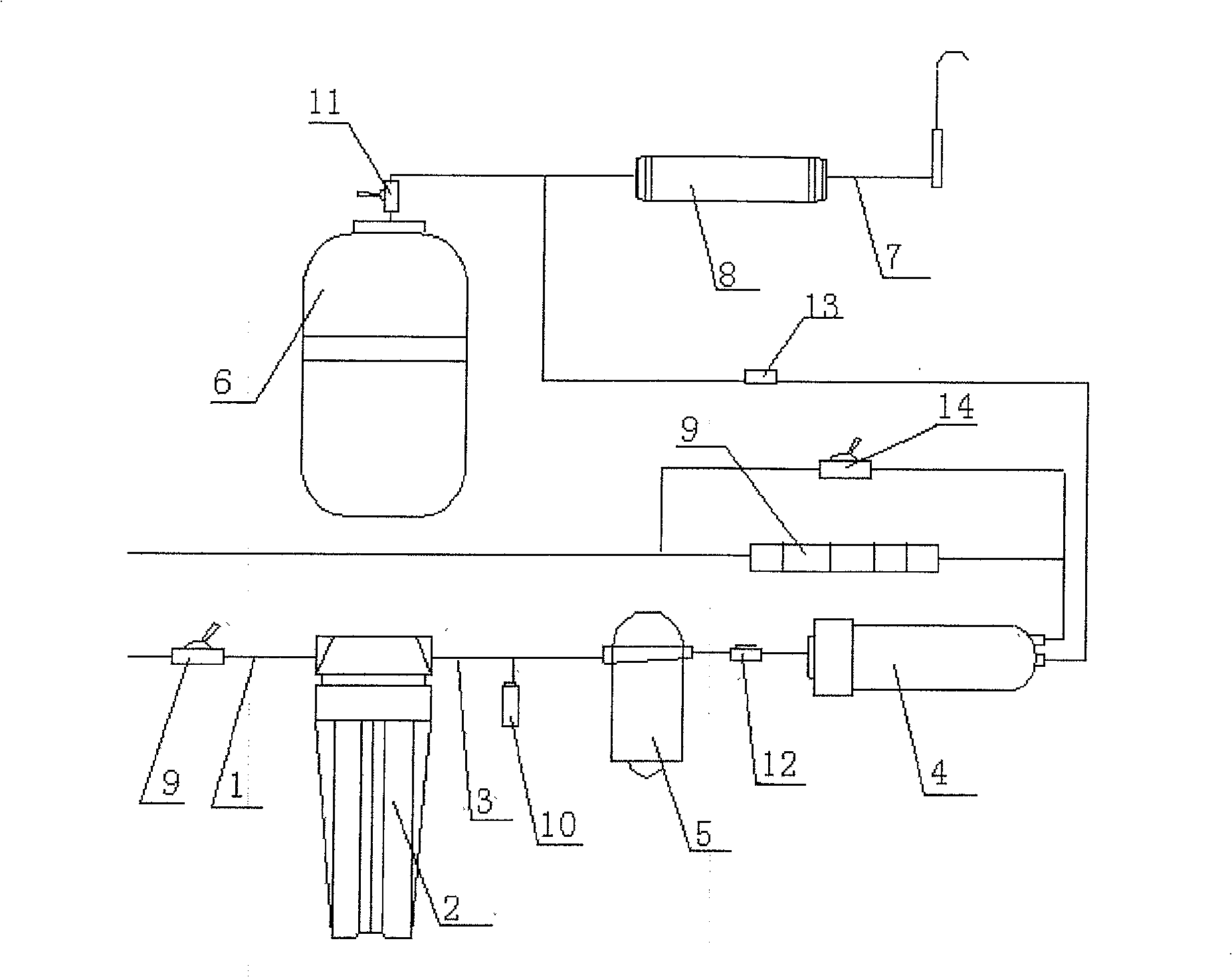
Figure 1
Abstract
Description
Technical field
[0001] The invention relates to a treatment method and treatment system for household water purification, and belongs to the technical field of water treatment. Background technique
[0002] Because household water purifiers are easy to use and low in running costs for water production, they can be directly installed in the cabinet, saving space and being beautiful, and are becoming more and more popular with consumers.
[0003] The current household purified water treatment system is mainly composed of three parts: water pretreatment part, reverse osmosis filtration part and pure water storage. Usually, the tap water in the tap water pipe is filtered through a pp cotton filter element to remove suspended solids in the water. Because the reverse osmosis membrane element has strict requirements on the free chlorine content of the influent, the residual chlorine content is required to be less than 0.1mg / L, otherwise the membrane will be damaged The structure, result...
Examples
Embodiment Construction
[0016] Embodiments of the present invention; 1. A treatment method for household water purification, characterized in that: the method is to first pass tap water into a polypropylene cotton filter rod, and remove suspended solids and large particles in the tap water through the polypropylene cotton filter rod. Impurities, and then pressurize the tap water filtered through the polypropylene cotton filter rod and then input it into the oxidation-resistant composite reverse osmosis membrane. The inorganic salts, heavy metal ions, organic matter, colloids, bacteria and viruses in the tap water are removed through the oxidation-resistant composite reverse osmosis membrane. At the same time, the residual chlorine in the tap water is used to control and kill microorganisms attached to the surface of the oxidation-resistant composite reverse osmosis membrane. The purified water filtered by the oxidation-resistant composite reverse osmosis membrane is discharged into a pressure barrel for ...