
Method for implementing parallel moving hypersensitive Laplacian gridding edition
A grid and editing technique used in the field of translation-sensitive Laplacian grid editing
Patent Information
- Authority / Receiving Office
- CN · China
- Patent Type
- Patents(China)
- Current Assignee / Owner
- Publication Date
- 2012-04-18
- Estimated Expiration
- Not applicable · inactive patent
Smart Images
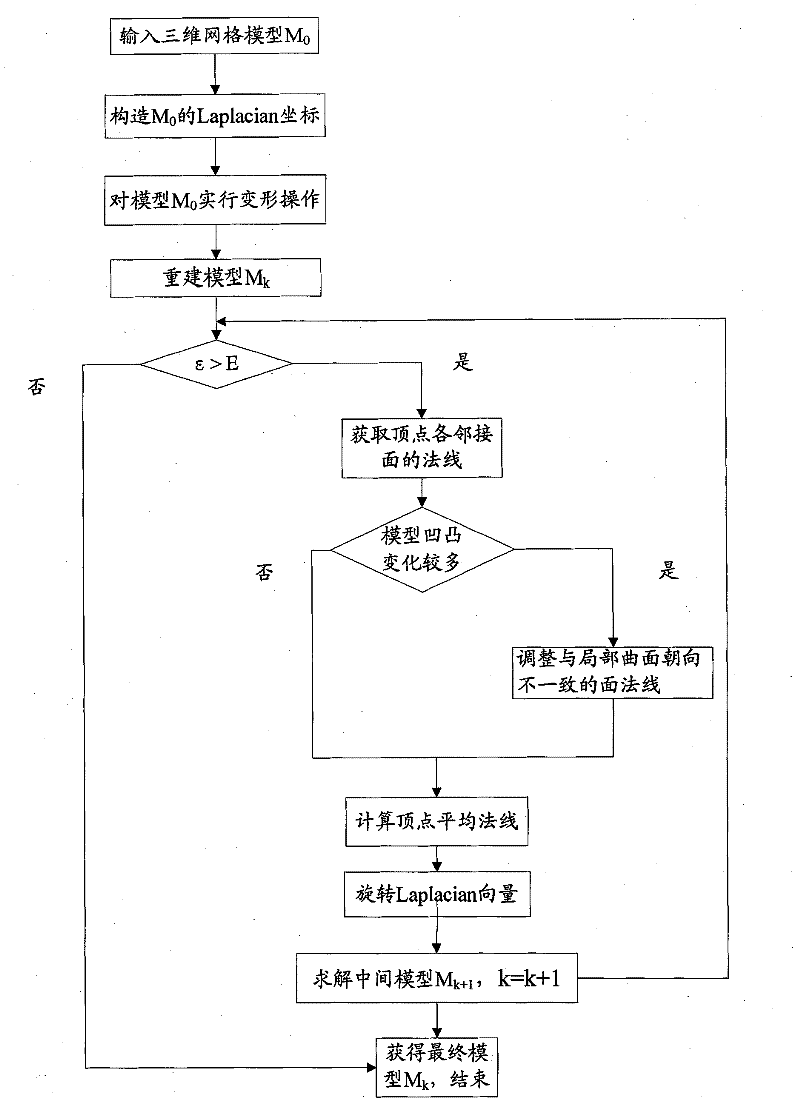
Figure 1 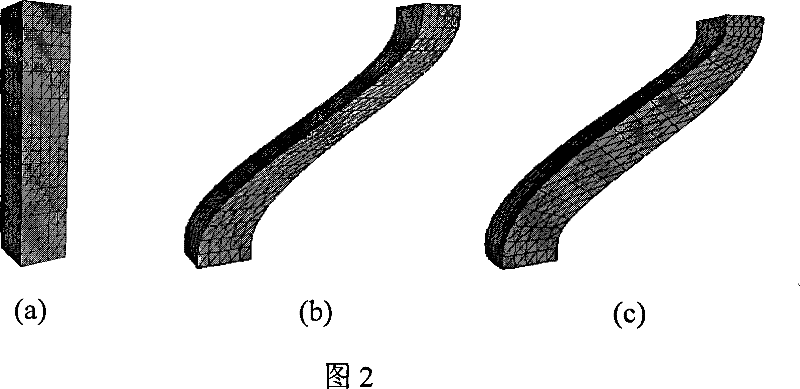
Figure 2 
Figure 3
Abstract
Description
technical field
[0001] The invention belongs to the technical field of geometry modeling, in particular to a Laplacian grid editing method realizing translation sensitivity. Background technique
[0002] With the advancement of computer animation and industrial modeling, model editing technology has developed rapidly. Many scholars have proposed various mesh editing technologies, such as free deformation technology, multi-resolution mesh editing technology, and methods based on geometric differential attributes. new model.
[0003] Since the 1980s, there have been two major technological breakthroughs in the field of 3D model editing. The first breakthrough occurred in the 1980s, called free deformation technology, to edit the model by means of manipulating the proxy model. The second breakthrough occurred in the 1990s, called multi-resolution editing technology, to manipulate simplified models as a means of mesh editing. These two technological breakthroughs have provid...
Examples
Embodiment Construction
[0058] The present invention will be further described below in conjunction with the accompanying drawings.
[0059] The schematic diagram of the execution steps of the method of the present invention is as attached figure 1 shown. Input the 3D mesh model M through the terminal 0 , the model can be acquired through a 3D scanner or built using modeling tools (such as Maya, 3ds max, etc.). Define M 0 = (V, E, F) has |V| vertices. Among them, V, E, and F represent the collection of vertices, edges, and faces, respectively.
[0060] Build the Laplacian coordinates of the model. First, the Laplacian operator needs to be constructed. Uniform weights can be used, or different weights can be set according to different grids, such as the weight of cotangent or the area of triangular grids.
[0061] Transform the model. This step can be manipulated by user-defined ROI (Region of Interest, region of interest).
[0062] Then reconstruct the intermediate model M of the Cartesia...