
Method and device for eliminating intercoupling effect at transmitter side
A transmitter-side and transmitter technology, applied in the field of multiple-input multiple-output wireless communication systems, can solve the problem of eliminating the mutual coupling effect of the MIMO system, which is not proposed, and achieve the effect of eliminating the mutual coupling effect and improving the system capacity.
Patent Information
- Authority / Receiving Office
- CN · China
- Patent Type
- Applications(China)
- Current Assignee / Owner
- Publication Date
- 2012-05-09
- Estimated Expiration
- Not applicable · inactive patent
Smart Images
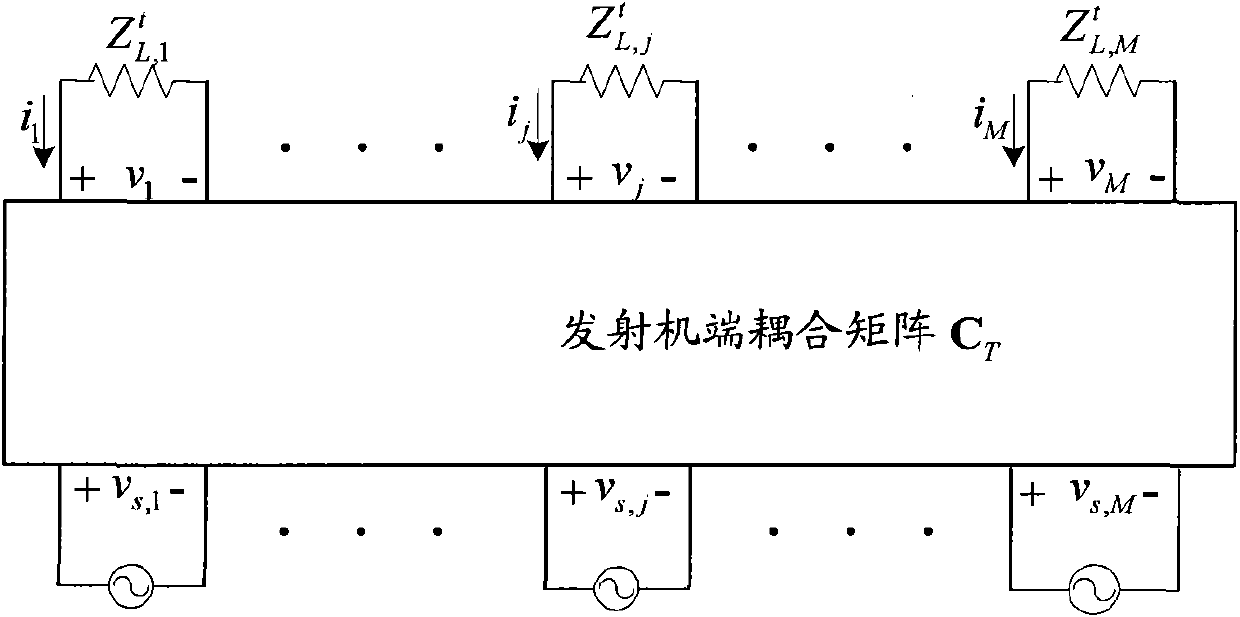
Figure 1 
Figure 2 
Figure 3
Abstract
Description
technical field
[0001] The invention relates to a multiple-input multiple-output wireless communication system, in particular to a method and device for eliminating the mutual coupling effect at the transmitter end. Background technique
[0002] As we all know, in a multi-input multi-output (Multi-Input Multi-Output) system, theoretically increasing the number of antennas can improve system performance. However, in practical applications, the size of the antenna array is limited by space. For a fixed size antenna array, increasing the number of antennas will decrease the distance between antenna elements. When the distance between the antenna elements is arranged very close, if the mutual coupling effect between the antenna elements is not considered in advance in the system design, the performance of the system will be greatly reduced.
[0003] The so-called mutual coupling between the antenna elements refers to the mutual interaction between the various antenna elements....
Examples
Embodiment Construction
[0018] System model:
[0019] The system model considering the mutual coupling effect of the transmitter and the receiver can be expressed as: (1)
[0020] y=C r HC t x+z(1)
[0021] where x is the transmitted signal vector, C r is the coupling matrix at the receiver, C t is the coupling matrix at the transmitter, H is the spatial channel matrix, and z is the additive noise vector.
[0022] The antenna array at the transmitter can be expressed as figure 1 The circuit network shown.
[0023] According to Kirchoff's voltage law (KVL), it can be concluded that:
[0024] C t = Z L t ( Z t + Z L t ) - 1 - - - ( ...