

Concrete additive and preparation method thereof
A concrete admixture and retarder technology, which is applied in the field of engineering materials and its preparation, can solve the problems of long demolition time, low strength, and increased engineering costs, and achieve shortened demolition time, improved use efficiency, and reduced workload Effect
Patent Information
- Authority / Receiving Office
- CN · China
- Patent Type
- Patents(China)
- Current Assignee / Owner
- Publication Date
- 2014-12-03
- Estimated Expiration
- Not applicable · inactive patent
Smart Images
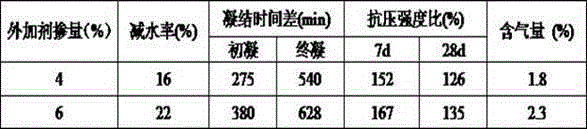
Figure 1 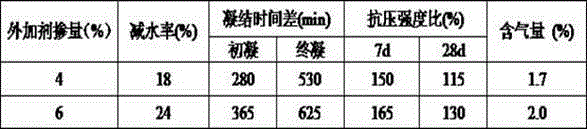
Figure 2 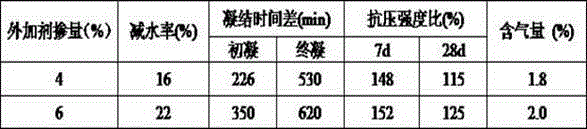
Figure 3
Abstract
Description
technical field
[0001] The invention relates to an engineering material and a preparation method thereof, in particular to a concrete admixture and a preparation method of the admixture. Background technique
[0002] At present, with the increase of large-scale projects, cast-in-place large-volume concrete is becoming more and more common in water conservancy projects and water transportation projects. The following problems often occur in the construction of cast-in-place mass concrete:
[0003] 1. Due to the loose control of concrete setting time and construction speed, cold joints appear between layers of cast-in-place concrete, which reduces the bonding force between layers, especially for concrete buildings with water-retaining functions. This caused serious water leakage between layers and lost the water retention function of the building; for example, the cold seam of No. 4 unit of the main workshop of Yantan Hydropower Station in Guangxi was caused by the inconsiste...
Examples
Embodiment 1
[0031] 1. Preparation of water reducing agent
[0032] (1) Weigh 14 parts of sodium p-aminobenzenesulfonate, 2.2 parts of dicyandiamide, 6.0 parts of bisphenol A, 18 parts of formalin, 0.3 parts of tartaric acid, 0.7 parts of sodium hydroxide, 3.8 parts of phenol, and 55 parts of water ;
[0033] (2) Add the weighed sodium p-aminobenzenesulfonate, dicyandiamide, bisphenol A, tartaric acid, phenol and water into the reaction kettle, stir evenly, and when the pH value of the reaction system is 3.0 to 5.0, heat up to 85~100℃;
[0034] (3) When the temperature reaches 85~100°C, stir the material in the reaction kettle evenly, add formalin dropwise within 2.0h, and continue heating for 2.8h;
[0035] (4) Adjust the pH value to 8.0~9.0 with sodium hydroxide, and react at a temperature of 85~100°C for 4.5h;
[0036] (5) Use sodium hydroxide to adjust the pH value to 10.0~12.5, react at 85~100°C for 3 hours, then cool down and discharge to obtain a reddish-brown liquid, which is sp...
Embodiment 2
[0051] 1. Preparation of water reducing agent
[0052] (1) Weigh 16 parts of sodium p-aminobenzenesulfonate, 2.0 parts of dicyandiamide, 5.9 parts of bisphenol A, 18.2 parts of formalin, 0.3 parts of tartaric acid, 0.8 parts of sodium hydroxide, 2.8 parts of phenol, and 54 parts of water ;
[0053] (2) Add the weighed sodium p-aminobenzenesulfonate, dicyandiamide, bisphenol A, tartaric acid, phenol and water into the reaction kettle, stir evenly, and when the pH value of the reaction system is 3.0 to 5.0, heat up to 85~100℃;
[0054] (3) When the temperature reaches 85~100°C, stir the material in the reaction kettle evenly, add formalin dropwise within 2.3h, and continue heating for 2.8h;
[0055] (4) Adjust the pH value to 8.0~9.0 with sodium hydroxide, and react at a temperature of 85~100°C for 5.0h;
[0056] (5) Use sodium hydroxide to adjust the pH value to 10.0~12.5, react at 85~100°C for 3 hours, then cool down and discharge to obtain a reddish-brown liquid, which is ...
Embodiment 3
[0071] 1. Preparation of water reducing agent
[0072] (1) Weigh 18 parts of sodium p-aminobenzenesulfonate, 2.0 parts of dicyandiamide, 6.0 parts of bisphenol A, 19.0 parts of formalin, 0.4 parts of tartaric acid, 0.8 parts of sodium hydroxide, 3.0 parts of phenol, and 50.8 parts of water ;
[0073] (2) Add the weighed sodium p-aminobenzenesulfonate, dicyandiamide, bisphenol A, tartaric acid, phenol and water into the reaction kettle, stir evenly, and when the pH value of the reaction system is 3.0 to 5.0, heat up to 85~100℃;
[0074] (3) When the temperature reaches 85~100°C, stir the material in the reaction kettle evenly, add formalin dropwise within 2.5h, and continue heating for 3.0h;
[0075] (4) Adjust the pH value to 8.0~9.0 with sodium hydroxide, and react at a temperature of 85~100°C for 5.0h;
[0076] (5) Use sodium hydroxide to adjust the pH value to 10.0~12.5, react at 85~100°C for 3 hours, then cool down and discharge to obtain a reddish-brown liquid, which i...