
Fullereneporphyrin derivate photosensitizer as well as preparation method and application thereof
A technology of fullerene porphyrins and derivatives, which is applied in the direction of drug combinations, pharmaceutical formulas, and medical preparations containing active ingredients, etc., which can solve the problem of affecting the efficiency of active oxygen, reducing the effect of photodynamic therapy, and easy aggregation of photobleaching and other problems, to achieve the effect of increasing the probability of interaction, significant killing effect, and high phototoxicity
Patent Information
- Authority / Receiving Office
- CN · China
- Patent Type
- Applications(China)
- Current Assignee / Owner
- Publication Date
- 2014-04-16
Smart Images
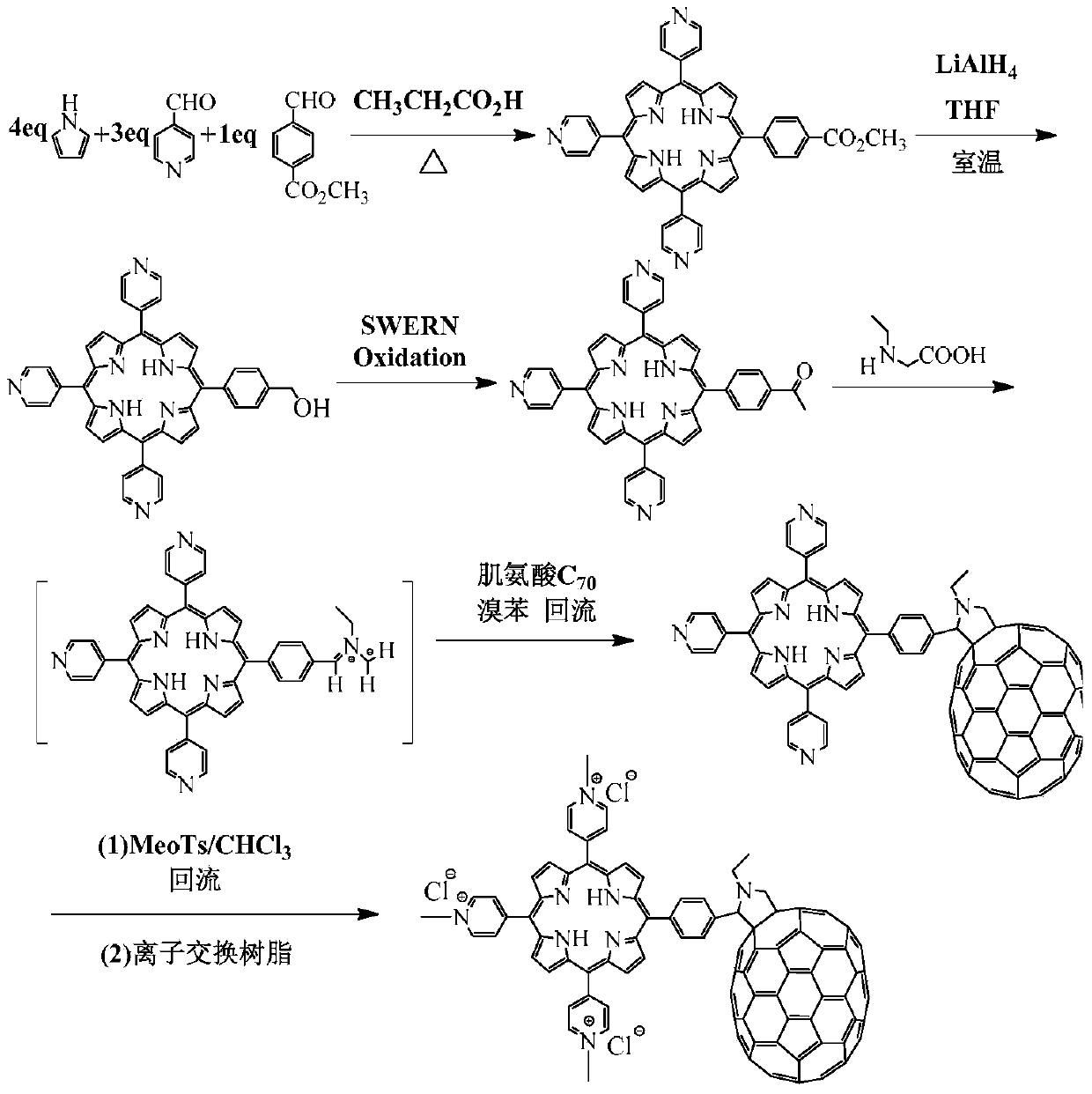
Figure 1 
Figure 2 
Figure 3
Abstract
Description
technical field
[0001] The invention relates to a fullerene porphyrin derivative photosensitizer, a preparation method and application thereof. Background technique
[0002] Photodynamic therapy (PDT for short) is a new cancer treatment method that has emerged after traditional surgery, radiotherapy, and chemotherapy. The method has the advantages of good selectivity, low toxicity, small trauma, small risk, small side effects, broad anti-tumor spectrum, good applicability, easy elimination of hidden cancer lesions, repeatable treatment, and easy to be used in combination with other cancer treatment methods, etc. advantage. At present, PDT has been approved at home and abroad, and has become a routine method for treating tumors, and has been recognized and widely used internationally. The first-generation photosensitizer (hematoporphyrin derivative HpD) and the second-generation photosensitizer (5-aminolevulinic acid ALA) have been approved by the US Food and Drug Administr...
Examples
Embodiment 1
[0040] Preparation of fullerene porphyrin derivatives shown in embodiment 1, formula I
[0041] The reaction equation is as figure 1 shown.
[0042] (1) Methyl p-formylbenzoate, 4-pyridinecarbaldehyde and pyrrole are mixed according to 1:3:4 (molar ratio), using propionic acid as a solvent, heated to reflux for 1.5h, and the reacted mixture is first recrystallized with methanol , purified by silica gel column separation (eluent: trichloromethane:methanol=98:2, v / v) to obtain the compound shown in formula 1.
[0043] (2) The compound shown in formula 1 and LiAlH4 The molar ratio of substances was 1:8, reacted at room temperature (25°C), and the reactant was monitored by column chromatography (developing solvent: chloroform:ethanol=97:3, v / v) to obtain the compound shown in formula 2.
[0044] (3) The compound shown in formula 2 oxidized the hydroxyl group to an aldehyde group through the Swern oxidation reaction, and the specific steps were as follows: 0.5 mL of oxalyl chlori...
Embodiment 2
[0048] Example 2, Evaluation of the Toxic Effect of Fullerene Porphyrin Derivatives Shown in Formula I on A549 Cells
[0049] (1) Resuscitate A549 cells (Cell Resource Center, Shanghai Institutes for Biological Sciences, Chinese Academy of Sciences), adjust the cell density to 5×10 4 / mL, seed A549 cells into 96-well plates (6×6), at 37°C, 5% CO 2 Incubate for 24h under the condition;
[0050] (2) After the cells adhere to the wall, replace with DMEM (Corning R10-013-CV, purchasing company: Baierdi) solution containing different concentration gradients of fullerene porphyrin derivatives shown in formula I at 37°C, 5% CO 2 The culture was continued for 24 h under the same conditions.
[0051] According to the instructions for use, use cck-8 to detect the activity of A549 cells, the dark toxicity test results of fullerene porphyrin derivatives shown in formula I to A549 cells are as follows Image 6 (B) shown.
[0052] Depend on Image 6 (B) It can be known that fullerene ...
Embodiment 3
[0053] Example 3, Photodynamic Killing Effect of Fullerene Porphyrin Derivatives Shown in Formula I on A549 Cells
[0054] (1) Resuscitate A549 cells and adjust the cell density to 5×10 4 / mL, seed A549 cells into 96-well plates (6×6), at 37°C, 5% CO 2 Incubate for 24h under the condition;
[0055] (2) After the cells adhered to the wall, they were replaced with DMEM solutions containing different concentration gradients of fullerene porphyrin derivatives shown in formula Ⅰ at 37°C and 5% CO 2 Continue culturing for 3 h under the condition;
[0056] (3) Remove the medium containing the fullerene porphyrin derivative shown in formula I, and replace it with fresh colorless DMEM at 20mW / cm -2 Under the light intensity of 10min, replace the fresh medium and continue to incubate for 24h.
[0057] According to the instructions for use, use cck-8 to detect the activity of A549 cells, the phototoxicity test results of fullerene porphyrin derivatives shown in formula I to A549 cell...