
Synthesis method of 1,3-disubstituted allene with high optical activity
An optically active, two-substituted technology, applied in organic chemistry methods, chemical instruments and methods, asymmetric synthesis, etc., can solve the problems of narrow substrate range and large amount, and achieve the goal of reducing dosage, cheap and easy raw materials, excellent non-parallel Enantioselectivity or the effect of enantioselectivity
Patent Information
- Authority / Receiving Office
- CN · China
- Patent Type
- Applications(China)
- Current Assignee / Owner
- Publication Date
- 2014-12-10
Smart Images

Figure 1 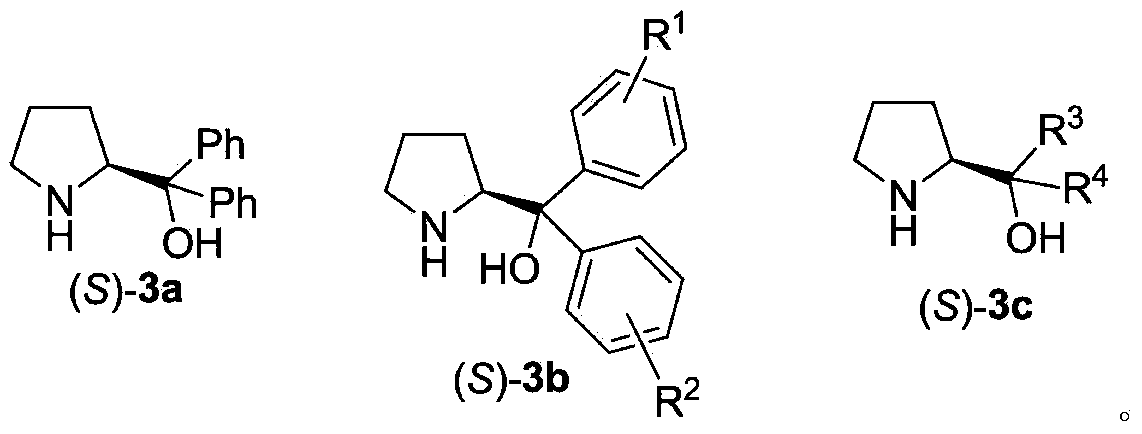
Figure 2 
Figure 3
Abstract
Description
technical field
[0001] The invention relates to a chemical synthesis method, in particular to a synthesis method of highly optically active 1,3-disubstituted allene. Background technique
[0002] Due to the unique structure, active reactivity of allene compounds and their increasingly important role in organic synthesis, allene chemistry has received more and more attention (S. Yu, S. Ma, Angew. Chem. , Int.Ed.2012, 51, 3074; M.A.Tius, Chem.Soc.Rev.2014, 43, 2979; J.L.Bras, J.Muzart, Chem.Soc.Rev.2014, 43, 3003; S.Kitagaki, F .Inagaki,C.Mukai,Chem.Soc.Rev.2014,43,2956; M.P. Chem.Soc.Rev.2014,43,3164; C.S.Adams,C.D.Weatherly,E.G.Burke,J.M.SchomakerChem.Soc.Rev.2014,43,3136;R.Zimmer,H.U.Reissig,Chem.Soc.Rev.,2014, 43, 2888; m) W. Yang, A.S.K. Hashmi, Chem. Soc. Rev., 2014, 43, 2941; B. Alcaide, P. Almendros, C. Aragoncillo, Chem. Soc. Rev. 2014, 43, 3106; T. F.M. Truscott, R. Rodriguez, G. Maestri, M. Malacria, Chem. Soc. Rev. 2014, 43, 2916; F. López, J.L. Chem. Soc. ...
Examples
Embodiment 1
[0020]
[0021] Among them, equiv means equivalent weight, mol means mole, 1,4-dioxane means 1,4-dioxane, de means diastereomeric excess, and ee means enantiomeric excess.
[0022] Under nitrogen protection, CuBr was sequentially added to the dry Schlenk reaction tube 2(44.9mg, 0.2mmol), propargyl glucoside 1a (387.0mg, 1.0mmol), α,α-diphenylprolinol (S)-3a (304.5mg, 1.2mmol) and freshly distilled n-octanal 2a (180.1mg, 1.4mmol) and dry 1,4-dioxane (3.0mL), insert a condenser into the reaction tube after addition, close the reaction tube piston, place the reaction tube in a place that has been heated to 130 Stirred in an oil bath at °C for 16 hours, thin layer chromatography (TLC) tracking showed that the reaction was complete. Stop heating and stirring, remove the reaction tube from the oil bath, and cool to room temperature. Add 30 mL of ethyl acetate for dilution, transfer the resulting mixture to a separatory funnel, wash with dilute hydrochloric acid (v / v=10%), separ...
Embodiment 2
[0024]
[0025] Operation with reference to Example 1. CuBr 2 (89.3mg, 0.4mmol), propargyl glucoside 1a (772.5mg, 2.0mmol), α,α-diphenylprolinol (R)-3a (607.6mg, 2.4mmol), freshly distilled n-octyl aldehyde 2a (360.6 mg, 2.8 mmol) and 1,4-dioxane (6.0 mL). After reacting at 130°C for 16 hours, column chromatography (eluent: petroleum ether / ethyl acetate=3 / 1) yielded a liquid axial chiral allene glucoside (S a )-4aa (508.2mg, 51%): 98% de (HPLC measurement conditions: Chiralcel AS-H column, n-hexane / isopropanol=95 / 5, 0.4mL / min, λ=214nm, t R (small peak) = 35.5min,t R (big peak)=36.5min); [α] D 20 =+36.8 (c=0.975, CHCl 3 ); 1 H NMR (300MHz, CDCl 3 )δ5.28-4.95(m,5H),4.64(d,J=7.8Hz,1H),4.34-4.25(m,2H),4.18-4.07(m,2H),3.75-3.66(m,1H) ,2.08(s,3H,Me),2.04(s,3H,Me),2.03(s,3H,Me),2.00(s,3H,Me),2.12-1.95(m,2H,CH 2 ),1.48-1.18(m,10H,CH 2 ×5),0.88(t,J=6.6Hz,3H,Me); 13 C NMR (75Hz, CDCl 3 ( )ν(cm -1 ) 2929, 2857, 1962, 1759, 1435, 1367, 1227, 1166, 1040; MS (ESI, m / z) 516...
Embodiment 3
[0027]
[0028] Operation with reference to Example 1. CuBr 2 (44.9mg, 0.2mmol), propargyl glucoside 1a (388.1mg, 1.0mmol), α,α-diphenylprolinol (S)-3a (303.3mg, 1.2mmol), freshly distilled phenylacetaldehyde 2b (168.8 mg, 1.4 mmol) and 1,4-dioxane (3.0 mL). After reacting at 130°C for 16 hours, column chromatography (eluent: petroleum ether / ethyl acetate=2.5 / 1) yielded liquid axial chiral allene glucoside (R a )-4ab (273.0mg, 55%): 97% de (HPLC measurement conditions: Chiralcel IA-H column, n-hexane / isopropanol=95 / 5, 1.0mL / min, λ=214nm, t R (big peak) = 16.4min,t R (small peak) = 23.0min); [α] D 20 =-30.4 (c=1.405, CHCl 3 ); 1 H NMR (300MHz, CDCl 3 )δ7.39-7.19(m,5H,ArH),5.50-5.37(m,1H),5.22-5.11(m,2H),5.06(t,J=9.6Hz,1H),4.95(t,J= 8.9Hz, 1H), 4.35(d, J=7.8Hz, 1H), 4.32-4.19(m, 2H), 4.13-4.02(m, 2H), 3.55-3.29(m, 3H), 2.07(s, 3H ,Me),2.029(s,3H,Me),2.026(s,3H,Me),2.00(s,3H,Me); 13 C NMR (75Hz, CDCl 3 )δ205.7, 170.4, 170.0, 169.15, 169.06, 139.2, 128.34, 128.28, 1...