
A lightweight RFID mutual authentication method on elliptic curves
An elliptic curve, mutual authentication technology, applied in the field of RFID mutual authentication technology, can solve problems such as label information privacy, achieve the effect of protecting identity information and realizing mutual authentication
Patent Information
- Authority / Receiving Office
- CN · China
- Patent Type
- Patents(China)
- Current Assignee / Owner
- Publication Date
- 2017-07-11
- Estimated Expiration
- Not applicable · inactive patent
Smart Images
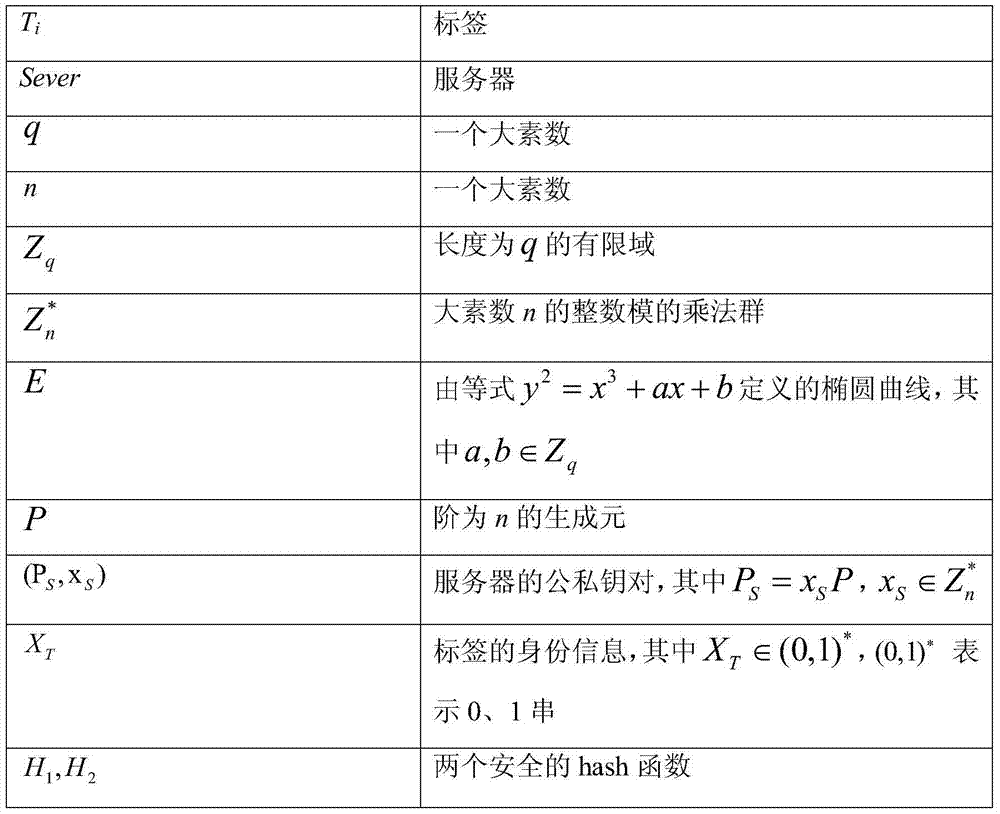
Figure 1 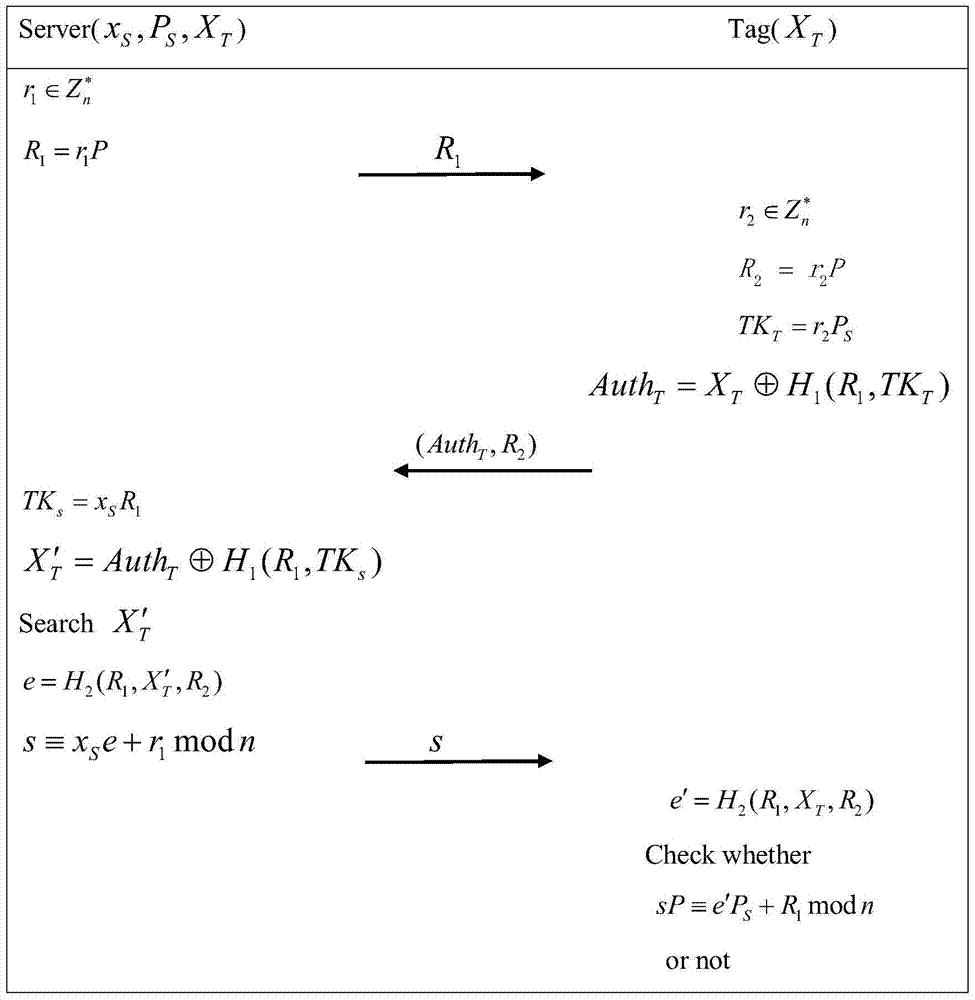
Figure 2
Abstract
Description
technical field
[0001] The invention relates to digital authentication technology, in particular to RFID mutual authentication technology. Background technique
[0002] Radio Frequency Identification (RFID) is a fast, accurate, real-time collection and processing of information, automatic identification technology to achieve pervasive computing environment. The RFID system mainly uses radio frequency signals to achieve non-contact information transmission through spatial coupling, and achieves the purpose of mutual identification based on the transmitted information.
[0003] In an authentication system, there are three parties, tags, readers and servers. The server contains the background database. The channel between the reader and the server is secure, the channel between the tag and the reader is not secure. An important challenge in RFID security issues is privacy leakage. Since the reader and the tag use radio frequency signals to communicate, the inherent vulnerab...
Examples
Embodiment Construction
[0020] The symbols used in the implementation are described in the table below:
[0021]
[0022] In this scheme, there is no trusted third party as the issuing institution. Only server, reader and tag. The server generates the public-private key pair of the reader and the tag. Furthermore, the communication channel between reader and server is secure. So in this solution, we write the communication between the tag and the reader as the communication between the tag and the server.
[0023] (1) System initialization: the server generates its public-private key pair, tag identity information and two secure hash functions. The identity list of all legal labels is stored in the server.
[0024] The server chooses q, n two large prime numbers, and two hash functions H 1 with H 2 , an n-order generator P;
[0025] The server determines the elliptic curve E to be y 2 =x 3 +ax+b, where the elliptic curve constant a,b∈Z q ,Z q is a finite field of length q;
[0026] The...