

Preparation method for ethyl 3-(pyridin-2-ylamino) propanoate
A technology of ethyl propionate and ethyl acrylate, which is applied in the field of preparation of ethyl 3-propionate, can solve the problems of long reaction time, low yield, complicated reaction process, etc., and achieve short operation time, environmental friendliness, The effect of the simple synthesis process
Patent Information
- Authority / Receiving Office
- CN · China
- Current Assignee / Owner
- Publication Date
- 2015-09-23
- Estimated Expiration
- Not applicable · inactive patent
Smart Images
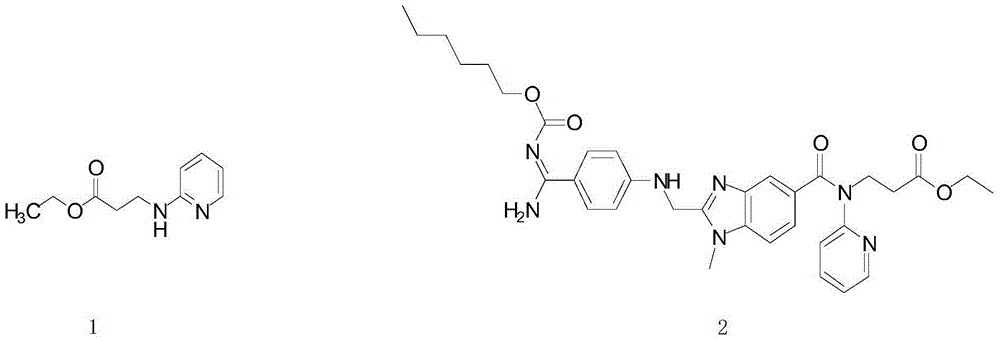
Figure 1 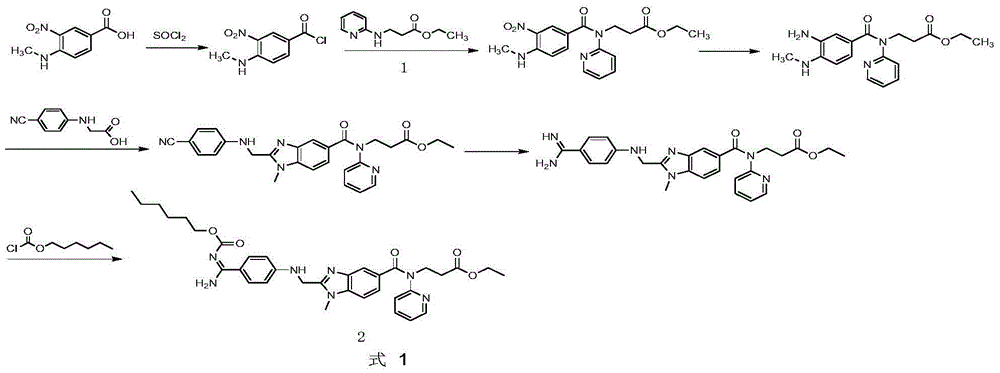
Figure 2 
Figure 3
Abstract
Description
technical field
[0001] The invention relates to medicinal chemistry, in particular to a preparation method of ethyl 3-(pyridin-2-ylamino)propionate. Background technique
[0002] Ethyl 3-(pyridin-2-ylamino)propionate (compound 1) is one of the important intermediates in the synthesis of the direct thrombin inhibitor dabigatran etexilate (dabigatrau etexilate, trade name Pradaxa, compound 2) . Dabigatran etexilate is the first new class of oral anticoagulant drugs to be marketed in 50 years after warfarin. Compared with warfarin, dabigatran etexilate has the characteristics of oral administration, rapid onset of action, no need for special drug monitoring, and less drug interaction. In vivo, in vitro tests and clinical studies have shown that it has good curative effect and pharmacokinetics. It has good clinical application prospect.
[0003]
[0004] In the prior art, such as CN1088702C, the synthesis route of dabigatran is shown in formula 1:
[0005]
[0006] In ...
Examples
Embodiment 1
[0034] (1) Put an electromagnetic stirrer bar of appropriate size in a 500mL round bottom flask, weigh 50g of o-aminopyridine into the bottle, and add 50mL of absolute ethanol;
[0035] (2) Stir, and after the solid is dissolved or most of it is dissolved, add 56.5 mL of ethyl acrylate to step (1);
[0036] (3) Stir for a while, slowly add 9 mL of trifluoromethanesulfonic acid dropwise;
[0037] (4) Add nitrogen protection, stir and reflux in an oil bath at 120-160°C for 18 hours;
[0038] (5) After the reaction is completed, the reaction solution is concentrated under reduced pressure after being washed with petroleum ether at a temperature of 35-40°C and a pressure of 0.09-0.1 MPa;
[0039] (7) The concentrated solution was washed with petroleum ether / ethyl acetate (volume ratio 5:1), recrystallized, and suction filtered to obtain white flaky crystals.
[0040] The white flaky crystals are ethyl 3-(pyridin-2-ylamino)propionate with a yield of 80% and a purity of 99% (HPLC)...
Embodiment 2
[0042] (1) Put an electromagnetic stirrer of appropriate size in a 500mL round bottom flask, weigh 100g of o-aminopyridine into the bottle, and add 100mL of absolute ethanol;
[0043] (2) Stir, and until the solid is dissolved or most of it is dissolved, add 113 mL of ethyl acrylate to step (1);
[0044] (3) Stir for a while, slowly drop 15mL trifluoromethanesulfonic acid;
[0045] (4) Add nitrogen protection, stir and reflux in an oil bath at 120-160°C for 20 hours;
[0046] (5) After the reaction is completed, the reaction solution is concentrated under reduced pressure after being washed with petroleum ether at a temperature of 35-40°C and a pressure of 0.09-0.1 MPa;
[0047] (7) The concentrated solution was washed with petroleum ether / ethyl acetate (volume ratio 8:1), recrystallized, and suction filtered to obtain white flaky crystals.
[0048] The white flaky crystals are ethyl 3-(pyridin-2-ylamino)propionate, with a yield of 83% and a purity of 99% (HPLC).
Embodiment 3
[0050] (1) Put an electromagnetic stirrer of appropriate size in a 1000mL round bottom flask, weigh 150g of o-aminopyridine into the bottle, and add 80mL of absolute ethanol;
[0051] (2) Stir, and until the solid is dissolved or mostly dissolved, add 169.5 mL of ethyl acrylate to step (1);
[0052] (3) Stir for a while, slowly add 25mL trifluoromethanesulfonic acid dropwise;
[0053] (4) Add nitrogen protection, stir and reflux in an oil bath at 120-160°C for 16 hours;
[0054] (5) After the reaction is completed, the reaction solution is concentrated under reduced pressure after being washed with petroleum ether at a temperature of 35-40°C and a pressure of 0.09-0.1 MPa;
[0055] (7) The concentrated solution was washed with petroleum ether / ethyl acetate (volume ratio 10:1), recrystallized, and suction filtered to obtain white flaky crystals.
[0056] The white flaky crystals are ethyl 3-(pyridin-2-ylamino)propionate, with a yield of 85% and a purity of 99% (HPLC).
[005...