
Method for preparing cyclopropyl boronic acid
A technology of cyclopropylboronic acid and cyclopropylcarboxylic acid, which is applied in the field of fine chemical intermediate synthesis, can solve the problems of safety, many coupling by-products, and poor stability of boronizing reagents in the environment or experimental personnel, and avoids high toxicity. The use of mercury oxide and the effect of simplifying the operation process
Patent Information
- Authority / Receiving Office
- CN · China
- Patent Type
- Applications(China)
- Current Assignee / Owner
- Publication Date
- 2015-10-28
Smart Images

Figure 1 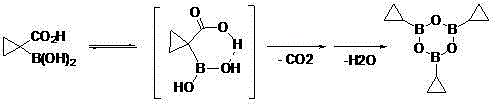
Figure 2 
Figure 3
Abstract
Description
technical field
[0001] The invention relates to a method for preparing cyclopropylboronic acid, which belongs to the field of synthesis of fine chemical intermediates. Background technique
[0002] Cyclopropyl structural units are widely found in drugs under research and new drugs already on the market, such as the blood lipid-lowering drug pitavastatin calcium and antibacterial drugs: ciprofloxacin, moxifloxacin hydrochloride, etc. Due to the particularity of the structure of the cyclopropyl group, the simplest and most effective way to connect this group in the molecule is to use cyclopropylboronic acid for Suzuki coupling.
[0003]
[0004] Pitavastatin Calcium Ciprofloxacin
[0005] The current synthetic method of cyclopropyl boronic acid has fewer open reports. In the existing data, it is all about reacting cyclopropyl bromide with metal magnesium or metal lithium / butyllithium to obtain cyclopropyl Grignard or lithium reagent, and then Reaction with boron reagent...
Examples
Embodiment 1
[0022] Synthesis of 1-carboxycyclopropylboronic acid:
[0023] Under the protection of nitrogen, add 120 ml of anhydrous 2-methyltetrahydrofuran and diisopropylamine (0.24 mol) into the reaction flask equipped with a dropping device, cool to -70°C, and start adding 2.5M n-butyllithium solution dropwise 88 ml. After completion of the dropwise addition, keep stirring for 1 hour. Dissolve cyclopropyl formic acid (0.1 mol) in 50 ml of anhydrous tetrahydrofuran, mix well, transfer to the above-mentioned dropping funnel, start adding the mixed solution dropwise, and keep the reaction temperature at -70°C to - 60°C. After the dropwise addition, continue to stir and react for 1-2 hours, and add deuterated water to confirm that the conversion rate is greater than 95%. Then, a mixed solution of trimethyl borate (0.20 mol) dissolved in 40 ml of anhydrous 2-methyltetrahydrofuran was added into the dropping funnel, and the reaction temperature was kept at -70°C to -60°C during the dr...
Embodiment 2
[0029] Synthesis of 1-carboxycyclopropylboronic acid:
[0030] Under the protection of nitrogen, add 120 ml of anhydrous tetrahydrofuran and 2,2,6,6-tetramethylpiperidine (0.26 mol) into the reaction flask equipped with a dropping device, cool to -50 °C, and start dropping 2.5 M n-BuLi solution 90 ml. After completion of the dropwise addition, keep stirring for 1 hour. Dissolve cyclopropyl formic acid (0.1 mol) in 50 ml of anhydrous tetrahydrofuran, mix well, transfer to the above-mentioned dropping funnel, start adding the mixed solution dropwise, and keep the reaction temperature at -70°C to - 60°C. After the dropwise addition, continue to stir and react for 1-2 hours, and add deuterated water to confirm that the conversion rate is greater than 95%. Then, a mixed solution of triisopropyl borate (0.30 mol) dissolved in 40 ml of anhydrous tetrahydrofuran was added into the dropping funnel, and the reaction temperature was kept at -70°C to -60°C during the dropwise additi...
Embodiment 3
[0036] Synthesis of 1-carboxycyclopropylboronic acid:
[0037] Under the protection of nitrogen, add 120 ml of anhydrous tetrahydrofuran and hexamethyldisilazane (0.26 mol) into the reaction flask equipped with a dropping device, cool to -40°C, and start to add 2.5M n-butyllithium solution dropwise 96 ml. After completion of the dropwise addition, keep stirring for 1 hour. Dissolve cyclopropyl formic acid (0.11 mol) in 55 ml of anhydrous tetrahydrofuran, mix well and transfer it into the above-mentioned dropping funnel, start adding the mixed solution dropwise, during the dropping process, keep the reaction temperature at -70°C to - 60°C. After the dropwise addition, continue to stir and react for 1-2 hours, and add deuterated water to confirm that the conversion rate is greater than 95%. Then, a mixed solution of tris(trimethylsilyl)boron (0.20 mol) dissolved in 40 ml of anhydrous 2-methyltetrahydrofuran was added to the dropping funnel, and the reaction temperature was...