

A method for asymmetric catalytic synthesis of (s) aromatic curcumene
An aromatic curcumene, asymmetric technology, applied in the field of new asymmetric catalytic synthesis - aromatic curcumene, can solve the problems of complicated reaction steps and harsh reaction conditions
Patent Information
- Authority / Receiving Office
- CN · China
- Patent Type
- Patents(China)
- Current Assignee / Owner
- Publication Date
- 2017-03-29
- Estimated Expiration
- Not applicable · inactive patent
Smart Images
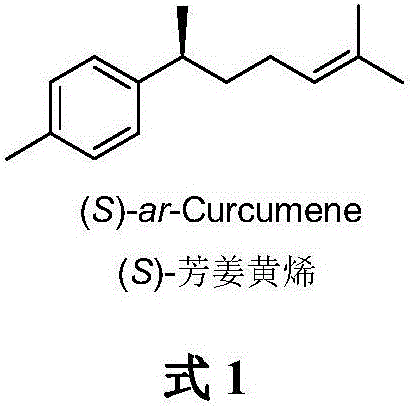
Figure 1 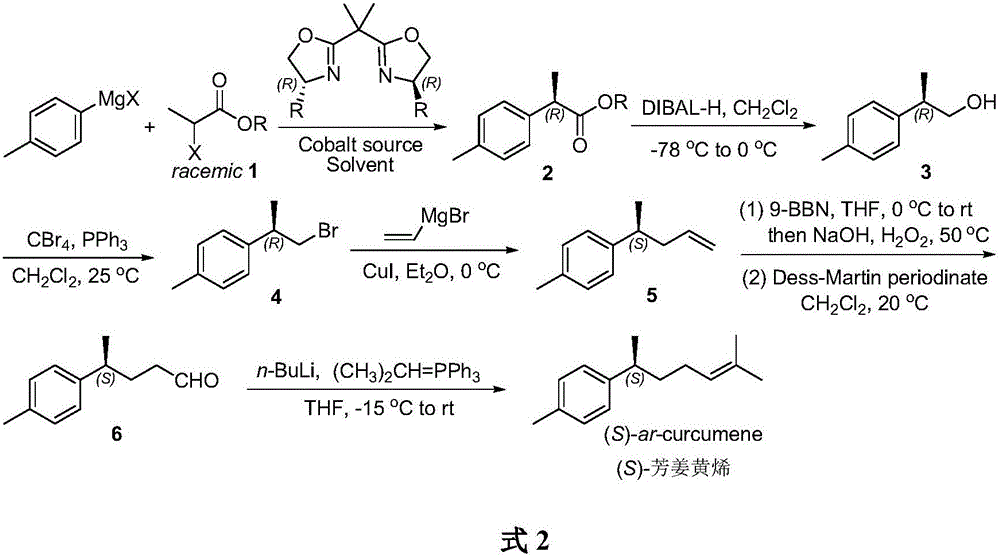
Figure 2 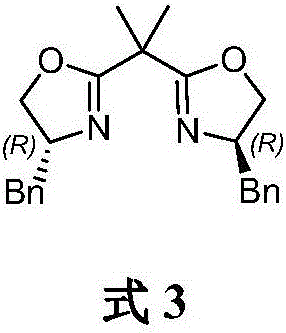
Figure 3
Abstract
Description
technical field
[0001] The invention relates to the field of chemical synthesis of natural products, in particular to a new method for asymmetric catalytic synthesis of (S)-aryl curcumene. Background technique
[0002] (S)-ar-curcumene (S-ar-curcumene) is an important class of sesquiterpenoids, which are present in various plants such as ginger, violet and Angelica dahurica (Uhde, G.; Ohloff, G.. Helv . Chim. Acta. 1972, 55, 2621–2625. Sigurdsson, S.; Ogmundsdottir, H.M.; Gudbjarnason, S. Anticancer Res. 2005, 25, 1877–1880. El-Baroty, G.S.; Farag, R.S.; Saleh, M.A. Afr. J. Biochem. Res. 2010, 4, 167–174.). Essential oils extracted from these plants generally have bactericidal and antioxidant activities, and at the same time have strong cytotoxicity, which can inhibit the growth of cancer cells (El-Baroty, G.S.; Abd El-Baky, H.H.; Farag, R.S.; Saleh, M.A.Afr . J. Biochem. Res. 2010, 4, 167–174. Sigurdsson, S.; Oegmundsdottir, H.M.; Gudbjarnason, S. Anticancer Res. 2005, 25...
Examples
Embodiment 1
[0026] Synthesis of (R)-benzyl p-toluene propionate 2
[0027] Under argon protection, add CoI to a 200mL Schlenk reaction flask 2 (0.63g, 2mmol), dried under vacuum for 30min. Add (4R,4'R)-bis(4-benzyloxazolin-2-yl)-propane L1 (0.87g, 2.4mmol) and anhydrous tetrahydrofuran (15mL), and stir at room temperature for 1h. Add racemic benzyl 2-bromophenylpropionate (4.86g, 20mmol) using a syringe, the temperature of the mixture drops to -78°C, slowly drop in p-tolylmagnesium bromide (30mL, 1.0M THF solution ,30mmol). Stirring was continued at -78°C for 8 h, and the reaction was quenched by adding saturated aqueous ammonium chloride (20 mL), and the organic phase was separated. The aqueous phase was extracted with diethyl ether (3 x 20 mL). The combined organic phases were washed with saturated NaCl solution. Anhydrous Na 2 SO 4Drying and concentration under reduced pressure gave the crude product, which was finally purified by silica gel column chromatography (petroleum ethe...
Embodiment 2
[0031] Synthesis of (R)-p-tolylpropanol 3
[0032] Under argon protection, add anhydrous CH to a 100 mL Schlenk reaction flask 2 Cl 2 (25 mL), (R)-benzyl p-tolylpropionate 2 (3.81 g, 15 mmol) was added by syringe. The mixture was lowered to -78°C, and diisobutylaluminum hydride (DIBAL-H) (22 mL, 1.5M solution in toluene, 33 mmol) was added dropwise using a syringe pump. After the dropwise addition was completed, the reaction was stirred at -78°C for 30 minutes, then the temperature was raised to 0°C, and the reaction was stirred for another 30 minutes. After the reaction, the temperature of the reaction solution was lowered to -78 °C, and the reaction was quenched with 1 mL of methanol. An aqueous potassium sodium tartrate solution (66 mL, 0.5 M, 33 mmol) was added, the temperature of the mixture was raised to room temperature and stirring was continued for 12 h. Separate the organic phase and use CH for the aqueous phase 2 Cl 2 (3 x 50 mL) extraction. The combined or...
Embodiment 3
[0034] Synthesis of (R)-2-p-tolyl-1-bromopropane 4
[0035] Add (R)-p-tolylpropanol 3 (1.50g, 10mmol), triphenylphosphine (3.15g, 12mmol) and CH to a 100mL reaction flask 2 Cl 2 (33 mL). Add CBr in batches with stirring 4 (3.42g, 10.3mmol), then the temperature of the reaction solution was raised to room temperature, and the stirring reaction was continued for 4h. After concentrating under reduced pressure, petroleum ether (40 mL) was added, suction filtered, the solid part was washed with a small amount of petroleum ether, and the filtrates were combined. with anhydrous Na 2 SO 4 Drying and concentration under reduced pressure gave the crude product, which was finally purified by silica gel column chromatography (petroleum ether) to obtain (R)-2-p-tolyl-1-bromopropane 4 (2.00g, yield 94%, optical 90% purity). [α] D 20 =19.3(c 1.8, CHCl 3 ). 1 H NMR (300MHz, CDCl 3 )δ7.14(d, J=8.3Hz, 2H), 7.10(d, J=8.3Hz, 2H), 3.56(dd, J=9.8, 6.1Hz, 1H), 3.46(dd, J=9.8, 8.0 Hz,1H)...