
Non-seismic data volume processing method and device
A processing method and non-seismic technology, applied in the field of oil and gas exploration geophysical prospecting, can solve the problem of low characterization accuracy of conglomerate, and achieve the effect of improving characterization accuracy
Patent Information
- Authority / Receiving Office
- CN · China
- Patent Type
- Patents(China)
- Current Assignee / Owner
- Publication Date
- 2018-03-13
Smart Images
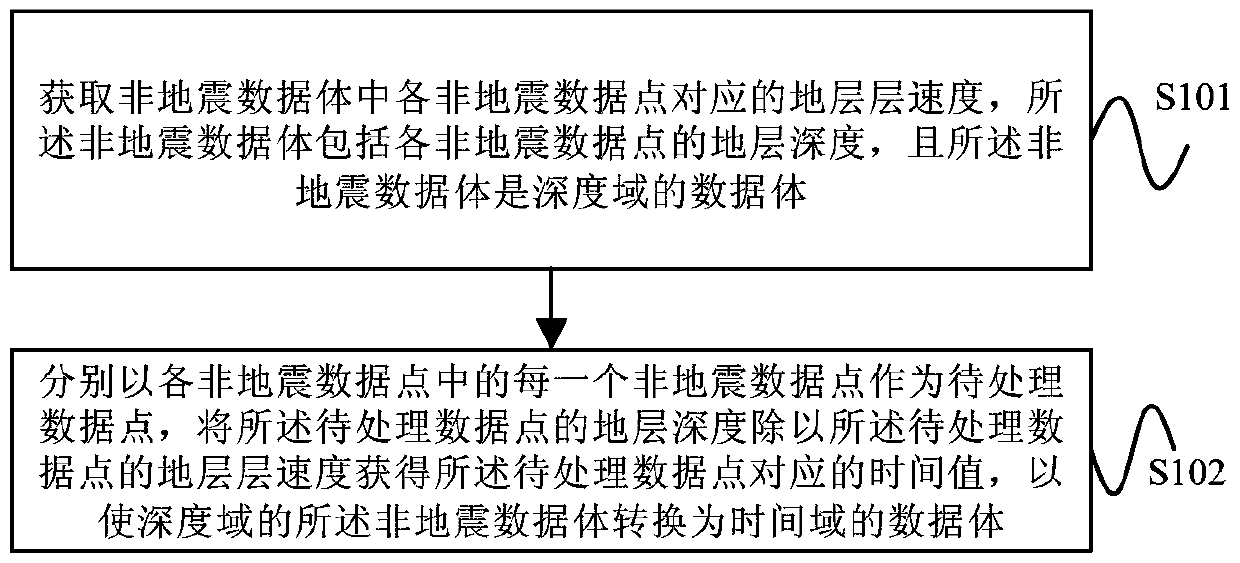
Figure 1 
Figure 2 
Figure 3
Abstract
Description
technical field
[0001] Embodiments of the present invention relate to the technical field of oil and gas exploration and geophysical prospecting, in particular to a method and device for processing non-seismic data volumes. Background technique
[0002] In the process of oil and gas exploration, it is necessary to carry out lithology identification and characterization of lithology and lithofacies.
[0003] In the existing technology, the conglomerate is characterized by the joint inversion technology of 3D seismic and 3D electrical method, specifically, the conglomerate is characterized by the wave impedance inversion of the seismic data constrained by the conglomerate frame identified by the 3D electrical method data. Among them, the 3D Electrical data is a data body in the depth domain, and seismic data is a data body in the time domain.
[0004] The combined inversion of 3D seismic and 3D electrical methods using 3D electrical data in the depth domain and seismic data i...
Examples
Embodiment Construction
[0023] figure 1 It is a flow chart of the non-seismic data volume processing method provided by the embodiment of the present invention. The embodiment of the present invention aims at the problem of low precision of conglomerate description, and provides a non-seismic data volume processing method, and the specific steps are as follows:
[0024] Step S101, obtaining the stratum velocity corresponding to each non-seismic data point in the non-seismic data volume, the non-seismic data volume includes the stratum depth of each non-seismic data point, and the non-seismic data volume is a data volume in the depth domain;
[0025] In the embodiment of the present invention, the non-seismic data volume is specifically a three-dimensional electrical data volume, and the three-dimensional electrical data volume includes a plurality of non-seismic data points, and each non-seismic data point corresponds to a resistivity value corresponding to the non-seismic data point. The depth of t...