

Preparation method of ropivacaine hydrochloride impurity F
A technology for ropivacaine hydrochloride and impurities, which is applied in the field of chemical synthesis, can solve the problems such as the synthetic method of impurity F that is not reported in public materials, and achieves the effects of high product purity, short synthesis route, and solving the difficult problem of quality control.
Patent Information
- Authority / Receiving Office
- CN · China
- Current Assignee / Owner
- Publication Date
- 2016-06-08
Smart Images
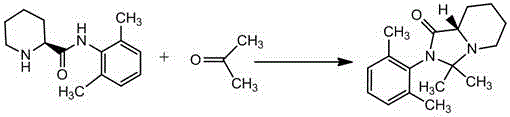
Figure 1
Abstract
Description
technical field
[0001] The invention belongs to the technical field of chemical synthesis, in particular to a ropivacaine hydrochloride impurity F(8aS)-2-(2,6-dimethylphenyl)-3,3-dimethyl-imidazo[1, 5-a] Process for the preparation of pyridin-1(5H)-one. Background technique
[0002] Ropivacaine hydrochloride is a new type of long-acting amide local anesthetic, which went on the market in 1996 and was developed by the Swedish Astra Pain Control Center. The chemical name is (-)-(2S)-N-(2,6-dimethylphenyl)-1-n-propylpiperidine-2-carboxamide hydrochloride, and the trade name is Naropin. Ropivacaine hydrochloride is a new generation of long-acting, safe local anesthetic; used for surgical anesthesia, midwifery procedures, local or regional anesthesia, and the treatment of acute or postoperative pain.
[0003] The impurity of ropivaca hydrochloride is mainly its degradation product, which has certain toxicity, so its content should be strictly controlled. There are 8 impurities...
Examples
Embodiment 1
[0022] Add 100 g of acetone and 20 g of (S)-N-(2',6'-xylyl)-2-piperidinecarboxamide into a 250ml clean three-neck flask equipped with mechanical stirring, stir and heat to dissolve all the solids. Then 5 g of acetic acid was added, and the temperature continued to rise to reflux. After 5 hours of reaction, the raw materials were basically reacted by TLC (TLC conditions: dichloromethane: methanol = 10:1). Start to slowly evaporate the solvent under normal pressure. After the solvent distillation, add 300 g of deionized water at 50°C to the residue to slowly precipitate solids, and then adjust the pH to 9 with sodium hydroxide solution. After filtering, the filter cake was washed with deionized water and dried to obtain 19 g of crude product with a liquid phase purity greater than 97%. Add 19g of the crude product to 76g of ethanol, heat and reflux for 30 minutes to dissolve the solid; cool to room temperature, filter, and dry the filter cake to obtain 15.3g of impurity F pure p...
Embodiment 2
[0024] Add 200g of acetone and 25g of (S)-N-(2',6'-xylyl)-2-piperidinecarboxamide into a 500ml clean three-neck flask equipped with mechanical stirring, stir and heat to dissolve all the solids. Then 15 g of concentrated hydrochloric acid was added, and the temperature was continued to reflux. After 10 hours of reaction, the raw materials were basically reacted by TLC (TLC conditions: dichloromethane: methanol = 10:1). Start to slowly evaporate the solvent under normal pressure. After the solvent distillation is completed, add 375 g of deionized water at 50°C to the residue to slowly precipitate a solid, and then adjust the pH value to 9 with sodium hydroxide solution. Filter, wash the filter cake with deionized water, and dry to obtain 24 g of crude product, the liquid phase purity is greater than 96%. Add 24g of the crude product to 168g of methyl isobutyl ketone, heat and reflux for 30 minutes to dissolve the solid; cool to room temperature, filter, and dry the filter cake ...
Embodiment 3
[0026] Add 75g of acetone and 25g of (S)-N-(2',6'-xylyl)-2-piperidinecarboxamide into a 250ml clean three-neck flask equipped with mechanical stirring, stir and heat to dissolve all the solids. Then add 2.5 g of sulfuric acid, continue to heat up to reflux, and react for 8 hours, and the raw materials are basically reacted by TLC (TLC conditions: dichloromethane: methanol = 10:1). Start to slowly evaporate the solvent under normal pressure, add 375 g of deionized water at 50°C to the residue after solvent distillation, and slowly precipitate solids, then adjust the pH value to 9 with sodium hydroxide solution. Filter, wash the filter cake with deionized water, and dry to obtain 25 g of crude product, the liquid phase purity is greater than 96%. Add 25g of the crude product into 50g of acetonitrile, heat and reflux for 30 minutes to dissolve the solid; cool to room temperature, filter, and dry the filter cake to obtain 19.4g of impurity F pure product; the liquid phase purity i...