
Device and method for inhibiting turbidity of liquid maltitol
A maltitol and liquid technology, applied in the field of functional sugar production, can solve the problems of easy turbidity, short storage period, increased cost and the like during the storage process of liquid maltitol, and achieve the effects of avoiding turbidity of liquid maltitol, low cost, and not easy to become turbid.
Patent Information
- Authority / Receiving Office
- CN · China
- Patent Type
- Applications(China)
- Current Assignee / Owner
- Publication Date
- 2017-01-25
Smart Images
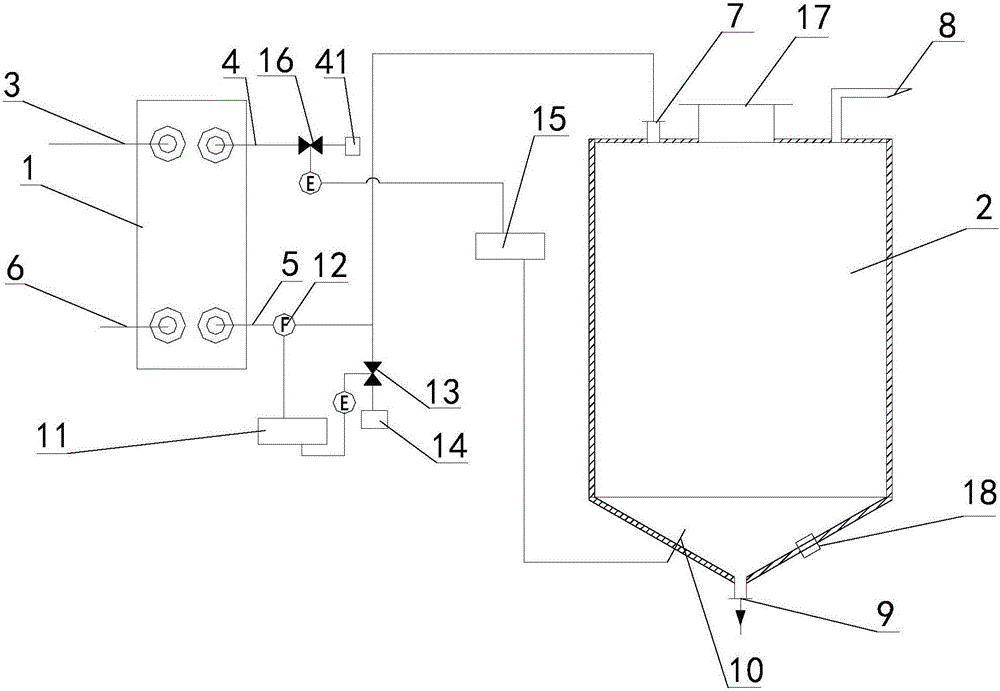
Figure 1
Abstract
Description
technical field
[0001] The invention relates to the field of functional sugar production, in particular to a device and method for suppressing turbidity of liquid maltitol. Background technique
[0002] Maltitol is a new type of functional sweetener, because of its low-calorie, non-carious, indigestible, calcium absorption promotion and other physiological properties, it has attracted widespread attention and is widely used in food industry. Maltitol is a white crystalline powder or a colorless transparent neutral viscous liquid, and the latter is the liquid maltitol mentioned in the present invention, which is obtained from starch through pulping, liquefaction, saccharification, hydrogenation, purification and separation, and concentration . Since the nitrogen-containing substances in starch cannot be completely removed during the purification and separation process, and the liquefaction and saccharification processes cannot fully enzymatically hydrolyze the starch, leavi...
Examples
Embodiment 1
[0048] like figure 1 As shown, the heat exchanger 1 adopts a plate heat exchanger.
[0049] (1) Add liquid maltitol with a temperature of 25°C and a light transmittance of 99.0% or more at 420nm detected by a spectrophotometer into the heat exchanger through the feed liquid inlet, while the thermocouple in the storage tank detects the temperature in the storage tank, and The second flow control solenoid valve is controlled by the second PID module to open. At this time, the heat source inlet is passed into the heat exchanger. The heat source is the waste heat of evaporation and concentration, and the temperature of the liquid maltitol is regulated at 50°C through the heat exchanger;
[0050] (2) The liquid maltitol after the temperature control of the heat exchanger in step (1) enters the storage tank through the feed hole, and the electronic flowmeter detects the feed volume of the liquid maltitol, and according to the density of the liquid maltitol, it can be converted Obta...
Embodiment 2
[0054] like figure 1 As shown, the heat exchanger 1 adopts a shell-and-tube heat exchanger.
[0055] (1) Add liquid maltitol with a temperature of 20°C and a light transmittance of 97.0% or more at 420nm detected by a spectrophotometer into the heat exchanger through the feed liquid inlet, while the thermocouple in the storage tank detects the temperature in the storage tank, and The second flow control solenoid valve is controlled by the second PID module to open. At this time, the heat source inlet leads to the heat source into the heat exchanger. The heat source is fresh steam, and the temperature of the liquid maltitol is controlled at 40°C through the heat exchanger;
[0056] (2) The liquid maltitol after the temperature control of the heat exchanger in step (1) enters the storage tank through the feed hole, and the electronic flowmeter detects the feed volume of the liquid maltitol, and according to the density of the liquid maltitol, it can be converted Obtain the qual...
Embodiment 3
[0060] like figure 1 As shown, the heat exchanger 1 adopts a shell-and-tube heat exchanger.
[0061] (1) Add liquid maltitol with a temperature of 55°C and a light transmittance of 99.5% or more at 420nm detected by a spectrophotometer into the heat exchanger through the feed liquid inlet, while the thermocouple in the storage tank detects the temperature in the storage tank, and The second flow control solenoid valve is controlled by the second PID module to open. At this time, the heat source inlet leads to the heat source into the heat exchanger. The heat source is fresh steam, and the temperature of the liquid maltitol is controlled at 70°C through the heat exchanger;
[0062] (2) The liquid maltitol after the temperature control of the heat exchanger in step (1) enters the storage tank through the feed hole, and the electronic flowmeter detects the feed volume of the liquid maltitol, and according to the density of the liquid maltitol, it can be converted Obtain the qual...