
Catalyst for preparation of aliphatic polycarbonate by reaction of carbon dioxide and cyclohexene oxide and catalysis method
A technology for oxidizing cyclohexene and carbon dioxide, which is applied in the field of organic synthesis, can solve problems such as single industrial structure, and achieve the effects of high catalytic efficiency, mild catalytic reaction conditions, and convenient operation
Patent Information
- Authority / Receiving Office
- CN · China
- Patent Type
- Applications(China)
- Current Assignee / Owner
- Publication Date
- 2018-02-23
Smart Images
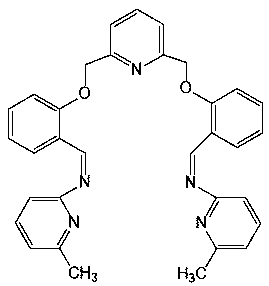
Figure 1
Abstract
Description
technical field
[0001] The invention belongs to the technical field of organic synthesis, and in particular relates to a catalyst and a catalytic method for preparing aliphatic polycarbonate by reacting carbon dioxide and cyclohexene oxide. Background technique
[0002] With the development of the global economy and the rapid increase of the world population, carbon resources with limited reserves on the earth, such as coal, oil and natural gas, are constantly being consumed. One day, human beings will face the grim reality of exhaustion of existing carbon resources and energy. It is urgent to find new carbon sources. In addition, the excessive development and use of these non-renewable carbon resources has led to an increase in the emission of carbon dioxide into the atmosphere, causing a series of serious consequences such as the "greenhouse effect". At the same time, carbon dioxide is also a recyclable carbon source, and its reserves are more than the sum of coal, oil, ...
Examples
Embodiment 1
[0023] The preparation method of catalyst 2,6-bis(2-formylphenoxymethyl)pyridine 2-amino-6-picoline zinc complex is as follows:
[0024] (1) Dissolve 1.08g (0.01mol) of 2-amino-6-methylpyridine and 1.74g (0.005mol) of 2,6-bis(2-formylphenoxymethyl)pyridine in 15mL of methanol, at room temperature Add the methanol solution of 2-amino-6-methylpyridine dropwise to the methanol solution of 2,6-bis(2-formylphenoxymethyl)pyridine, heat to reflux after the dropwise addition, and continue to stir for 2h. The precipitate was filtered off, washed with ether, and dried to obtain 2,6-bis(2-formylphenoxymethyl)pyridinyl 2-amino-6-picoline ligand; 2,6-bis( The structural formula of 2-formylphenoxymethyl)pyridine 2-amino-6-picoline ligand is
[0025]
[0026] Structural characterization of ligands: 1 H NMR (400 MHz, CDCl 3 ): δ 2.67(s, 6H, -CH 3 ), 5.82(s,4H, -CH 2 ), 6.8~8.6(m, 17H, aromatic H), 8.83(s, 2H, -CH);
[0027] (2) Weigh 0.1mol of 2,6-bis(2-formylphenoxymethyl)pyridine 2...
Embodiment 2
[0029] The preparation method of catalyst 2,6-bis(2-formylphenoxymethyl)pyridine 2-amino-6-picoline zinc complex is as follows:
[0030] (1) Dissolve 1.08g (0.01mol) of 2-amino-6-methylpyridine and 1.91g (0.0055mol) of 2,6-bis(2-formylphenoxymethyl)pyridine in 15mL of methanol, at room temperature Add the methanol solution of 2-amino-6-methylpyridine dropwise to the methanol solution of 2,6-bis(2-formylphenoxymethyl)pyridine, heat to reflux after the dropwise addition, and continue to stir for 1h. The precipitate was filtered out, washed with ether, and dried to obtain 2,6-bis(2-formylphenoxymethyl)pyridine 2-amino-6-picoline ligand;
[0031](2) Weigh 0.1mol of 2,6-bis(2-formylphenoxymethyl)pyridine 2-amino-6-picoline ligand into a container, vacuumize, fill with nitrogen, and under the protection of nitrogen, Add 200mL toluene to dissolve the bis-2,6-bis(2-formylphenoxymethyl)pyridine 2-amino-6-picoline ligand, and add toluene containing 0.13mol diethylzinc under ice-salt ba...
Embodiment 3
[0033] The method for preparing aliphatic polycarbonate by using catalyst 2,6-bis(2-formylphenoxymethyl)pyridinium 2-amino-6-picoline zinc to catalyze the reaction of carbon dioxide and cyclohexene oxide, the steps are as follows:
[0034] (1) Put 0.10g of the 2,6-bis(2-formylphenoxymethyl)pyridinium 2-amino-6-picoline zinc catalyst prepared in Example 1 into a vacuum-dried autoclave (high pressure A stirring bar is placed in the reaction kettle), vacuum-dried at 100°C for 1 hour, cooled to room temperature, filled with carbon dioxide to normal pressure; 10.42mL (10g) cyclohexene oxide was added to the reaction kettle, and the temperature was raised to 150 ℃, fill with carbon dioxide, keep the pressure at 4MPa, stir with magnetic force, after reacting for 30h, cool to room temperature, stop the reaction;
[0035] (2) Take out the reaction solution, distill off the unreacted cyclohexene oxide, dissolve the residue with dichloromethane, filter, wash the filtrate with dilute acid...