
Periosteum material with tissue oxygenation function and its preparation method and application
A technology of periosteum and tissue, which is applied in the field of polylactic acid-glycolic acid copolymer PLGA particles, periosteum material and its preparation, and periosteum material prepared by electrospinning method. Slow speed and other problems, to achieve the effect of benefiting bone cell growth and bone tissue repair, simple process and high safety
Patent Information
- Authority / Receiving Office
- CN · China
- Patent Type
- Patents(China)
- Current Assignee / Owner
- Publication Date
- 2021-06-04
Smart Images
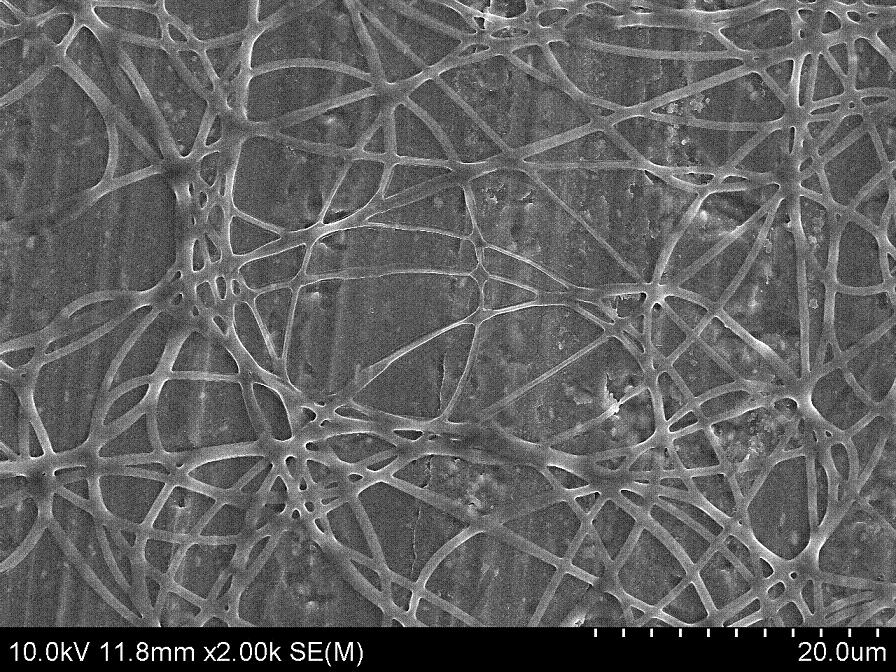
Figure 1
Abstract
Description
technical field
[0001] The invention relates to a periosteum material with tissue oxygenation function and its preparation method and application, in particular to poly(racemic lactic acid-caprolactone) PDLLA added with perfluoro-n-octyl bromide (PFOB) loaded polylactic acid- Glycolic acid copolymer PLGA particles, periosteal material prepared by electrospinning. The method belongs to the field of biomedical materials, and the prepared materials can be widely used in the repair of periosteum tissue. Background technique
[0002] Periosteum is a dense connective tissue membrane that covers almost all bone surfaces except joints. It consists of an outer fibrous layer and an inner cambium, and plays an important role in bone development and fracture healing. The fibrous layer is rich in vascular network, nerves, fibrous cells, collagen and elastic fibers, which makes the bone active and provides the mechanical stability of the periosteum, which is the key to osteogenesis; the ...
Examples
Embodiment 1
[0026] 1. Preparation of PLGA-coated PFOB particles (PLGA-PFOB)
[0027] Dissolve 5 mg PLGA, 5 mg polylactic-co-glycolic acid-polyethylene glycol (PLGA-PEG), 200 μl Span 80 (S80) / dichloromethane (DCM) (3 / 17, volume ratio) in 200 μl DCM, then mixed with 2 ml of water, and 30 μl / ml of PFOB with a purity greater than 99% was added. Homogenize with a homogenizer for 1 min (ice bath), then sonicate for 3 min, 3 s and 10 s off, at 50% power. Homogenize with a homogenizer for 10 min (homogenize for 1 min and stop for 1 min) and then stir at room temperature for 3 h. Oxygenate the emulsion with medical oxygen for 10 minutes.
[0028] 2. Preparation of electrospinning solution
[0029] Add 0.6 g of poly(racemic lactic acid-caprolactone) copolymer (PDLLA-CL) to 10 ml of solvent dichloromethane: dimethylformamide (DMF) = 7:3 (V / V), stir magnetically at room temperature for 8 Hours; 2 ml of PLGA-PFOB solution was added thereto, and ultrasonication was performed for 10 minutes to obtai...
Embodiment 2
[0034] 1. Preparation of PLGA-coated PFOB particles (PLGA-PFOB)
[0035] Dissolve 1 mg PLGA, 1 mg polylactic-co-glycolic acid-polyethylene glycol (PLGA-PEG), 40 μl Span 80 (S80) / dichloromethane (DCM) (3 / 17, volume ratio) in 40 μl DCM, then mixed with 0.4 ml of water, and 20 μl / ml of PFOB with a purity greater than 99% was added. Homogenize with a homogenizer for 1 min (ice bath), then sonicate for 3 min, 3 s and 10 s off, at 50% power. Homogenize with a homogenizer for 10 min (homogenize for 1 min and stop for 1 min) and then stir at room temperature for 3 h. Oxygenate the emulsion with medical oxygen for 5 minutes.
[0036] 2. Preparation of electrospinning solution
[0037] Add 0.3 g of poly(racemic lactic acid-caprolactone) copolymer (PDLLA-CL) to 5 ml of solvent dichloromethane: dimethylformamide (DMF) = 7:3 (V / V), stir magnetically at room temperature 10 hours; 0.5 ml of PLGA-PFOB solution was added thereto and ultrasonicated for 10 minutes to obtain a spinning soluti...
Embodiment 3
[0041] 1. Preparation of PLGA-coated PFOB particles (PLGA-PFOB)
[0042] Dissolve 5 mg PLGA, 5 mg polylactic-co-glycolic acid-polyethylene glycol (PLGA-PEG), 200 μl Span 80 (S80) / dichloromethane (DCM) (3 / 17, volume ratio) in 200 μl DCM, then mixed with 2 ml of water, and 150 μl / ml of PFOB with a purity greater than 99% was added. Homogenize with a homogenizer for 1 min (ice bath), then sonicate for 3 min, 3 s and 10 s off, at 50% power. Homogenize with a homogenizer for 10 min (homogenize for 1 min and stop for 1 min) and then stir at room temperature for 3 h. Oxygenate the emulsion with medical oxygen for 10 minutes.
[0043] 2. Preparation of electrospinning solution
[0044] Add 0.6 g of poly(racemic lactic acid-caprolactone) copolymer (PDLLA-CL) to 10 ml of solvent dichloromethane: dimethylformamide (DMF) = 7:3 (V / V), stir magnetically at room temperature for 7 Hours; 3 ml of PLGA-PFOB solution was added thereto, and ultrasonication was performed for 10 minutes to obta...