
Novel antioxidation silane coupling agent containing hindered phenol structure and preparation method of novel antioxidation silane coupling agent
A technology of oxysilane coupling agent and silane coupling agent, which is applied in the field of new anti-oxygen silane coupling agent and its preparation, can solve the problems affecting polymer performance, no pollution, easy hydrolysis, etc., and achieve the effect of reducing surface energy
Patent Information
- Authority / Receiving Office
- CN · China
- Patent Type
- Applications(China)
- Current Assignee / Owner
- Publication Date
- 2018-08-24
- Estimated Expiration
- Not applicable · inactive patent
Smart Images
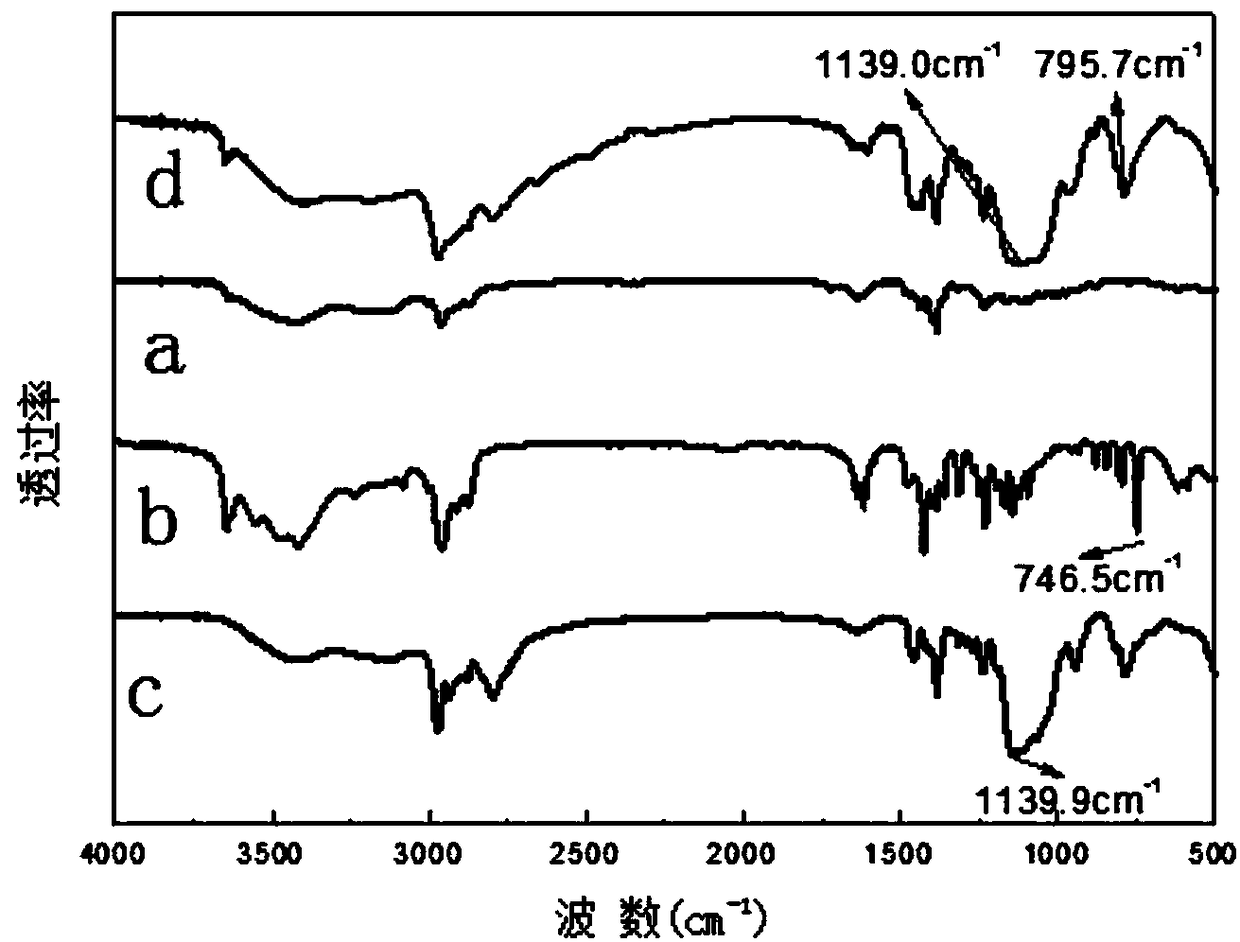
Figure 1 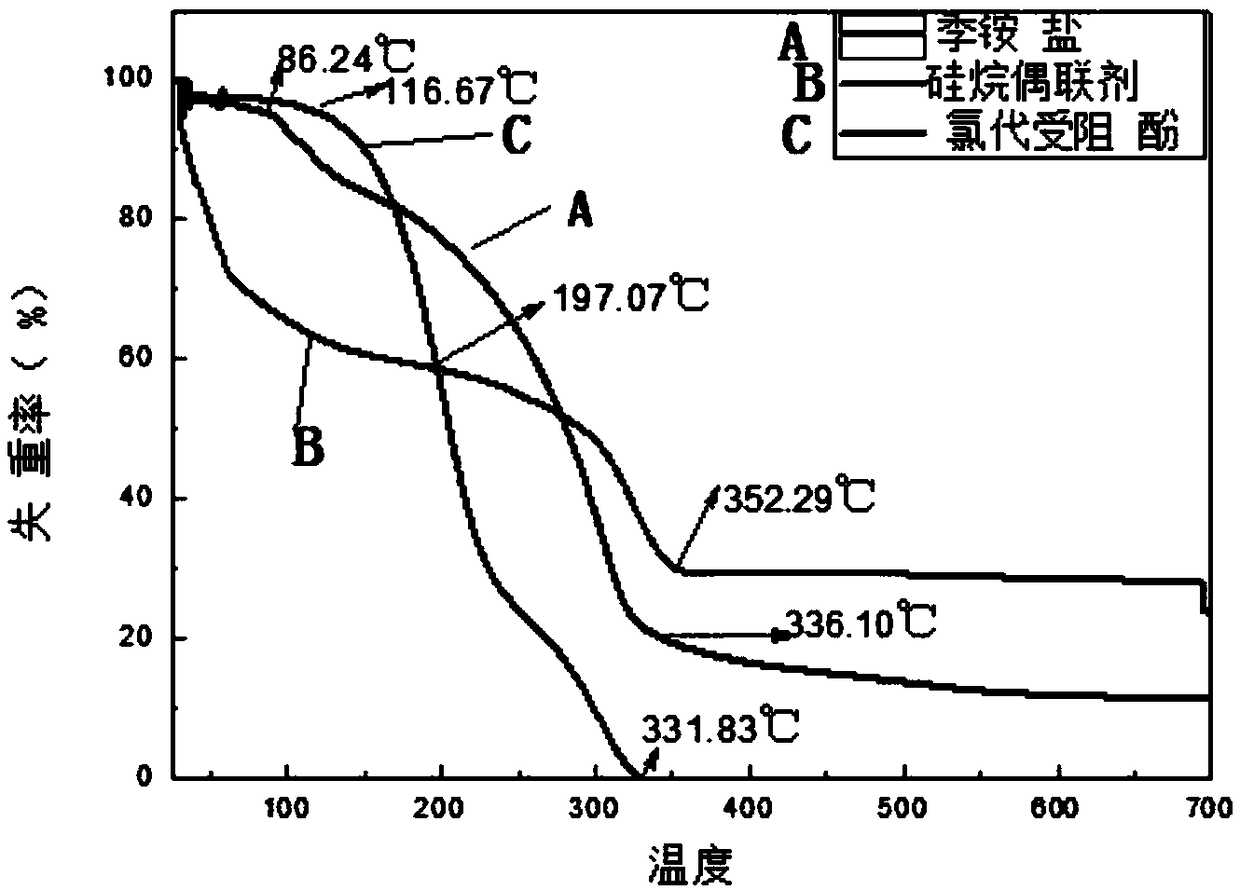
Figure 2 
Figure 3
Abstract
Description
Technical field
[0001] The invention relates to a coupling agent and a preparation method thereof, in particular to a novel antioxidant silane coupling agent containing a hindered phenol structure and a preparation method thereof. Background technique
[0002] Silane coupling agent is an organic-inorganic hybrid bifunctional compound. Due to this unique property, it can not only chemically bond with organic substances, but also interact with inorganic substances, combining organic substances with inorganic substances. The substances are firmly linked together and act as a chemical bridge. Silane coupling agents are used to improve the interface between inorganic and organic substances, and can improve the compression resistance, high temperature resistance, wear resistance and other properties of composite materials. In the polymer industry, the use of inorganic fillers can reduce costs and increase various properties of polymers. Common inorganic fillers such as calcium carbon...
Examples
Embodiment 1
[0016] (1) Benzyl chloride hindered phenol The preparation method is the same as CN104744813A.
[0017] (2) Synthesis of a new type of silane coupling agent for hindered phenol: in N 2 Under protection, add 10 parts of the above synthetic benzyl chloride hindered phenol, 5 parts of dimethyl sulfoxide, and 10 parts of diethylaminomethyl triethoxy into a 250mL three-necked flask equipped with mechanical stirring, condenser and thermometer. Silane Raise the oil temperature to 80℃, react for 10-48h, wash with 20 parts of petroleum ether, vacuum dry at 30℃ for 12h to obtain the hindered phenol new silane coupling agent, fractionate and recover the solvent, label it as hindered phenol new silane coupling agent 1
[0018] Infrared analysis of the synthesized hindered phenol new silane coupling agent (FT-IR, figure 1 ) And thermogravimetry (TG, figure 2 )analysis. Correct figure 1 Conduct analysis by figure 1 The curves a and b show that the wave number is 2980cm -1 The peaks on the l...
Embodiment 2
[0025] The difference between this example and Example 1 is that in the synthesis step (1) of the hindered phenol novel silane coupling agent 1, the temperature is changed to 90°C, the reaction time is 8h, and the diethylaminomethyltriethoxysilane is changed to 12 parts, 10 parts of solvent, 40 parts of petroleum ether. The vacuum drying temperature is 25°C, and the drying time is 14h; (2) The processing ingredients are changed to adding 0.25 parts of the hindered phenol new silane coupling agent to 30 parts by mass of calcium carbonate, and the modification process is 70°C high-speed stirring for 20 minutes.
[0026] See Table 1 for resistance to thermal oxidative aging. It can be seen from Table 1 that the random copolymer polypropylene added with 0.25 parts of hindered phenol new silane coupling agent modified calcium carbonate has a slight increase in melt index after different times of extrusion, but the change is not large, indicating random The molecular chain of copolyme...
Embodiment 3
[0029] The difference between this embodiment and Example 1 is that in the synthesis step (1) of the hindered phenol novel silane coupling agent 1, the temperature is changed to 100°C, the reaction time is 12h, and the amount of diethylaminomethyltriethoxysilane is 15 parts. , The solvent is changed to 20 parts of toluene and 50 parts of petroleum ether. Vacuum drying temperature is 45℃, drying time is 10h; (2) The processing ingredients are changed to add 0.1 part of hindered phenol new silane coupling agent 1 to 30 mass parts of calcium carbonate, and the modification process is 80℃ and high-speed stirring for 25 minutes .
[0030] See Table 1 for resistance to thermal oxidative aging. It can be seen from Table 1 that the random copolymer polypropylene with 0.1 part of hindered phenol new silane coupling agent 1 modified calcium carbonate has a slight increase in melt index after different times of extrusion, but the change is not large, indicating no The molecular chain of r...