
Dendranthema indicum extract and application
A technology of Shennong Xiangju and its extract, applied in the biological field, can solve the problems such as the uric acid-lowering effect of Shennong Xiangju which has not been reported, and achieve the effect of good medicinal efficacy and application prospect.
Patent Information
- Authority / Receiving Office
- CN · China
- Current Assignee / Owner
- Publication Date
- 2018-09-14
- Estimated Expiration
- Not applicable · inactive patent
Smart Images
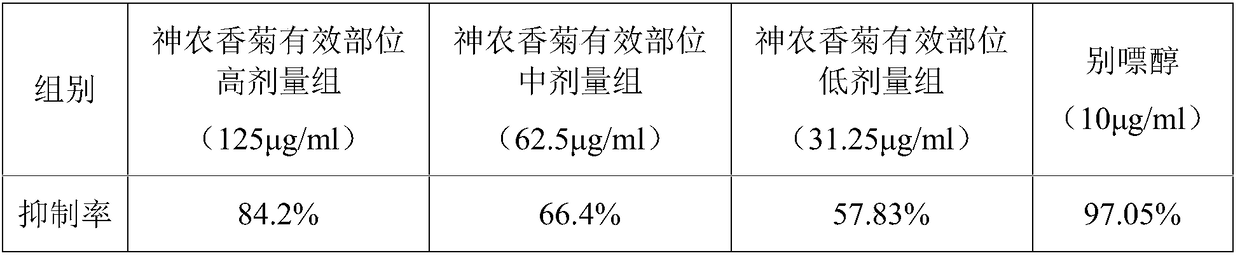
Figure 1
Abstract
Description
technical field
[0001] The invention belongs to the field of biotechnology, and more specifically relates to an extract of Shennong Fragrant Chrysanthemum and its application. Background technique
[0002] Hyperuricemia refers to the level of blood uric acid on an empty stomach twice on different days under a normal purine diet: men > 420 μmol / L, women > 360 μmol / L. With socioeconomic development and changes in lifestyle, the prevalence of hyperuricemia is on the rise worldwide. In the 1980s, the prevalence of hyperuricemia in European and American countries was 2% to 18%. In 2006, a survey in the Beijing area showed that the prevalence rate of males was 13.8%, and that of females was 6.00%. In some areas, the prevalence rate of adult males even reached 22.6%. According to reports on the prevalence of hyperuricemia in various places in recent years, it is conservatively estimated that there are about 120 million patients in my country, accounting for about 10% of the...
Examples
Embodiment 1
[0025] Example 1 verifies the effect of Shennong Fragrant Chrysanthemum Extract on inhibiting xanthine oxidase activity
[0026] 1. Sample preparation: take the medicinal dregs after extracting volatile oil from Shennong Xiangju as raw material, dry and pulverize them, add 8 times of 75% ethanol, stir, heat and reflux for extraction for 1.5 hours, separate solid and liquid, collect the filtrate, and further add 8 Double the amount of 75% ethanol; stir and heat at 50-60°C for reflux extraction for 1.5 hours, separate the solid and liquid, and collect the filtrate; combine the filtrate, concentrate under reduced pressure to remove ethanol, extract with petroleum ether and ethyl acetate sequentially, and concentrate the ethyl acetate layer to obtain Extract; the ethyl acetate part was separated by MCI gel resin column, eluted with 30%, 75%, and 95% ethanol respectively, and the eluents were collected, concentrated and dried to obtain component A, component B, and component C. It ...
Embodiment 2
[0038] Example 2 Verification of the Uric Acid-lowering Activity of Shennong Fragrant Chrysanthemum Extract
[0039] In this example, using allopurinol as a model control, an animal experiment on reducing uric acid in vivo was carried out to verify the uric acid-lowering activity of the extract of Shennong Fragrant Chrysanthemum.
[0040] (1) Weigh an appropriate amount of potassium oxonate, suspend it with 0.5% CMC-Na solution, and prepare a 12.5 mg / mL modeling solution (wherein, CMC-Na is sodium carboxymethyl cellulose, which is natural cellulose The cellulose derivative obtained after chemical modification is a kind of carboxymethyl etherification of cellulose).
[0041] (2) Take 60 test mice (Kunming species, male mice) and randomly divide them into 6 groups according to body weight, 10 in each group, and set them as blank control group, model control group, allopurinol group, and Shennong Xiangju group respectively. The high-dose group of effective parts, the middle-dose...