

An Exponential Local Active Memristor Simulator
A memristor, exponential technology used in circuit design
Patent Information
- Authority / Receiving Office
- CN · China
- Patent Type
- Patents(China)
- Current Assignee / Owner
- Publication Date
- 2022-03-01
Smart Images
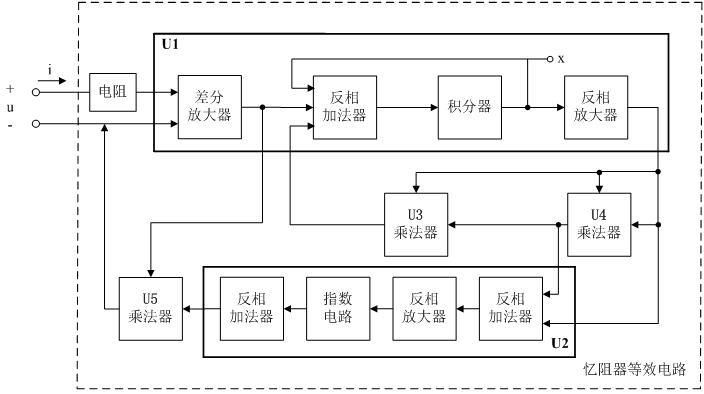
Figure 1 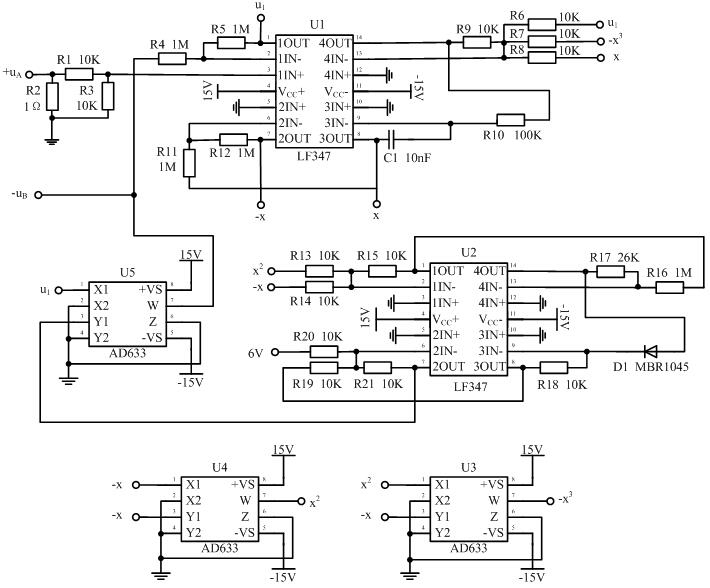
Figure 2 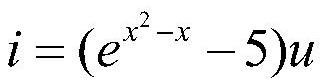
Figure 3
Abstract
Description
technical field
[0001] The invention belongs to the technical field of circuit design, and relates to an exponential local active memristor emulator, in particular to the design and realization of an exponential local active memristor emulator. Background technique
[0002] Memristor has non-volatile properties and can be applied in fields such as non-volatile memory, artificial neural network and circuit design. On the basis of memristors, Professor Cai Shaotang proposed the concept of local active memristors. Local active memristors have richer and more complex dynamic behaviors, which are the root cause of the complexity of nonlinear circuits and the maintenance of oscillations. Compared with passive memristors, the research on local active memristors is relatively less. Therefore, it is of great significance to design a simulator of local active memristor and use it to replace the actual memory device for experiment and application research. Contents of the invention ...
Examples
Embodiment Construction
[0013] The preferred embodiments of the present invention will be described in detail below in conjunction with the accompanying drawings.
[0014] The theoretical starting point of the present invention is an expression of an exponential local active memristor mathematical model deduced from the general voltage-controlled memristor mathematical model:
[0015]
[0016] dx / dt=-x 3 +x+u
[0017] Among them, i and u are the current and voltage of the memristor, and x is the state variable of the memristor.
[0018] Such as figure 1 As shown, the emulator circuit of the exponential local active memristor in this embodiment includes an integrated operational amplifier U1, an integrated operational amplifier U2, a multiplier U3, a multiplier U4, a multiplier U5, and component resistors, capacitors, and diodes. Operational amplifier U1 is used to realize differential amplification operation, inverting addition operation, integral operation and inverting amplification operation...