
Preparation method for 1, 2, 3, 4-cyclopentane tetracarboxylic acid dianhydride
A technology of cyclopentane tetracarboxylic acid and dicarboxylic anhydride, which is applied in the field of fine chemicals, and can solve the problems of violent exothermic reaction and runaway
Patent Information
- Authority / Receiving Office
- CN · China
- Current Assignee / Owner
- Publication Date
- 2019-04-16
- Estimated Expiration
- Not applicable · inactive patent
Smart Images
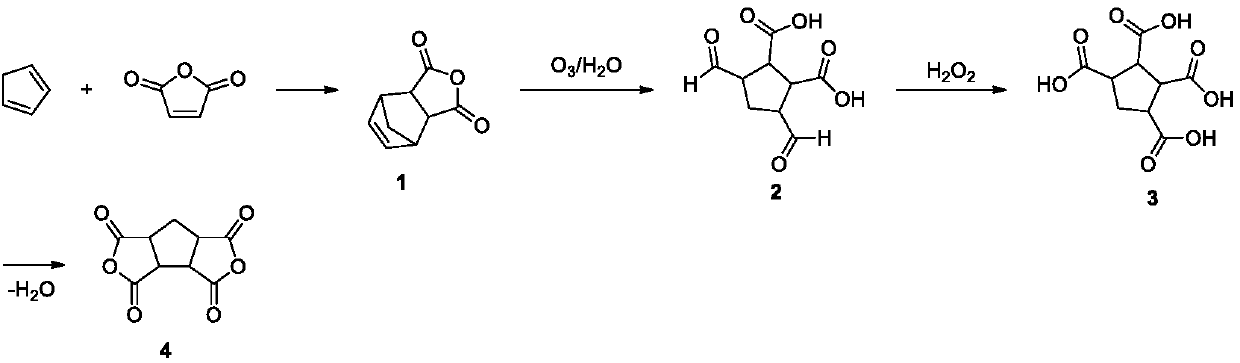
Figure 1
Abstract
Description
technical field
[0001] The invention belongs to the field of fine chemicals, in particular to a preparation method of 1,2,3,4-cyclopentane tetracarboxylic dianhydride. Background technique
[0002] 1,2,3,4-Cyclopentane tetracarboxylic dianhydride has been widely used so far as a raw material for preparing polymers such as polyimide, polyester, and epoxy resin. Polyimide material prepared from alicyclic 1,2,3,4-cyclopentane tetracarboxylic dianhydride and other diamine monomers, with good mechanical properties, excellent heat resistance, excellent light transmission Performance, stable chemical corrosion resistance, high radiation resistance, low thermal expansion coefficient, excellent dielectric properties, etc., are widely used in electrical insulation materials, photosensitive materials, alignment film materials of liquid crystal displays and microelectronics, etc. field.
[0003] In the prior art, there are few reports on the synthesis of 1,2,3,4-cyclopentane tetracarb...
Examples
Embodiment 1
[0021] Put 98.00g (1.00mol) of maleic anhydride in the reactor, add 300.00g of ethyl acetate to dissolve, slowly add 72.71g (1.10mol) of cyclopentadiene dropwise at low temperature, control the reaction temperature -10°C, and react During the process, white crystals were continuously precipitated. After the cyclopentadiene was added dropwise, the reaction was completed. After filtration and vacuum drying, 157.60 g of white solids were obtained, with a yield of 96.10%.
[0022] Place 157.60g (0.96mol) of 5-norbornene-2,3-dicarboxylic acid anhydride in the bubble reactor, add 800.00g of acetic acid and 160.00g of distilled water to dissolve it, at low temperature, from the bubble reactor Ozone gas was continuously fed into the bottom, and the reaction temperature was controlled at 0°C. After 6 hours of reaction, TLC detected that the raw materials had reacted completely, and the reaction was stopped. The prepared crude product was directly carried out to the next step without tre...
Embodiment 2
[0026] Put 98.00g (1.00mol) of maleic anhydride in the reactor, add 300.00g of ethyl acetate to dissolve, slowly add 72.71g (1.10mol) of cyclopentadiene dropwise at low temperature, control the reaction temperature -0°C, and react During the process, white crystals were continuously precipitated. After the cyclopentadiene was added dropwise, the reaction was completed. After filtration and vacuum drying, 156.35 g of white solids were obtained, with a yield of 95.24%.
[0027] Put 156.35g (0.95mol) of 5-norbornene-2,3-dicarboxylic anhydride in the bubble reactor, add 700.00 formic acid and 150.00g of distilled water to dissolve it, at low temperature, from the bottom of the bubble reactor Ozone gas was continuously introduced, and the reaction temperature was controlled at 5°C. After 7 hours of reaction, TLC detected that the raw materials were completely reacted, and the reaction was stopped, and the prepared crude product was directly carried out to the next step without treat...
Embodiment 3
[0031] Put 98.00g (1.00mol) maleic anhydride in the reactor, add 300.00g ethyl acetate to dissolve, slowly add 72.71g (1.10mol) cyclopentadiene dropwise at low temperature, control the reaction temperature at 10°C, the reaction process White crystals were continuously precipitated, and the reaction ended after cyclopentadiene was added dropwise. After filtration and vacuum drying, 153.31 g of white solids were obtained, with a yield of 93.48%.
[0032] Put 153.31g (0.93mol) of 5-norbornene-2,3-dicarboxylic acid anhydride in the bubble reactor, add 600.00g of ethanol and 150.00g of distilled water to dissolve it, at low temperature, from the bottom of the bubble reactor Ozone gas was continuously introduced, and the reaction temperature was controlled at 10°C. After 7.5 hours of reaction, TLC detected that the raw materials had reacted completely, and the reaction was stopped, and the prepared crude product was directly carried out to the next step without treatment.
[0033] P...