

Negative electrode slurry, negative electrode plate and preparation method of negative electrode plate
A negative electrode slurry and dry material technology, applied in the direction of negative electrodes, battery electrodes, active material electrodes, etc., can solve the problems of low peel strength of electrode sheets, poor low-temperature discharge and cycle performance of lithium-ion batteries, and improve flexibility And peel strength, good wetting, good dispersion effect
Patent Information
- Authority / Receiving Office
- CN · China
- Patent Type
- Applications(China)
- Current Assignee / Owner
- Publication Date
- 2020-08-07
Smart Images
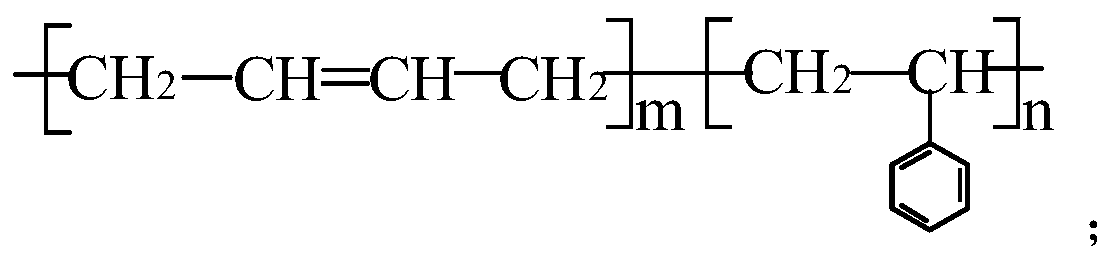
Figure 1 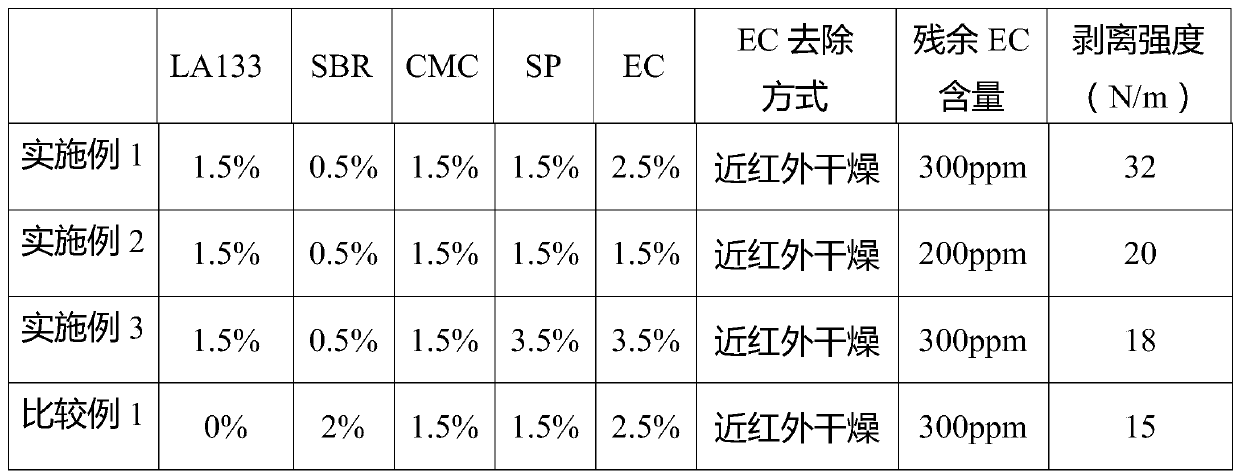
Figure 2 
Figure 3
Abstract
Description
technical field
[0001] The present application relates to the technical field of lithium ion batteries, in particular to a negative electrode slurry, a negative electrode sheet and a preparation method thereof. Background technique
[0002] Lithium-ion batteries have the advantages of high specific energy density, high working voltage, long storage life and low discharge rate, so they are widely used in various electronic information products.
[0003] The performance of lithium-ion batteries depends mainly on electrodes, electrolytes, separators and other battery materials contained therein, among which electrodes are particularly important. The electrode usually includes active material, current collector, conductive agent and binder, wherein the binder bonds the active material and conductive agent to the surface of the current collector. In the process of recycling, it is not easy to cause short-circuit failure due to powder drop and burr, and if the active material, co...
Examples
preparation example Construction
[0050] The embodiment of the present application also provides the preparation method of the above-mentioned negative electrode slurry. The preparation method is to first dissolve part of the acrylonitrile multi-polymer emulsion and the water-based thickener to form a mixed glue, and then mix the remaining acrylonitrile multi-polymer The late addition of the pulp process mainly includes the following steps:
[0051] Dissolve the water-based thickener and part of the acrylonitrile multi-polymer emulsion in water to form a glue;
[0052] Mixing the active material and the conductive agent evenly and adding the glue for the first dispersion to obtain the first dispersion;
[0053] Adding the remaining acrylonitrile multi-polymer copolymer emulsion, heat-melted ethylene carbonate, and the first amount of water to the first dispersion for second dispersion to obtain a second dispersion;
[0054] Adding styrene-butadiene latex or styrene-acrylic latex and a second amount of water t...
Embodiment 1
[0073] Material selection: artificial graphite (Kaijin New Energy Technology Co., Ltd.), LA133 (produced by Chengdu Dayi Yindile Battery Material Co., Ltd., with a viscosity of 7300mpa.s~10000mpa.s), styrene-butadiene latex (SBR, BASF, Germany , the model is Binder21-11ap, the second binding agent of the following embodiments is all selected styrene-butadiene latex as an example), sodium carboxymethyl cellulose (CMC, Shanghai Daicel Plastic Industry Co., Ltd.), conductive agent SP (TIMCAL ) and ethylene carbonate (EC, Xianghe Kunlun Chemical Co., Ltd.).
[0074]Preparation of negative electrode slurry: first dissolve CMC and part of LA133 (30% of the total weight of LA133) in water to prepare glue, control the viscosity of the glue to 7000mpa.s, filter and set aside; heat-melt EC , stand-by; add artificial graphite and SP in the slurry mixing kettle, under the condition that the online speed is 16rpm, stir for 15min, and mix evenly; add the prepared glue in the slurry mixing k...
Embodiment 2
[0080] The selection of material: with embodiment 1.
[0081] Preparation of the negative electrode slurry: same as in Example 1, wherein the weight of ethylene carbonate added is 1.5% of the total weight of the negative electrode slurry.
[0082] Preparation of the negative electrode sheet: the method steps are the same as in Example 1, the difference is that the content of the components left on the negative electrode sheet after the negative electrode slurry is dried is different, and the residual EC content of the negative electrode sheet after winding is calibrated by gas chromatography to be 200ppm . The components left on the negative plate after the negative electrode slurry is dried include: 95% artificial graphite; 1.5% LA133 dry material; 0.5% SBR dry material; 1.5% CMC; 1.5% sp.
[0083] Preparation of lithium-ion battery: Cut the positive electrode sheet of Example 1 and the negative electrode sheet of Example 2, laminate them together with the ceramic separator...