
Extending On-Time for Power Converter Control
A technology of on-time and off-time, which is applied in the direction of output power conversion device, DC power input conversion to DC power output, control/regulation system, etc., which can solve the problems of insufficient control stability, large duty cycle, disconnection time drops below the minimum, etc.
Patent Information
- Authority / Receiving Office
- CN · China
- Current Assignee / Owner
- Publication Date
- 2021-08-13
Smart Images
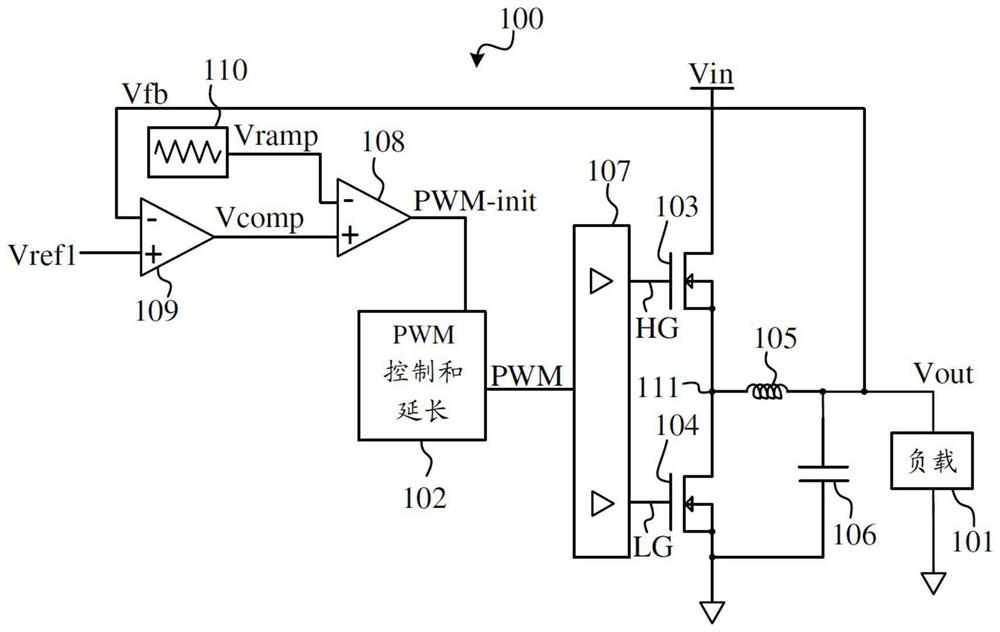
Figure 1 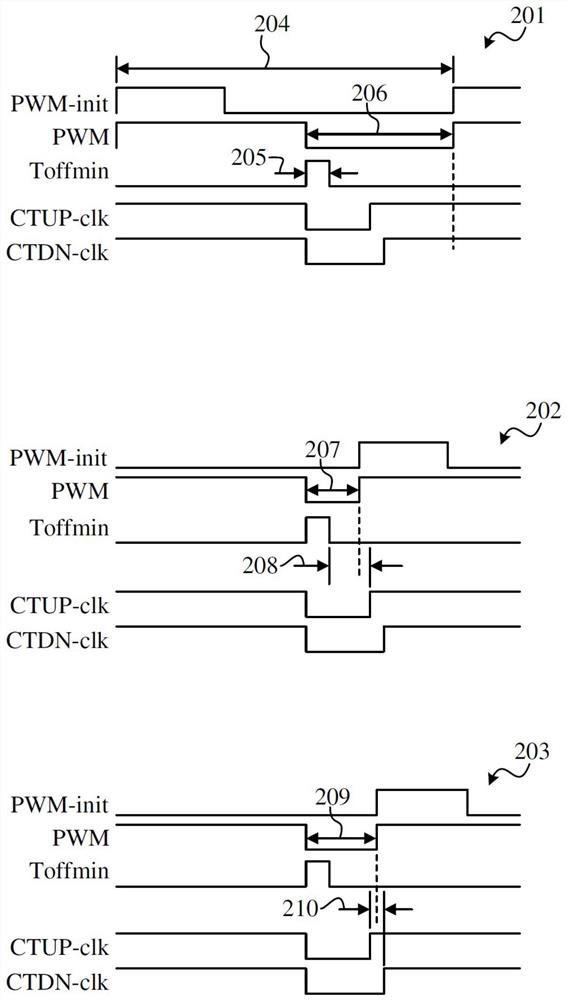
Figure 2 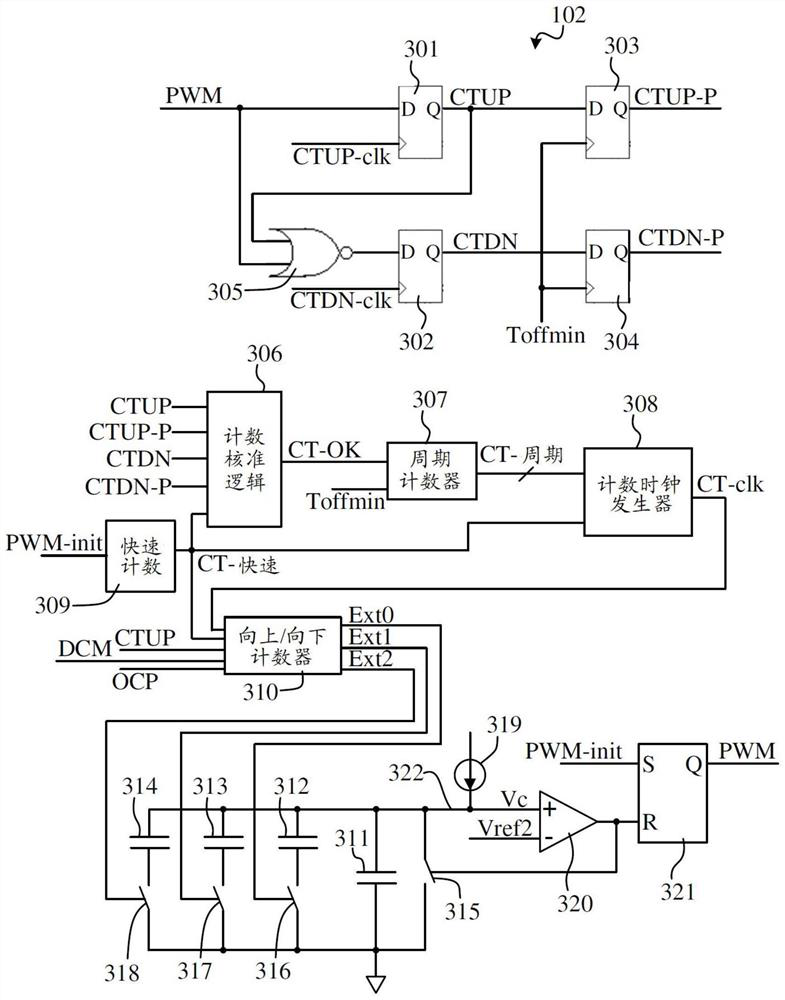
Figure 3
Abstract
Description
[0001] related application
[0002] This application claims priority to U.S. Nonprovisional Patent Application No. 17 / 247,536, filed December 15, 2020, entitled "Extending On-Time for PowerConverter Control," which claims Priority to U.S. Provisional Patent Application No. 62 / 976,171, entitled "Extending On-Time for Power Converter Control," both of which are incorporated herein by reference for all purposes. Background technique
[0003] Power converters generally generate a regulated output voltage Vout from a received input voltage Vin. In applications such as USB-PD (Universal Serial Bus-Power Distribution) that require driving various loads across a complex power distribution network with rapidly changing load transient distribution and a wide range of input voltage Vin and output voltage Vout, A constant on-time control architecture can be used to achieve fast load transient response with relatively simple compensation. A constant on-time architecture typically has a d...
Examples
Embodiment Construction
[0009] figure 1 A simplified schematic diagram of a power converter 100 for providing power to a load circuit 101 is shown, the power converter having a PWM (pulse width modulation) extension circuit 102 (i.e., a PWM signal generator) by using The on-time is kept constant and the off-time is varied to generate a PWM signal (switching signal). In addition, when the off-time of the PWM control and extension circuit 102 approaches the minimum allowable off-time, but before the off-time reaches or falls below the minimum off-time, the PWM control and extension circuit 102 extends the on-time of the PWM signal. time, thereby allowing the disconnection time to also increase. Therefore, there is a safety buffer between the point at which the PWM control and extension circuit 102 extends the on-time of the PWM signal and the minimum allowable off-time. This feature differs from prior art systems which do not include such a safety buffer, but instead do not extend the on-time until t...