
Emotion and mood data input, display, and analysis device
a technology of mood data and display, applied in the field of mood data input, display and analysis devices, can solve the problems of excessive sensitivity, difficult to objectively check the mood of each member and how each member is feeling the mood of all the members, and difficult to lead the emotions of all the members to relaxation, etc., to eliminate excess sensitivity or insensitivity. , the effect of eliminating excess sensitivity
Patent Information
- Authority / Receiving Office
- US · United States
- Patent Type
- Patents(United States)
- Current Assignee / Owner
- Publication Date
- 2018-12-25
Smart Images
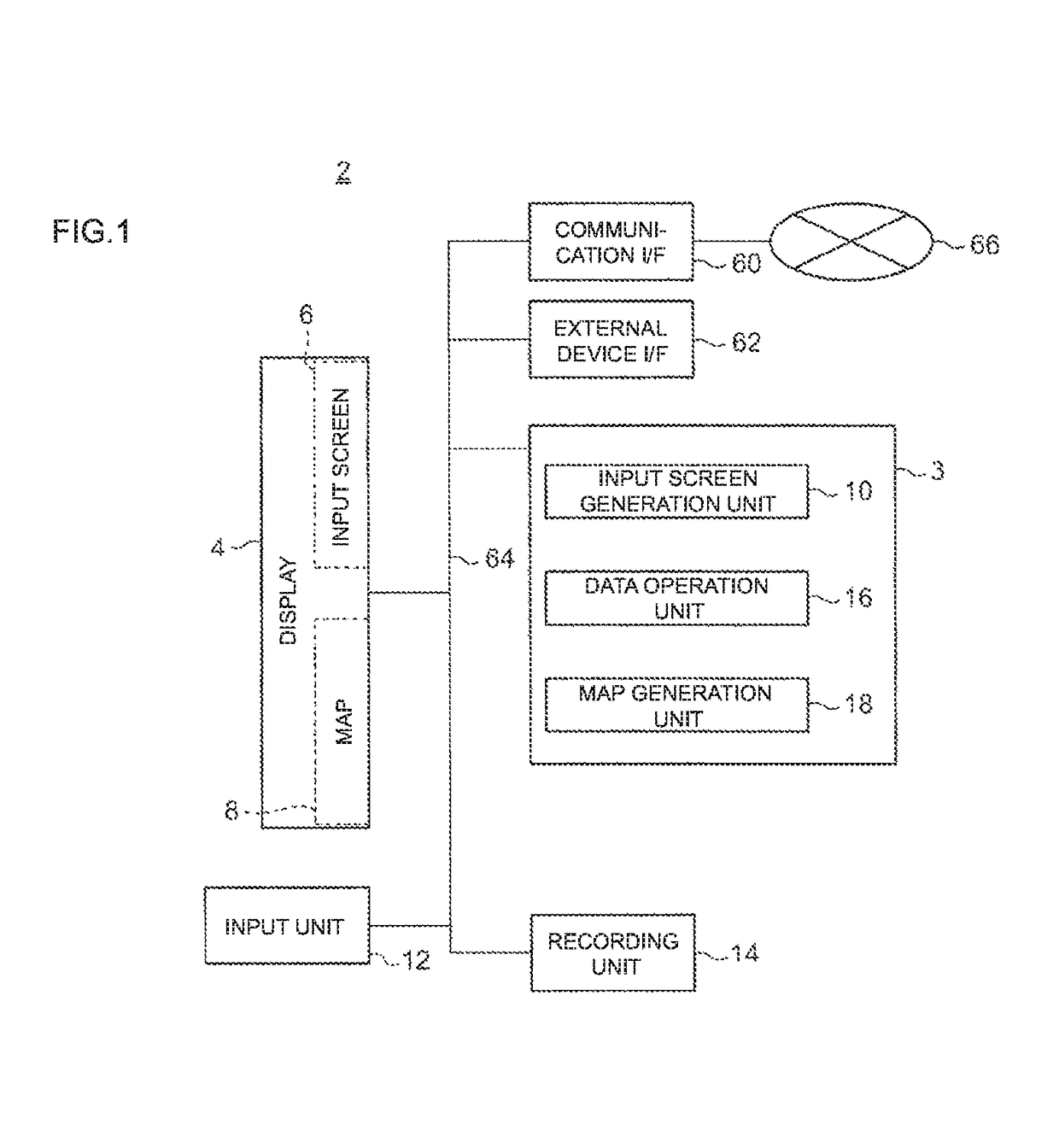
Figure 1 
Figure 2 
Figure 3
Abstract
Description
TECHNICAL FIELD
[0001] The present invention relates to an emotion / mood data input, display, and analysis device.BACKGROUND ART
[0002] In society, many individuals live collectively in a group or team consisting of multiple members, as seen in a home or office. The total of words or deeds expressed on the basis of feelings or emotions of the members of the group forms the mood of the group. The mood is inputted to the brain of each member through his or her sensitivity and then outputted from his or her brain in the form of a feeling or emotion. That is, an emotion (feeling) of each member and the mood (sensitivity) of the surrounding members felt by him or her have an influence on each other.
[0003] Each member has his or her own feeling and his or her own sensitivity to the mood of the surrounding members, and the level of the sensitivity varies among members. For this reason, some make excessively sensitive, too high reactions, and others make insensitive, too low reactions. Even when ...
Examples
first embodiment
[1-1] Configuration of Emotion / Mood Data Input, Display, and Analysis Device
[0052]FIG. 1 is a block diagram of an emotion / mood data input, display, and analysis device of a first embodiment. An emotion / mood data input, display, and analysis device 2 shown in FIG. 1 includes a controller (processor) 3, a display 4, an input unit 12, a recording unit 14, a communication interface 60, and an external device interface 62. The controller (processor) 3 performs arithmetic operations and controls the entire device including the display 4, input unit 12, recording unit 14, communication interface 60, and external device interface 62. The display 4 displays operation results obtained by the controller (processor) 3 and the like and consists of a liquid crystal display, organic EL display, plasma display, or the like. The input unit 12 generates or receives data to be inputted to the device and typically consists of a keyboard, mouse, touchscreen, or the like. Note that an input screen 6 (to ...
second embodiment
[2-1] Configuration of Emotion / Mood Data Input, Display, and Analysis Device
[0115]FIG. 10 is a block diagram of an emotion / mood data input, display, and analysis device of a second embodiment. The emotion / mood data input, display, and analysis device of the second embodiment has approximately the same configuration as the emotion / mood data input, display, and analysis device of the first embodiment. For this reason, the same elements are given the same reference signs and will not be described, and the difference therebetween will be mainly described.
[0116]As with the emotion / mood data input, display, and analysis device of the second embodiment shown in FIG. 1, an emotion / mood data input, display, and analysis device 2 of the second embodiment shown in FIG. 10 includes a controller 3, a display 4, an input unit 12, a recording unit 14, a communication interface 60, and an external device interface 62. Further, it includes an optimum program presentation unit 22. The controller incl...