
Low energy carbonylation process
a carbonylation process and low energy technology, applied in the preparation of carboxylic preparations from carbon monoxide reactions, organic chemistry, carboxylic compounds, etc., can solve the problems of affecting the commercial desirability of the final product, affecting the purity of the product, and increasing the purification train. , to achieve the effect of low energy carbonylation and high purity
Patent Information
- Authority / Receiving Office
- US · United States
- Patent Type
- Applications(United States)
- Current Assignee / Owner
- Publication Date
- 2002-10-17
- Estimated Expiration
- Not applicable · inactive patent
Smart Images
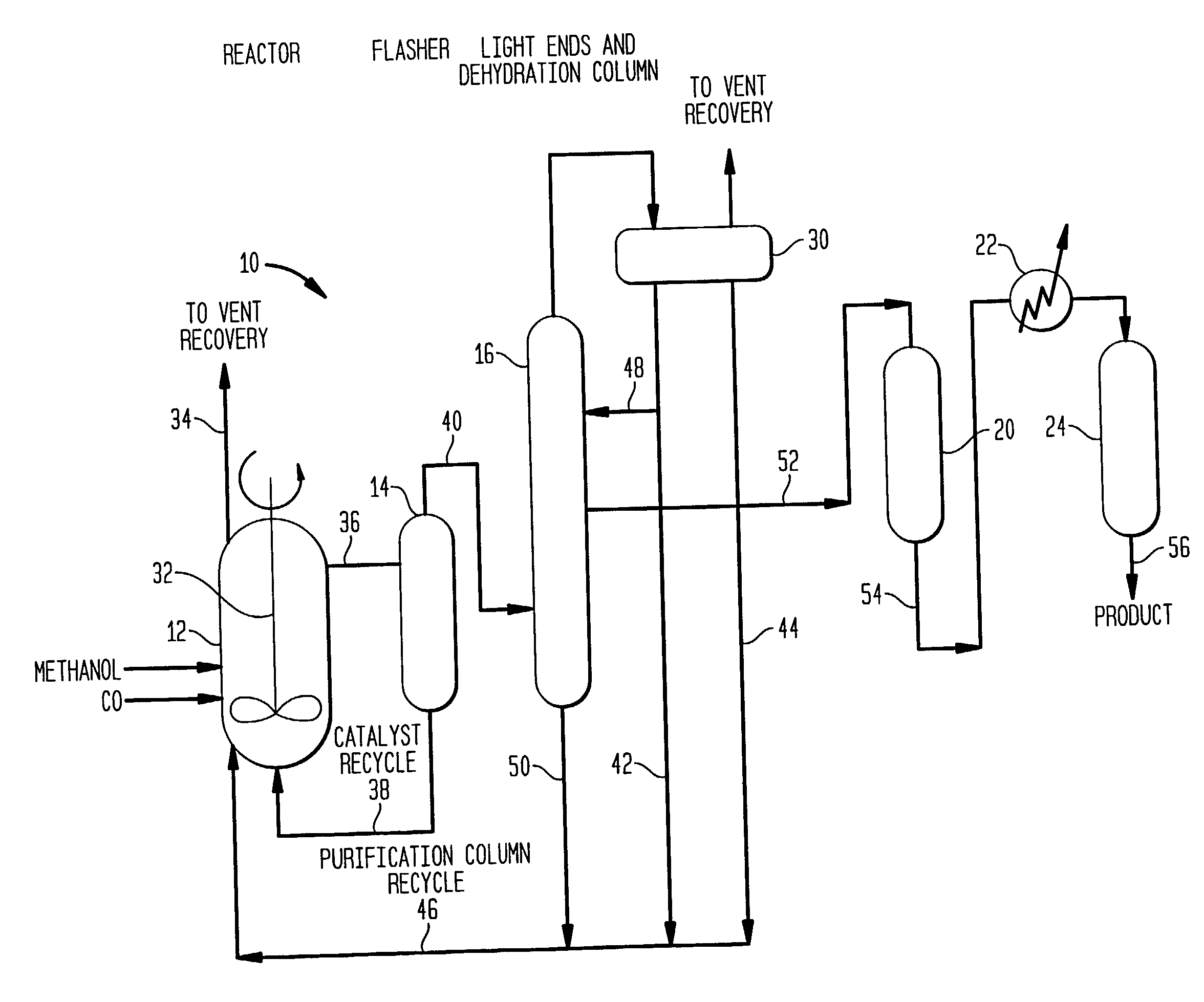
Figure 1 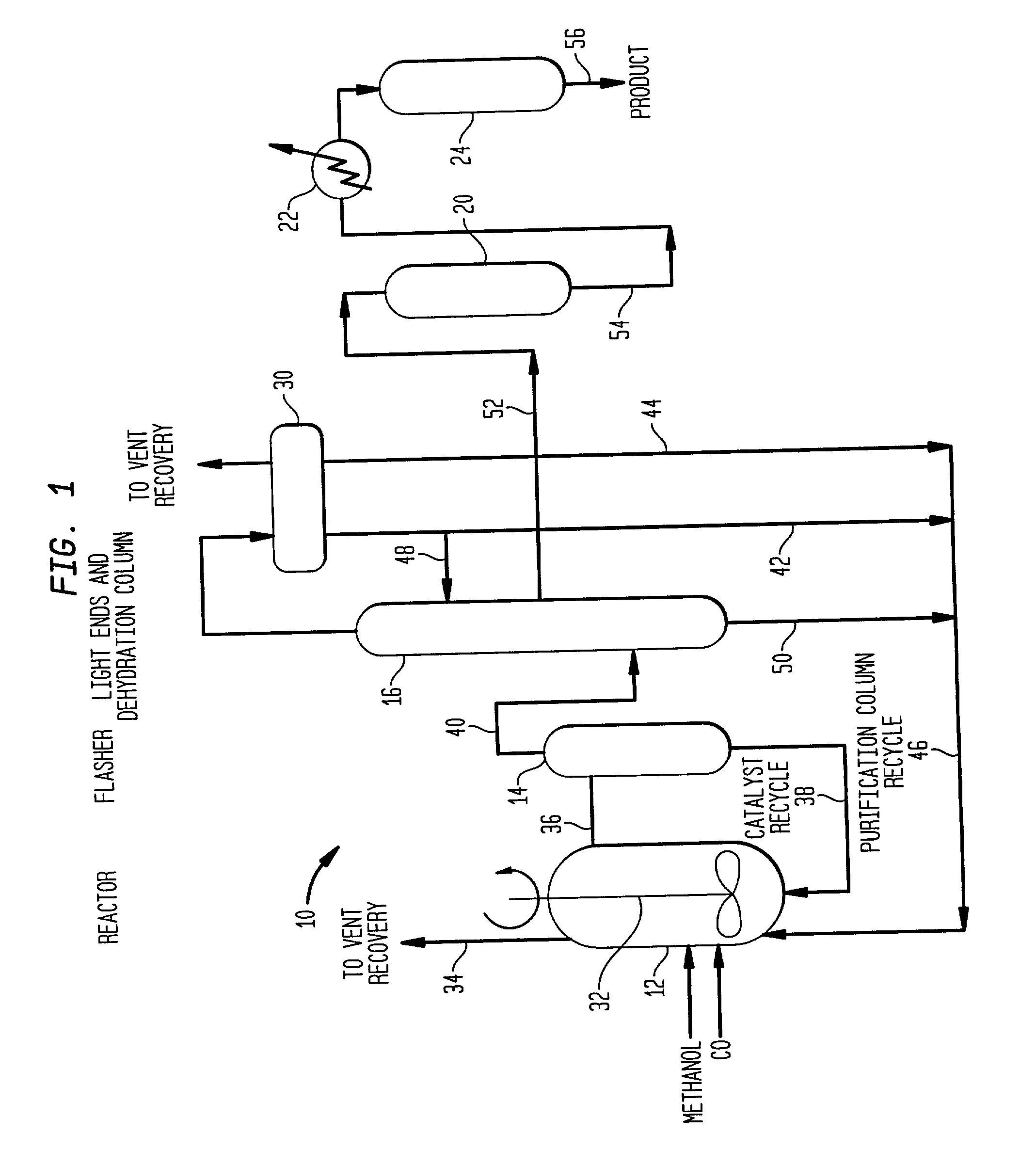
Figure 2 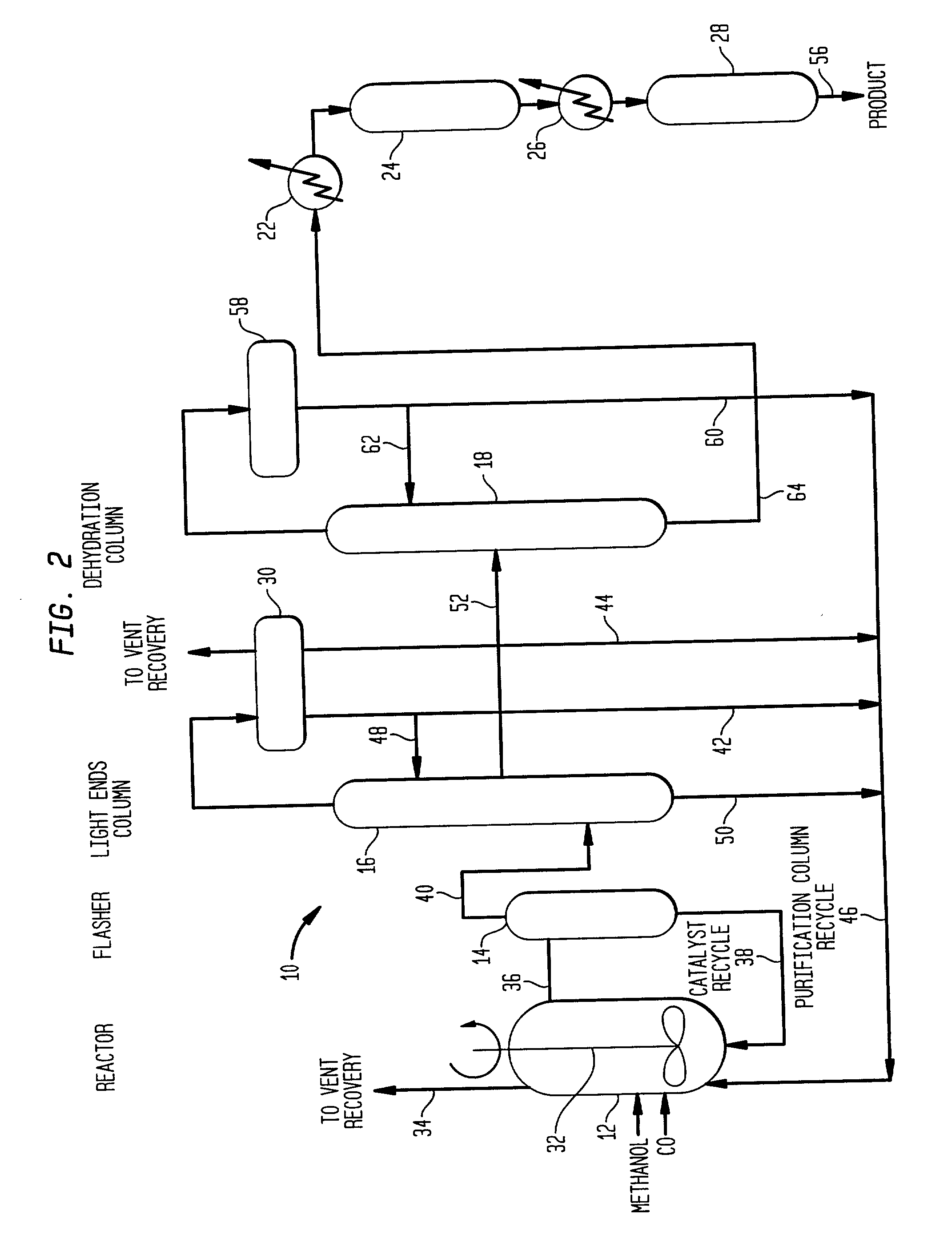
Figure 3
Abstract
Description
[0001] The present invention relates generally to processes for making acetic acid; and in particular to a low energy process for making acetic acid by way of carbonylating methanol with carbon monoxide and utilizing at most two distillation columns in the primary purification train
[0002] Among currently employed processes for synthesizing acetic acid, one of the most useful commercially is the rhodium catalyzed carbonylation of methanol with carbon monoxide as taught in U.S. Pat. No. 3,769,329 of Paulik et al. The carbonylation catalyst comprises rhodium, either dissolved or otherwise dispersed in a liquid reaction medium along with a halogen containing catalyst promotor as exemplified by methyl iodide. Generally, the reaction is conducted with the catalyst being dissolved in a liquid reaction medium through which carbon monoxide gas is continuously bubbled. Paulik et al. disclosed that water may be added to the reaction mixture to exert a beneficial effect upon the reaction rate. ...
Examples
examples 2-4
[0088] Following the procedure outlined above, performance of a silver-exchanged Amberlyst.RTM. 15 guard bed was evaluated for removal of dodecyl iodide at 25.degree. C., 50.degree. C., 75.degree. C., and 100.degree. C. and for removal of hexyl iodide at 25.degree. C. Results appear in FIG. 6 where Examples C and D also appear for purposes of comparison. Here again, it can be seen removal efficiencies in useful capacities of the bed are greatly enhanced at temperatures above about 50.degree. C.
example 5
[0089] Following the procedures outlined above, samples of acetic acid (drying column residue) from a Monsanto type acetic acid plant containing respectively 540 ppb total iodide (Example A), 238 ppb total iodide (Example B) and 259 ppb total iodide (Example 5). The acid was treated, as before, using a silver exchanged Amberlyst.RTM. 15 guard bed at 25.degree. C. and 50.degree. C. As can be seen from FIG. 7, performance at 50.degree. C. was far superior to removal efficiencies at 25.degree. C. Indeed the guard bed removed greater than 99% (nearly quantitative removal) of the total iodide at 50.degree. C.
[0090] As part of the present invention it is desirable to control the amount of acetaldehyde carbonyl impurities that are included in the product stream. Some techniques involve the treatment of acetic acid with oxidizers, ozone, water, methanol, amines and the like. These techniques might include, for example, the removal of carbonyl impurities from organic streams by treating the ...
examples 6-9
[0099] A continuous pilot plant equipped generally as described above with a 4-liter reactor operating at 1.5 liter reaction volume was used to investigate the effect of hydrogen partial pressure on the formation of by-products while carbonylating methanol. Operating conditions and results appear in Table 2 below. "Column Residue Impurities" refers to impurities in the crude acetic acid product and "H2pp" refers to the partial pressure of hydrogen in the reaction vessel in pounds per square inch absolute.
2TABLE 2 Hydrogen Partial Pressure Data Examples 6 7 8 9 Reactor H2pp (psia) 2.0 3.3 9.4 14.6 Methanol Feed (grams / min) 14.9 15.0 15.0 15.0 Reactor Composition Methyl Iodide, wt % 10.6 11.0 10.8 10.9 Methyl Acetate, wt % 2.6 2.5 2.5 2.5 Water, wt % 4.0 4.0 4.1 4.3 Rh, ppm 631 652 657 651 LiI, wt % 6.6 8.2 8.4 8.7 Rx. Temp. deg C. 195.2 194.0 191.8 192.3 Column Residue Impurities Propionic Acid, ppm 140 197 363 500 Crotonaldehyde, ppm 1 4 6 8 2-ethyl-Crotonaldehyde, ppm 1 3 6 8 Butyl...