
Synergistic composition for preparing high concentration fullerene (c60) glass and a method for preparing the glass in bulk monolith
a technology of high concentration fullerene and composition, which is applied in the direction of camera filters, lighting and heating apparatus, instruments, etc., can solve the problems of limited success, inability to meet ambient environmental conditions, and inability to completely protect fullerene from environmental degradation
Patent Information
- Authority / Receiving Office
- US · United States
- Patent Type
- Applications(United States)
- Current Assignee / Owner
- Publication Date
- 2006-05-25
- Estimated Expiration
- Not applicable · inactive patent
Smart Images
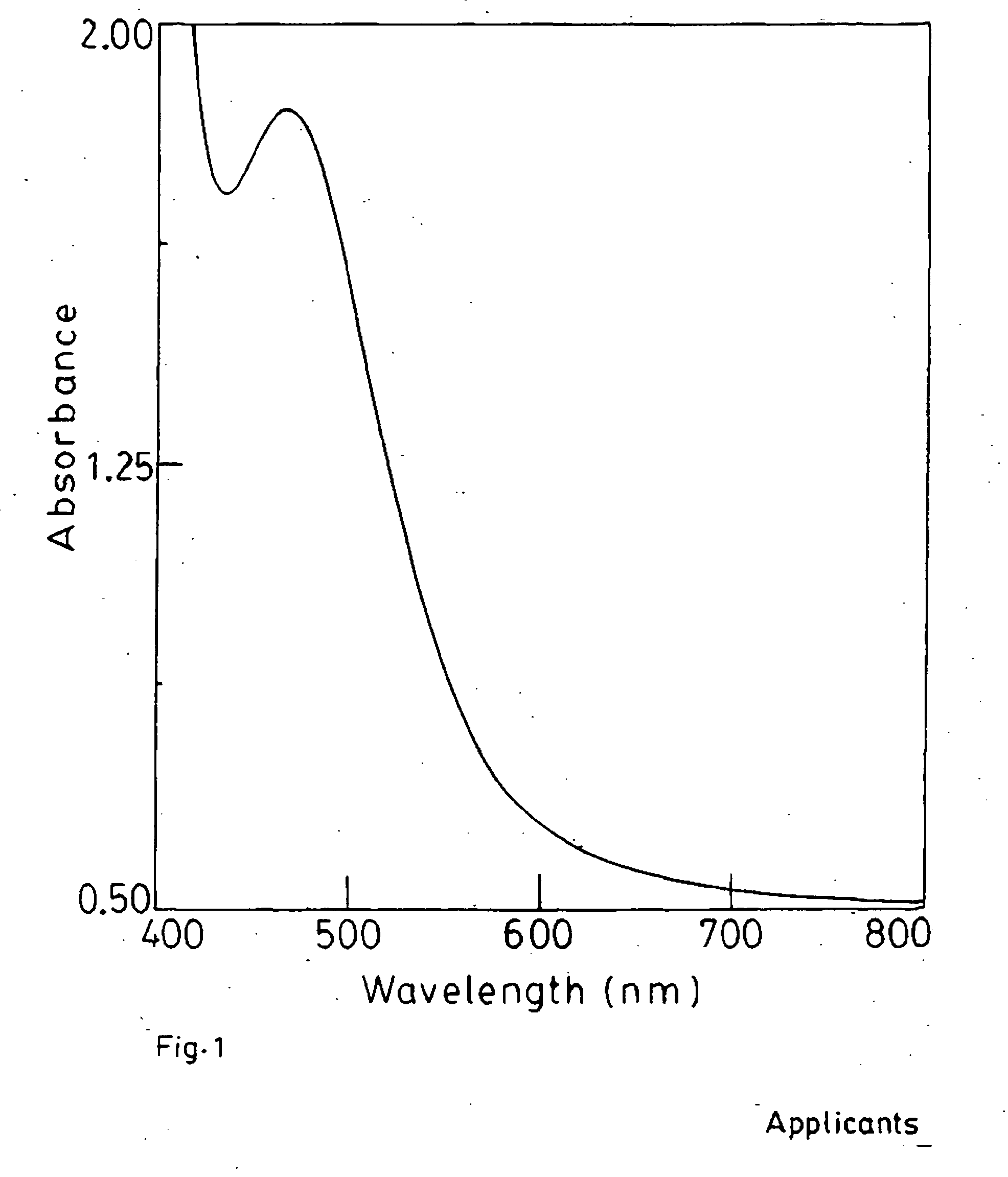
Figure 1
Abstract
Description
FIELD OF THE INVENTION
[0001] The present invention relates to a synergistic composition for preparing high concentration fullerene (C60)-glass and a method for preparing glass doped with fullerene (C60) in bulk monolith using the synergistic composition. The glass thus obtained is useful as a nonlinear photonic material and more particularly as a nonlinear optical medium and optical limiter. BACKGROUND AND PRIOR ART DESCRIPTION
[0002] Fullerenes are a class of closed shell carbon molecules having interesting optical and opto-electronic properties. Amongst the various homologues of the series which may consist of carbon atoms ranging in number from 20 to 980 and even more (Science of Fullerene and Carbon nanotudes—M. S. Dresselhaus et al, Academic Press, 1996), the most stable and widely investigated molecules are C60 and C70 fullerenes. Structurally, C60 and C70 have similarity in the sense, they have extended network of conjugated delocalized pi-electrons which are distributed ove...
Examples
example-1
[0052] A glass containing high concentration of fullerene was prepared by using an intimate mixture of 0.28 mole of boric acid (H3BO3), 0.07 mole of bismuth oxide (Bi2O3), 0.1225 mole of lead carbonate (PbCO3) and 0.0175 mole of SiO2—heating the batch in an alumina crucible in a furnace at 500-600° C. for half an hour—transforming the mass to a clear melt by raising the temperature up to around 800° C.—cooling the melt to solid—crushing the mass into powder—adding 14 mgm of C60 fullerene to 15 gms of the powder—heat treating the mixture in a carbon crucible around 360-375° C. for 3 hrs under vacuum—finally melting the mixture at a temperature around 680° C. for 35 minutes under controlled atmosphere of nitrogen gas. The glass obtained was a monolithic sample having green color.
example-2
[0053] The fullerene containing glass in an amount 48 gm was also prepared by starting with a batch mixture of 0.27 mole of H3BO3, 0.21 mole of Bi(NO3)3, 0.057 mole of PbCO3 and 0.003 mole of Al2O3—melting the batch in an alumina crucible in a furnace at around 650° C.—cooling the molten mass in the form of lump crushing the same into powder-adding 12 mgm of fullerene (C60) to 48 gms of this host material-heat treating the mixture in a carbon crucible at 385° C. for 2 hour under vacuum—then melting the mixture at 750° C. for 20 mins to a vitreous liquid under controlled atmosphere of nitrogen. The glass obtained showed a reddish green color.
example-3
[0054] In an another trial, the glass was prepared by starting with a batch mixture of 0.1575 mole of B2O3, 0.033 mole of ZnO, and 0.315 mole of OBi(NO3),—melting the mixture in an alumina crucible by raising the temperature to around 820° C. in a furnace-cooling the melt to a glass —crushing the lump into frits—adding 10 mgm of (C60) fullerene to about 6 gms of the frits—heat treating the mixture in a vitreous carbon crucible at around 370° C. for 1 hrs under vacuum—finally melting the mixture to a vitreous melt around 700° C. for 0.5 hr under controlled atmosphere of helium gas. The glass obtained was a monolithic sample with red color.