
Letrozole purification process
a technology of purification process and letrozole, which is applied in the direction of biocide, heterocyclic compound active ingredients, drug compositions, etc., can solve the problems of reducing estrogen production, significantly lowering serum estrogens, and impractical industrial scale, and achieves easy separability
Patent Information
- Authority / Receiving Office
- US · United States
- Patent Type
- Applications(United States)
- Current Assignee / Owner
- Publication Date
- 2007-05-17
- Estimated Expiration
- Not applicable · inactive patent
Smart Images
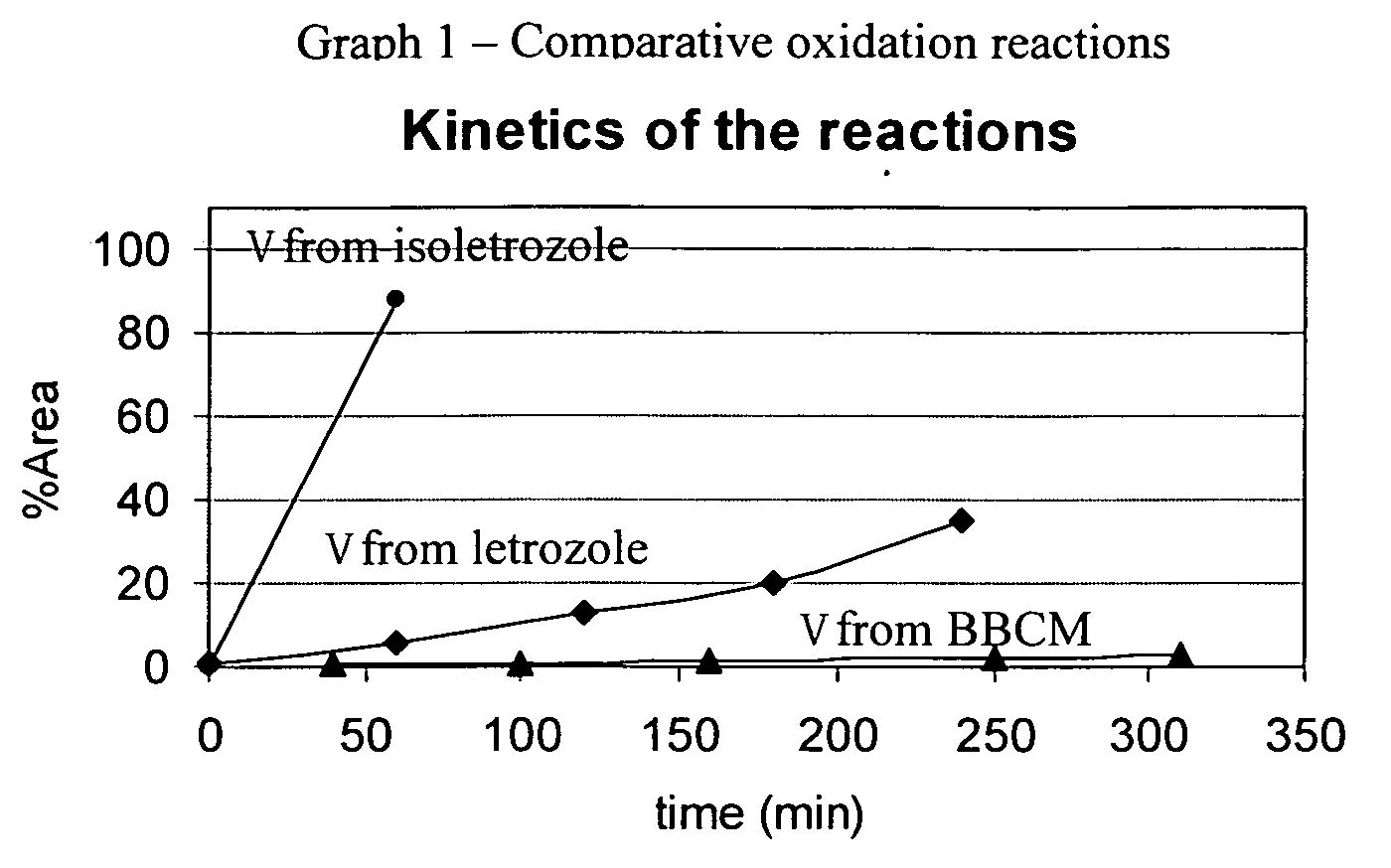
Figure 1 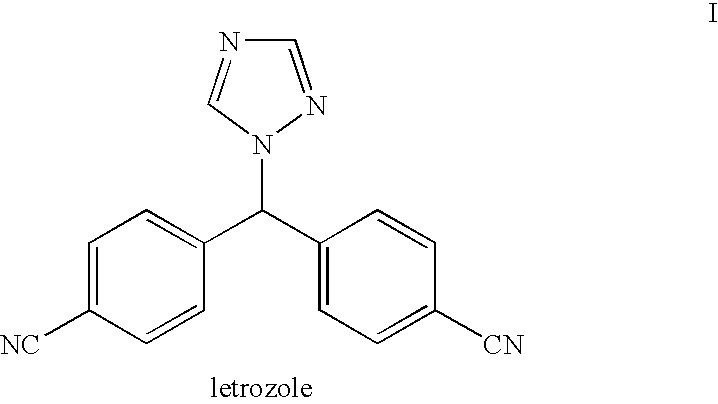
Figure 2 
Figure 3
Abstract
Description
CROSS-REFERENCE TO RELATED APPLICATIONS
[0001] This patent application is a continuation-in-part of copending U.S. patent application Ser. No. 11 / 273,276, filed Nov. 14, 2005.BACKGROUND OF THE INVENTION
[0002] Letrozole, the active ingredient in the product Femara®, is a nonsteroidal aromatase inhibitor, which has the chemical name 4-[α-(4-cyanophenyl)-1-(1,2,4-triazolyl)-methyl]-benzonitrile, and the following structural formula (I):
[0003] Letrozole was developed for treatment of advanced breast cancer in postmenopausal women with disease progression following anti-estrogen therapy, especially for first-line treatment of postmenopausal women with hormone receptor positive or hormone receptor unknown locally advanced or metastatic breast cancer.
[0004] The endosynthesis of estrogen in postmenopausal women is mediated by the aromatase enzyme, which converts androstenedione and testosterone and other androgens into estradiol and estrone. Letrozole inhibits the biosynthesis of estrog...
Examples
reference example 1
[0047] A reactor was charged with triazole (104 g, 1.5 moles) and bromo-bis(4-cyanophenyl)methane (108 g, 0.6 mole) followed by addition of DMF (720 ml) and toluene (1080 ml), and the impeller speed was set at 800 RPM. The temperature was raised to 60° C. and potassium carbonate was added (83.5 g, 0.6 mole). Then, the temperature was raised to 80° C. and mixing was maintained at this temperature during about 1.5 hours. An aliquot was withdrawn from the reaction mixture, diluted with a mixture of water and acetonitrile and analyzed by HPLC. The letrozole content was 83%, the isoletrozole content was 11.4%, while the content of 4,4′-dicyanobenzophenone was 1.6%. After cooling to a temperature of 25° C., acetic acid (57.6 ml) was added. DMF (414 ml) and water (1760 ml) were added to the reaction mixture to form a suspension (two liquid phases and a solid inter-phase in between). After heating the suspension to 60° C. the resulting mixture was allowed to cool to 25° C. for one hour and ...
example 2
[0048] A reactor was charged with triazole (104 g, 1.5 moles) and bromo-bis(4-cyanophenyl)methane (108 g, 0.6 mole) followed by addition of DMF (720 ml) and toluene (1080 ml), and the impeller speed was set at 800 RPM. The temperature was raised to 60° C. and potassium carbonate was added (83.5 g, 0.6 mole). Then, the temperature was raised to 80° C. and mixing was maintained at this temperature during about 1.5 hours. Then, air was bubbled at the same temperature for about 15 minutes at 3500 ml / minute air flow. An aliquot was withdrawn from the reaction mixture, diluted with a mixture of water and acetonitrile and injected to HPLC. The letrozole content was 73%, the isoletrozole content was 8.7% and of 4,4′-dicyano-benzophenone was 16.2%. After cooling to a temperature of 25° C., acetic acid (57.6 ml) was added. DMF (414 ml) and water (1760 ml) were added to the reaction mixture to form a suspension (two liquid phases and a solid inter-phase in between). After heating the suspensio...
examples 3-7
[0049] Letrozole was prepared according to Example 2, while the selective oxidation of isoletrozole was carried out at different reaction conditions. The results are detailed in tables 1 and 2 below, wherein table 1 specifies the experimental parameters and table 2 summarizes the results of the experiments.
TABLE 1Experimental parametersExperimentImpellerReactionAir(Example)speed,Impellertemp.ReactionbubblingNo.RPMconfiguration° C.time (hrs)time, min3600pump down70° C.10.0304700pump up80° C.2.0305800″80° C.2.516800″70° C.2.5157700″80° C.1.510
[0050]
TABLE 2Analytical ResultsExperiment(Example)IsoletrozoleIsoletrozoleContent ofIsoletrozoleNocontent %*letrozole, %**content %**V, %**content %***315.377.511.813.32.2414.5503.935.60.8516.780.816.01.71.8614.180.211.911.32.2714.07310.017.21.1
*End of the reaction without air bubbling
**End of the reaction with air bubbling
***After precipitating isoletrozole from the reaction mixture of the reaction including air bubbling
V = 4,4′-dicyanobenz...