
Synthetic method of glycol diesters from reaction of glycol monoesters and linear aliphatic carboxylic acids
a glycol diester and linear aliphatic technology, applied in the direction of climate sustainability, chemistry apparatus and processes, organic chemistry, etc., can solve the problems of low selectivity to glycol diester and yield thereof, inability to achieve significant reduction in reaction time, and low yield of final product, so as to reduce the reaction time of glycol diester and effectively separate reactants and water
Patent Information
- Authority / Receiving Office
- US · United States
- Patent Type
- Applications(United States)
- Current Assignee / Owner
- Publication Date
- 2009-01-22
Smart Images
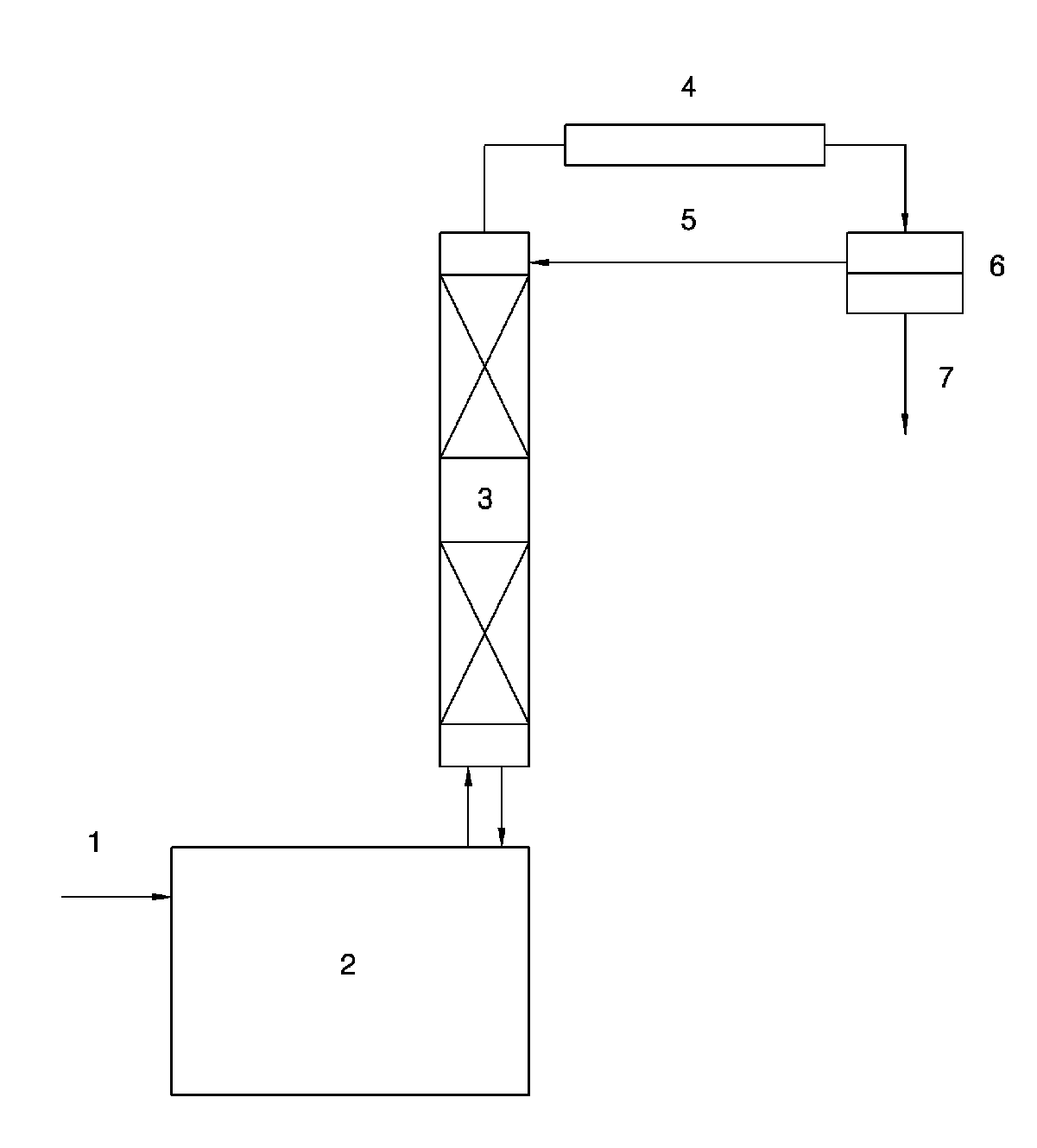
Figure 1 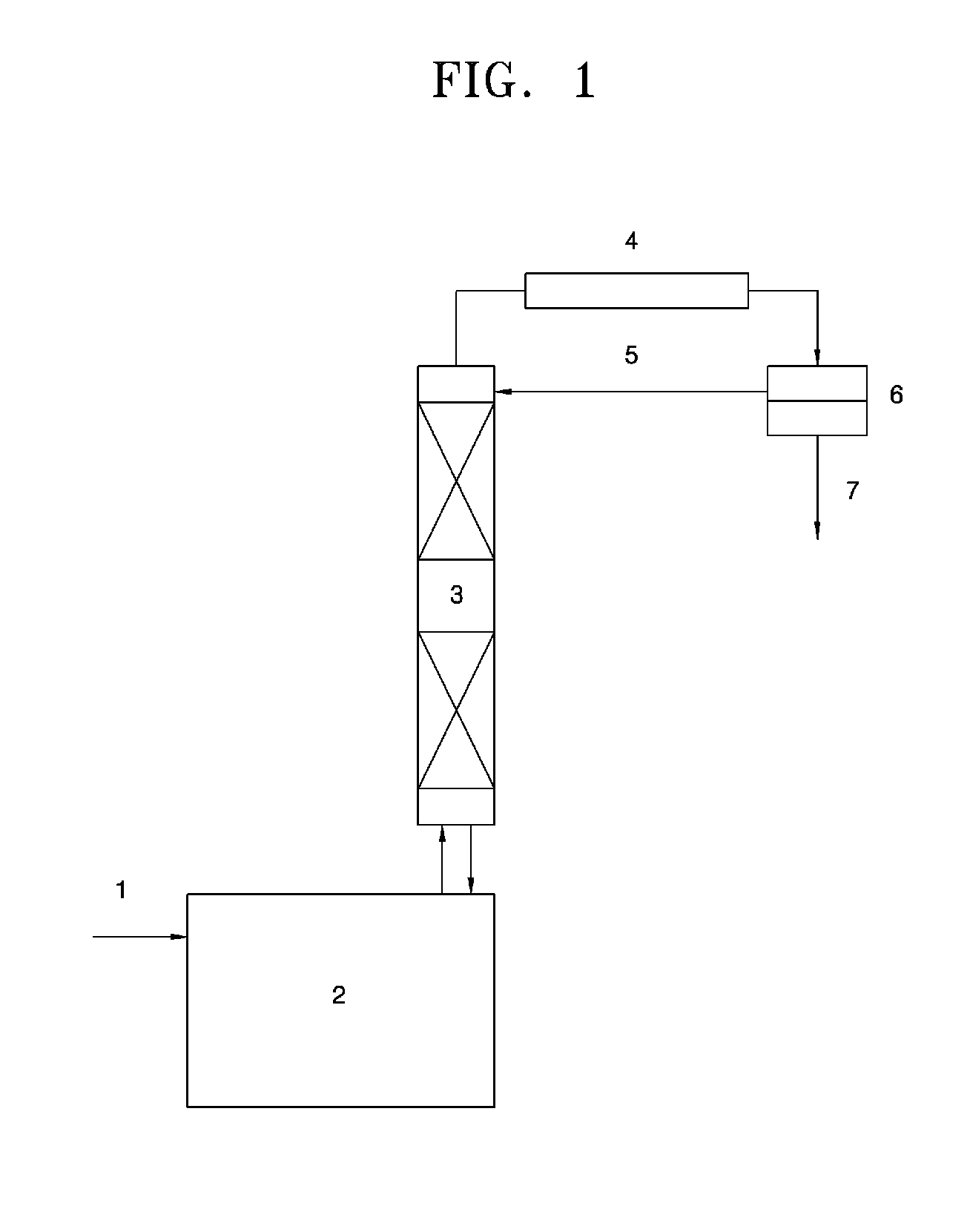
Figure 2
Abstract
Description
[0001] This application is a divisional application of U.S. patent application Ser. No. 11 / 209,255, filed Aug. 23, 2005, the disclosure of which is incorporated herein in its entirety by reference.BACKGROUND OF THE INVENTION
[0002] 1. Field of the Invention
[0003] The present invention relates to a method of synthesizing a glycol ester represented by formula (3) from a glycol monoester represented by formula (1) and a linear aliphatic carboxylic acid represented by formula (2) in the presence of a Lewis acid type catalyst utilizing reactive distillation technique in which a reaction time can be significantly reduced by rapidly removing water produced during the reaction:HO—R1—O—C(═O)—R2 (1)R3—C(═O)—OH (2)R3—C(═O)—O—R1—O—C(═O)—R2 (3)where R1 is a C1-C16 alkylidene group, R2 is a C1-C16 alkyl group, and R3 is a C3-C16 linear alkyl group.
[0004] 2. Description of the Related Art
[0005] Generally, in the case of the same molecular weight, glycol diesters produced by the reaction between glyco...
Examples
example 1
[0042]In the present Example, a 1 L glass reactor on which a distillation column filled with a packing material was mounted and to which a temperature controlling system was connected was used. 324.4 g of 2,2,4-trimethyl-1,3-pentanediol monoisobutyrate, 171.3 g of butyric acid and 3.25 g of tetraisopropyl titanate were charged into the reactor. The reactor was heated to 230° C. to perform the reaction. Water produced during the reaction formed an azeotrope with the butyric acid and was continuously removed through the distillation column on the reactor. The butyric acid separated from water was returned to the distillation column to be used in the reaction. As a result, the conversion rate of 2,2,4-trimethyl-1,3-pentanediol monoisobutyrate was 99.6% after 5 hours and the selectivity to 2,2,4-trimethyl-1,3-pentanediol monobutyrate monoisobutyrate was 95.4%.
example 2
[0043]The same experimental procedure as in Example 1 was performed, except that 1.47 g of tetraisopropyl titanate was used. As a result, the conversion rate of 2,2,4-trimethyl-1,3-pentanediol monoisobutyrate was 99.3% after 5 hours and the selectivity to 2,2,4-trimethyl-1,3-pentanediol monobutyrate monoisobutyrate was 95.2%.
example 3
[0044]In the present Example, a 3 L glass reactor on which a 15-step tray column with a diameter of 50 mm was mounted and to which a temperature controlling system was connected was used. 1373.5 g of 2,2,4-trimethyl-1,3-pentanediol monoisobutyrate, 728.5 g of butyric acid and 13.7 g of tetraisopropyl titanate were charged into the reactor. The reactor was heated to 230° C. to perform the reaction. Water produced during the reaction formed an azeotrope with the butyric acid and was included in an aqueous layer to be continuously removed through an oil water separator on the reactor. An organic layer separated from the aqueous layer was returned to the tray column (first step). As a result, the conversion rate of 2,2,4-trimethyl-1,3-pentanediol monoisobutyrate was 99.5% after 5 hours and the selectivity to 2,2,4-trimethyl-1,3-pentanediol monobutyrate monoisobutyrate was 95.3%.