
Elongated particle breakers in low pH fracturing fluids
a fracturing fluid and particle breaker technology, applied in the field of viscosification and low ph fracturing fluids, can solve the problems of oxidizing breaker, unusable solids, general effective destruction of crosslinking sites, etc., and achieve the effect of lowering the fluid ph, breaking the viscosity of the carrier fluid, and breaking the viscosity
Patent Information
- Authority / Receiving Office
- US · United States
- Patent Type
- Applications(United States)
- Current Assignee / Owner
- Publication Date
- 2009-10-01
- Estimated Expiration
- Not applicable · inactive patent
Smart Images
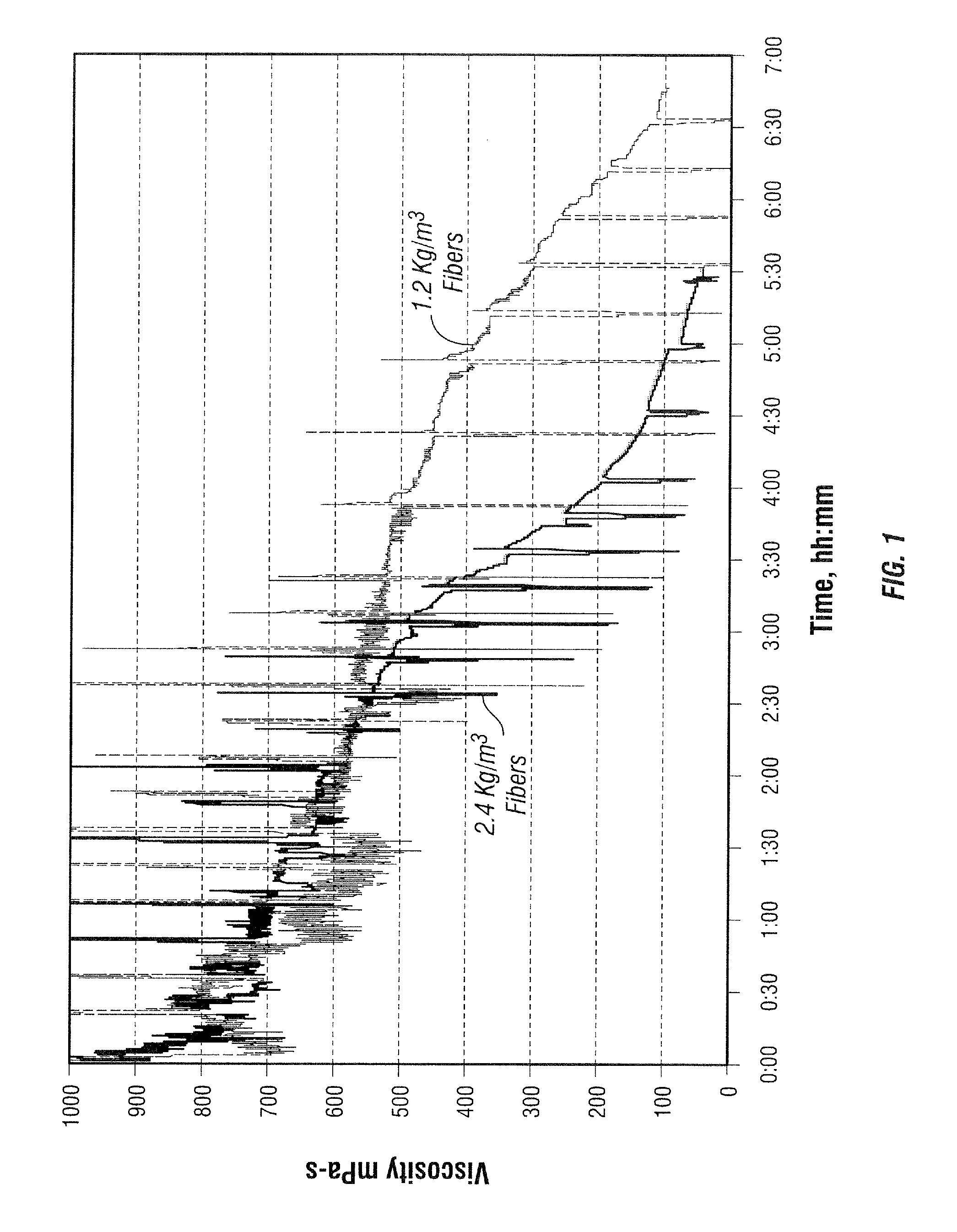
Figure 1 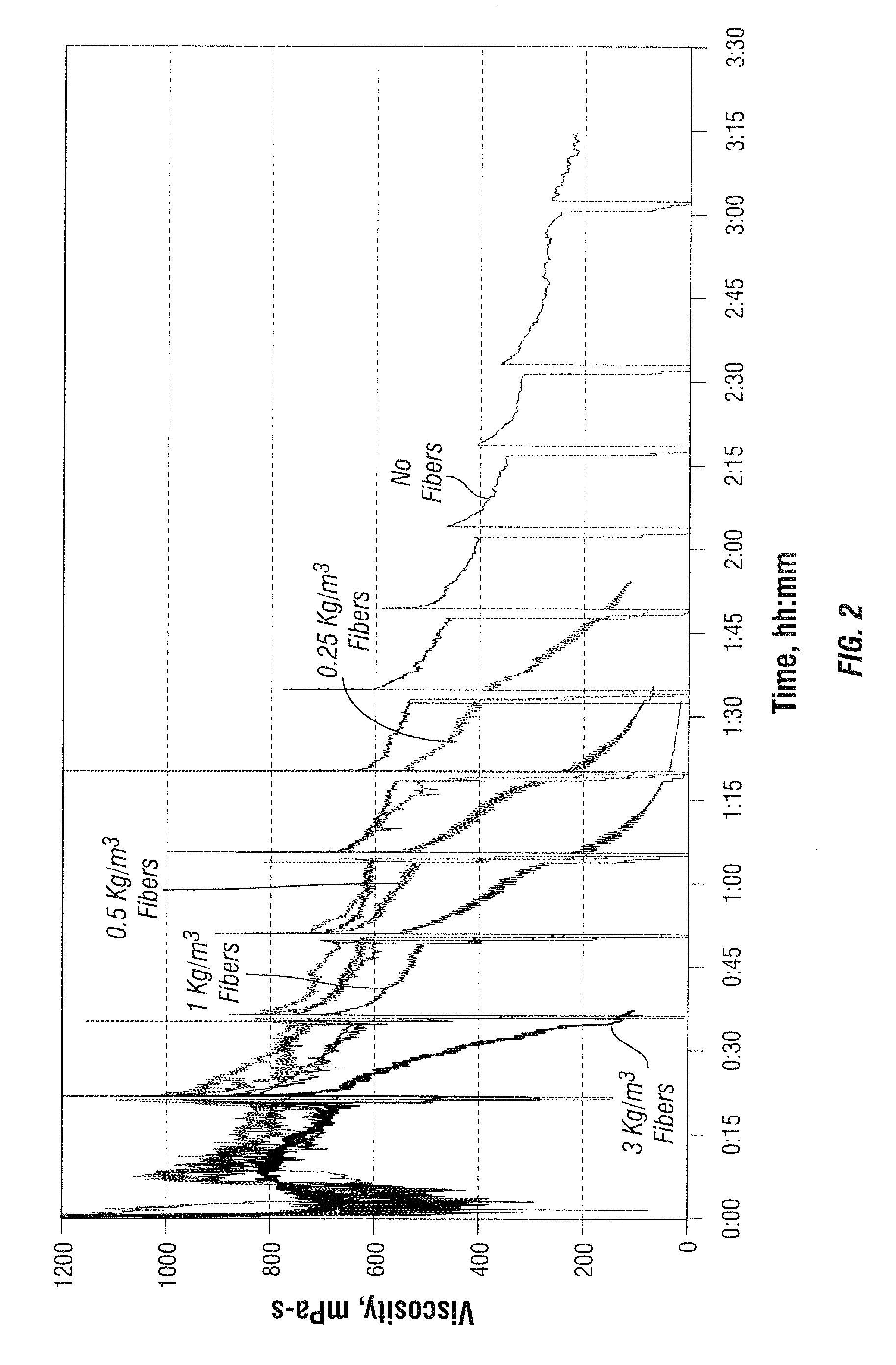
Figure 2 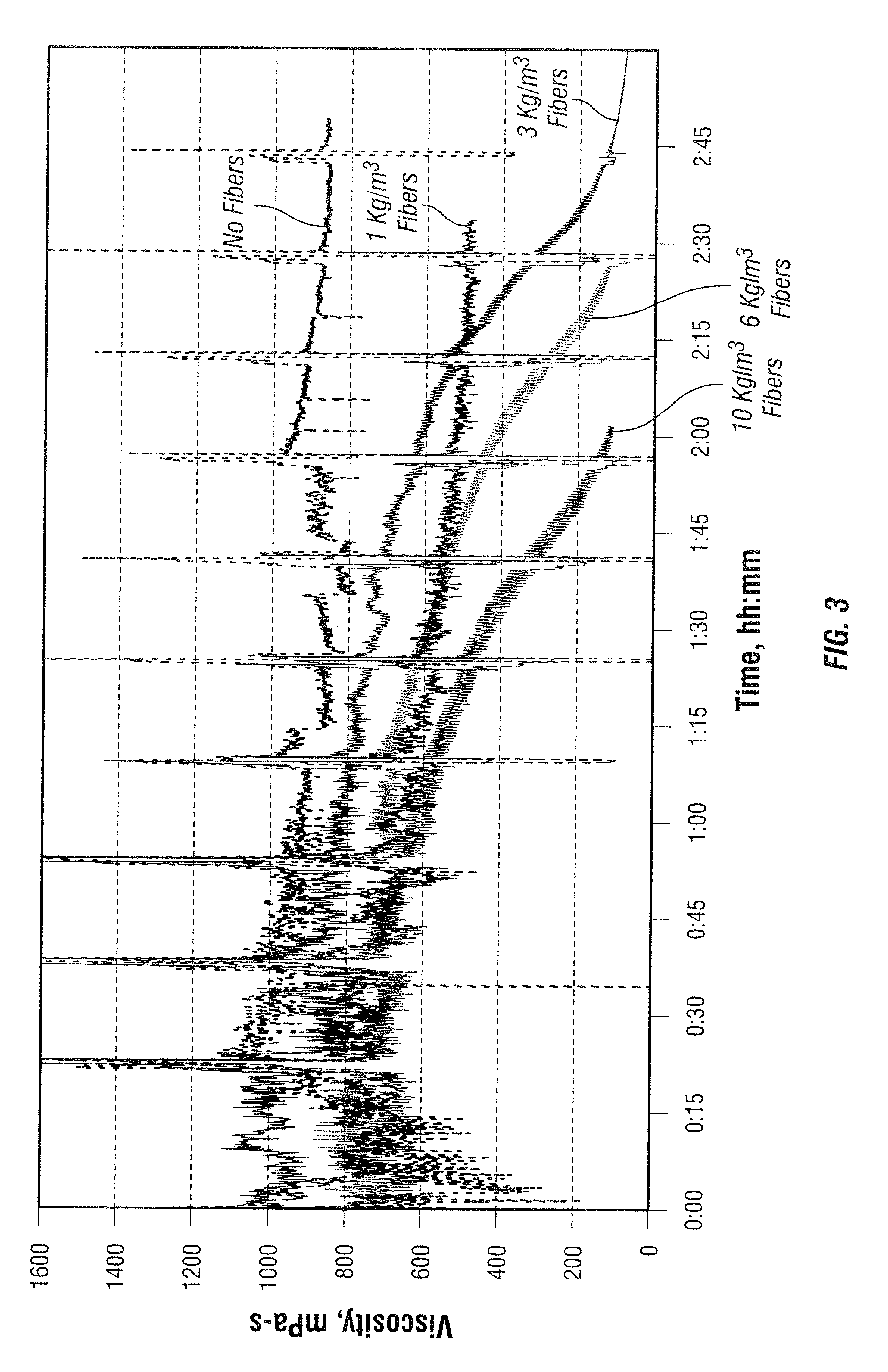
Figure 3
Abstract
Description
BACKGROUND OF THE INVENTION
[0001] The invention relates to viscosified, low pH fracturing fluids, and to the breaking of such fluids in a fracture after a suitable period of time.
[0002] A typical fracturing fluid is prepared by blending a polymer, often a polysaccharide, with an aqueous solution. The purpose of the polymer is to increase the viscosity of the fracturing fluid and to thicken the aqueous solution so that solid particles of proppant can be suspended in the solution for delivery into the fracture. If a crosslinking agent is added to the fracturing treatments, the agent further increases the viscosity of the fluid by crosslinking the polymer. However, when the fluid is viscosified with a polymer, especially a crosslinked polymer, some of the polymer can be left in the fracture after the treatment, which can later inhibit the flow of production fluids out of the formation, through the fracture, into the wellbore, and to the surface for recovery.
[0003] During hydraulic fractur...
Examples
example 1
[0090]The decomposition rate of a suitable fiber of the invention, a polylactic acid containing about 87 weight % polylactide, about 12 weight % water, and about 1 weight % sizing was determined. The material was NatureWorks™ PLA 6201D or NatureWorks™ PLA 6202D, made into a fiber of average length about 5.7 to 6.3 mm, and denier about 1.35 to about 1.45. It was found that the degradation rate is about the same for 6201D and 6202D. The fiber decomposed in about 1 day at 121° C. (about 250° F.) and at about 2 months at 79.4° C. (about 175° F.).
examples 2-3
[0091]The viscosity of a 3.6 g / L (30 ppt) guar-based fluid with 1 L / m3 (1 gpt) commercial surfactant solution and 2 L / m3 (2 gpt) tetramethyl ammonium chloride solution (clay stabilizer) was determined at 95° C. as a function of time at temperature in a Fann 50 viscometer. The linear gels had a pH of 7.8, a viscosity of 54 mPa-s at 170 l / s, and a viscosity of 28 mPa-s at 511 l / s. In one test, the fluid contained 1.2 g / L (10 ppt) of the fibers used in Example 1, and in another 2.4 g / L (20 ppt). Fluids were made in a Waring blender; in each case, the fluid was made by adding slurried guar to water, hydrating the polymer, then adding other additives, then adding fiber to the linear gel before the crosslinking step, and then adding borate crosslinker (commercial borate slurry in oil). The viscosity profiles are shown in FIG. 1. The fluid with 1.2 g / L fibers had a crosslink pH of 8.62 and after beaking had a viscosity of 15 mPa-s (511 l / s) and pH 4.50; with 2.4 g / L fibers, a crosslink pH ...
examples 4-9
[0092]The viscosity of a 3.6 g / L (30 ppt) guar-based fluid with 3 L / m3 (3 gpt) of a solution of clay stabilizer and surfactant and 4 L / m3 (4 gpt) of a borate crosslinker in mineral oil without added fiber was determined at 90° C. and 100° C. as a function of time at temperature in a Fann 50 viscometer. The viscosity of the same fluid with fiber contents of 0.25, 0.5, 1, 3, 6 and / or 10 g / L was similarly observed at 90° C. and / or 100° C., and the viscosity profiles are shown in FIGS. 2 and 3 with the fiber free fluids. The relative stability is indicated in the following table:
Fiber content, kg / m3400 mPa-s, hh:mm100 mPa-s, hh:mmSTABILITY TIME AT 100° C.none2:153:300.251:302:000.501:501:401.001:001:153.000:300:35STABILITY TIME AT 90° C.none>2:45 1.00>2:30 3.002:152:456.002:002:2010.00 1:301:50
[0093]It is seen that the fluids were effectively broken by the fibers, and that the break time can be controlled by selection of the amount of fiber used, depending on the temperature.
[0094]Altho...