
Mutated immunoglobulin-binding polypeptides
a technology of immunoglobulin and polypeptide, which is applied in the field of affinity chromatography, can solve the problems of inability to achieve complete cleaning, and inability to achieve complete cleaning, and achieve the effect of improving alkaline stability
Patent Information
- Authority / Receiving Office
- US · United States
- Patent Type
- Applications(United States)
- Current Assignee / Owner
- Publication Date
- 2016-06-09
Smart Images
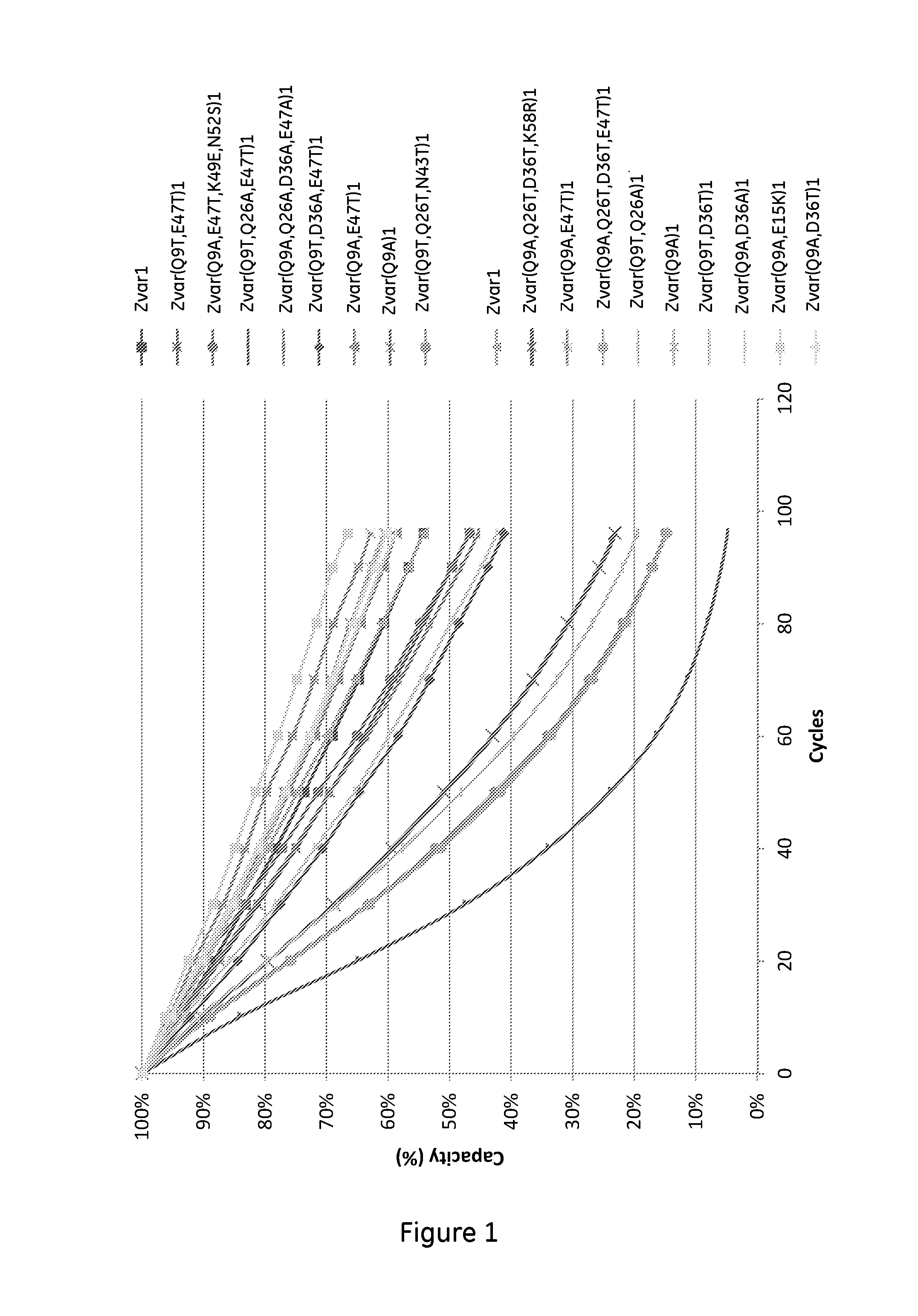
Figure 1 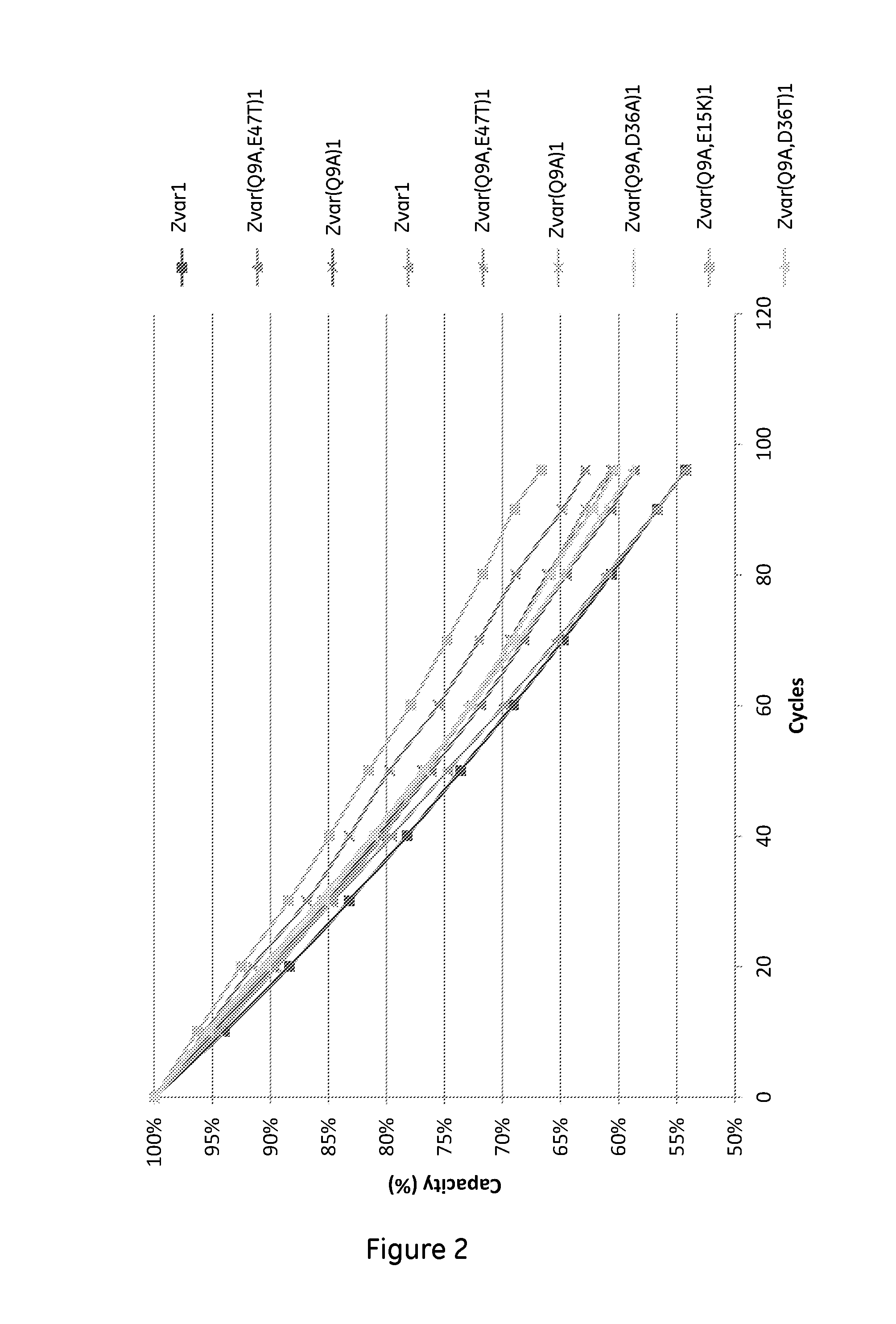
Figure 2 
Figure 3
Abstract
Description
TECHNICAL FIELD OF THE INVENTION
[0001] Embodiments of the present invention relate to the field of affinity chromatography, and more specifically to mutated immunoglobulin-binding domains of Protein A, which are useful in affinity chromatography of immunoglobulins. Embodiments of the present invention also relate to multimers of the mutated domains and to separation matrices containing the mutated domains or multimers.BACKGROUND OF THE INVENTION
[0002] Immunoglobulins represent the most prevalent biopharmaceutical products in either manufacture or development worldwide. The high commercial demand for and hence value of this particular therapeutic market has led to the emphasis being placed on pharmaceutical companies to maximize the productivity of their respective mAb manufacturing processes whilst controlling the associated costs.
[0003] Affinity chromatography is used in most cases, as one of the key steps in the purification of these immunoglobulin molecules, such as monoclonal or po...
Examples
example 1
[0066]The purified monomeric ligands listed in Table 1 were immobilized on Biacore CM5 sensor chips (GE Healthcare, Sweden), using the amine coupling kit of GE Healthcare (for carbodiimide coupling of amines on the carboxymethyl groups on the chip) in an amount sufficient to give a signal strength of about 1000RU in a Biacore instrument (GE Healthcare, Sweden). To follow the IgG binding capacity of the immobilized surface 1 mg / ml human polyclonal IgG (Gammanorm) was flowed over the chip and the signal strength was noted. The surface was then cleaned-in-place (CIP), i.e. flushed with 500 mM NaOH for 10 minutes at room temperature (22 + / −2° C.). This was repeated for 96 cycles and the immobilized ligand alkaline stability was followed as the relative loss of IgG binding capacity (signal strength) after each cycle. The results are shown in FIG. 1 and Table 1 and indicate that at least the ligands Zvar(Q9A)1, Zvar(Q9A,E15K)1, Zvar(Q9A,E47T)1, Zvar(Q9A,D36T)1, Zvar(Q9A,D36A)1 and Zvar(Q9...
example 2
[0067]The purified tetrameric ligands of Table 2 (all with an additional N-terminal cysteine) were immobilized on agarose beads using the methods described below and assessed for capacity and stability.
TABLE 2Initial RemainingRemaining IgG IgG capacityIgGSEQ Ligandcapacityafter 100capacity IDcontentQb 10cyclesafter 100 LigandNO.(mg / ml)(mg / ml)(mg / ml)cycles (%)Zvar4246.447.634.171.7Zvar(Q9A)4256.346.338.883.9Zvar(Q9A,E15K)4266.249.841.082.3Zvar(Q9A,E47T)4277.250.540.880.8
Activation
[0068]The base matrix used was rigid cross-linked agarose beads of 85 micrometers (volume-weighted) median diameter, prepared according to the methods of U.S. Pat. No. 6,602,990 and with a pore size corresponding to an inverse gel filtration chromatography Kav value of 0.70 for dextran of Mw 110 kDa, according to the methods described in Gel Filtration Principles and Methods, Pharmacia LKB Biotechnology 1991, pp 6-13.
[0069]25 mL (g) of drained base matrix, 10.0 mL distilled water and 2.02 g NaOH(s) was mixed...