
Makeup cosmetic having improved impregnated material
a technology of impregnated material and cosmetics, applied in the field of make-up cosmetic products, can solve the problems of relatively inconvenient carrying and use of forms, excessive discharge of content, etc., and achieve the effect of constant discharge amount and reduction of discharge amoun
Patent Information
- Authority / Receiving Office
- US · United States
- Patent Type
- Applications(United States)
- Current Assignee / Owner
- Publication Date
- 2018-11-08
- Estimated Expiration
- Not applicable · inactive patent
Smart Images
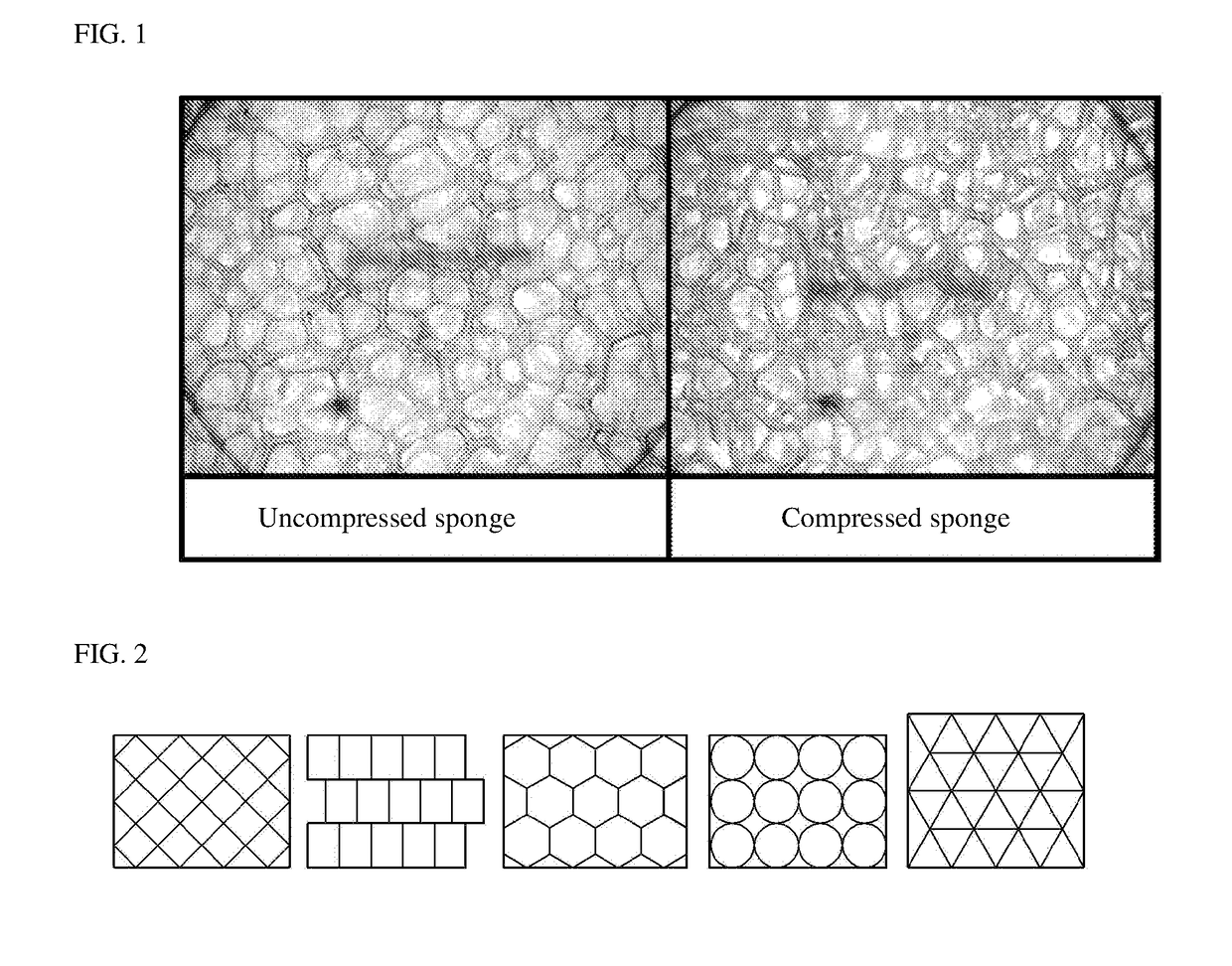
Figure 1
Abstract
Description
TECHNICAL FIELD
[0001] The present disclosure relates to a makeup cosmetic product including an improved impregnation material in which a cosmetic agent is supported. More particularly, the present disclosure relates to a makeup cosmetic product capable of controlling the discharge amount of the impregnated cosmetic agent consistently.BACKGROUND ART
[0002] In general, water-in-oil (W / O) type cosmetic agent or oil-in-water (O / W) type cosmetic agent having fluidity is contained in a tube or a pump-like formulation for use. However, there is a problem in that such a formulation is relatively inconvenient to carry and use.
[0003] According to the related art, JP 2003-12457, KR 10-1159877 and EP 0 528 705 disclose an easily portable product including a cosmetic agent supported in a porous impregnation material, such as urethane foam, and applied to the skin by using an applicator, such as a puff.
[0004] The sponge for impregnation suggested by the above-mentioned related art is obtained through ...
Examples
example 2
Determination of Physical Properties of Compressed Impregnation Material
[0042]1. Density
[0043]The difference in density between an impregnation material compressed to 2 mm from the top surface and an uncompressed conventional impregnation material was determined.
[0044]As can be seen from the following Table 1, the impregnation material including a compressed part has higher density as a whole.
TABLE 1Density (g / cm3)Conventional spongeCompressed sponge10.0220.03120.0220.03030.0210.03140.0210.03150.0210.03160.0220.03170.0210.03180.0220.03190.0210.03210 0.0210.031Average0.0210.031
[0045]Meanwhile, after comparing the density of the 2 mm compressed part in the impregnation material having a compressed part with that of the 2 mm part in the uncompressed impregnation material, it can be seen that the compressed part has a density (0.106 g / cm3) approximately 5 times higher than the density (0.021 g / cm3) of the uncompressed part.
[0047]As can be seen from FIG. 1, the comp...
example 3
Preparation of Cosmetic Composition
[0051]The following composition and ratio were used to prepare a cosmetic composition.
TABLE 3IngredientsMaterial (wt %)ExampleOil phaseCyclopentasiloxane17.0ingredientsPhenyl trimethicone14.0Caprylic / capric triglyceride2.0Ethylhexylmethoxy cinnamate7.5PEG-10 dimethicone3.0Sorbitane sesquioleate1.0Methyl paraben0.1ThickenerDisteardimonium hectorite0.2PigmentsTitanium dioxide15.0Yellow iron oxide0.9Red iron oxide0.2Black iron oxide0.1Aqueous phasePurified waterTo 100Dipropylene glycol5.0Salt1.0Tromethamine2.5Phenylbenzimidazole sulfonic acid4.0
example 4
Test for Determination of Discharge Amount
[0052]The impregnation material (Example 1) subjected to compression / pressurization and the non-treated impregnation material (Comparative Example) were used to compare the discharge amount at the initial stage (1-5 times) with the discharge amount after 6-10 times of use.
[0053]The test was carried out as follows.
[0054]A puff for application (available from S&P WORLD, cut into 1 cm x 1 cm) was mounted to a press machine (LLOYD LS1) capable of pressurizing a sample to the same depth over the same area under the same force. Then, the amount of a cosmetic composition dispensed from the porous foam was calculated, when the porous foam (cut into a size of diameter 4.6 cm×height 1 cm) impregnated with the cosmetic composition was pressurized for 3 seconds under the same pressure (0.4 kgf / cm2). The unit is gram (g).
TABLE 4Discharge number12345678910Conventional0.310.260.220.180.20.190.180.160.160.17spongeCompressed0.180.190.180.180.170.180.170.160....