
Memory page reclamation in a user idle mode
a memory page and idle mode technology, applied in the field of virtual memory page reclamation, can solve the problems of page faults, significant amount of time for page maintenance, page faults may occur, etc., and achieve the effect of reducing perturbation and restoring the performance of previous work
Patent Information
- Authority / Receiving Office
- US · United States
- Patent Type
- Applications(United States)
- Current Assignee / Owner
- Publication Date
- 2019-12-05
Smart Images
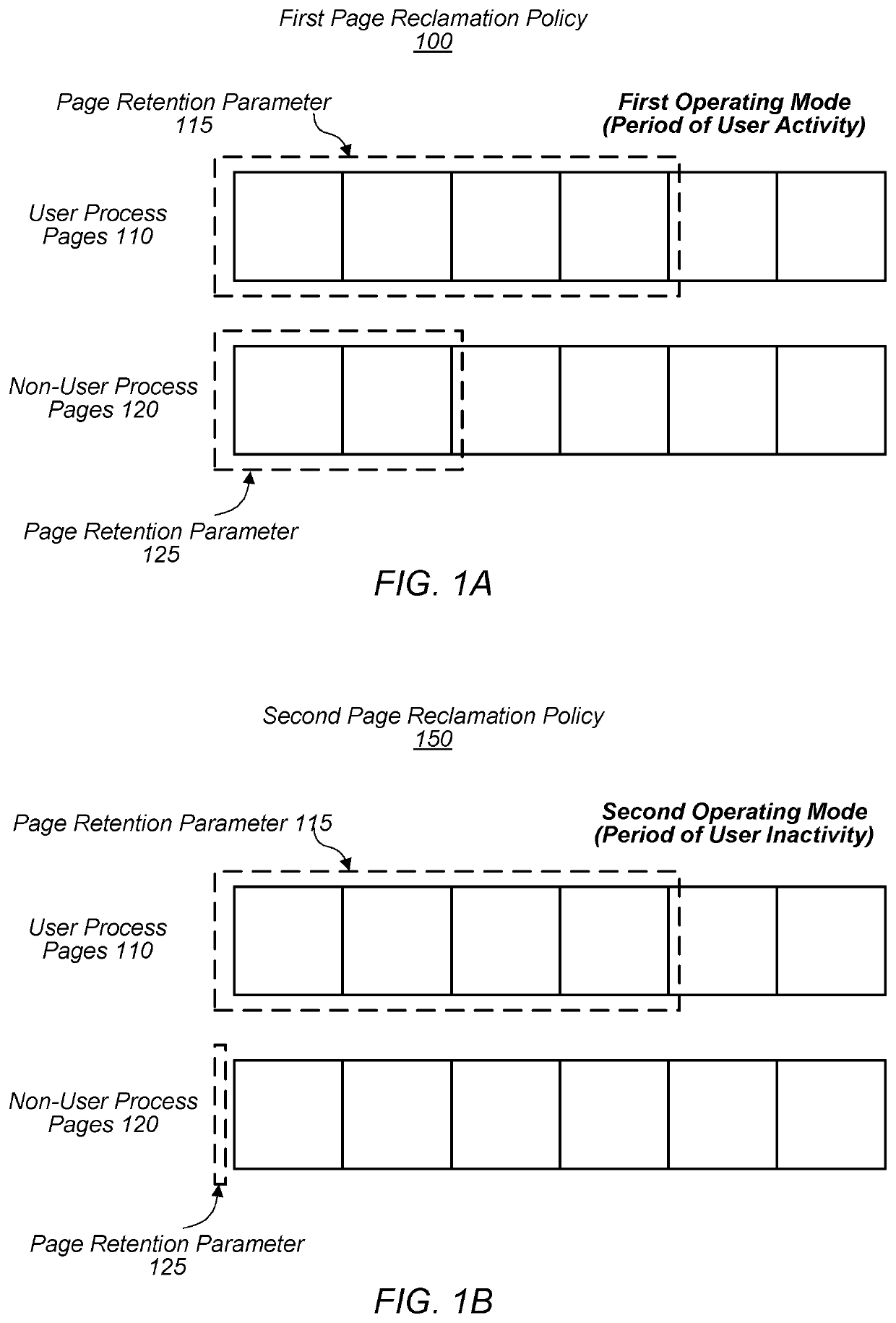
Figure 1 
Figure 2 
Figure 3
Abstract
Description
[0001] The present application claims priority to U.S. Provisional Appl. No. 62 / 679,851, filed Jun. 3, 2018, which is incorporated by reference herein in its entirety.BACKGROUNDTechnical Field
[0002] This disclosure relates generally to the field of computer memory and, more particularly, to virtual memory page reclamation while a computing device is operating in a state of user inactivity.Description of the Related Art
[0003] Modern computing devices typically implement a virtual memory system in which primary storage (i.e., main memory), such as random access memory (RAM), is used as a cache for secondary storage such as hard disk drives, optical drives, etc. To process a request to access a particular memory location, a memory management unit (MMU) may receive a virtual memory address of the particular memory location and translate the virtual address to a corresponding physical address in memory. The MMU may then reference the physical address to retrieve the desired data.
[0004] Mappi...
Examples
Embodiment Construction
[0016]During operation, a computing device may perform various types of processes concurrently, including both user processes and non-user processes. Further, modern computing devices typically implement a virtual memory system in which main memory is used as a cache to store data (e.g., data for user and non-user processes) from secondary storage. As such, in performing the various processes, the computing device stores pages of data for these processes in main memory. Once all available pages in main memory are in use, the operating system will typically need to select pages to evict from main memory to make room for newly requested data. An operating system may implement various page reclamation policies in determining which pages to evict from main memory. As used herein, the term “page reclamation policy” refers to an implementation that determines the manner in which pages are selected for eviction from main memory. In some embodiments, for example, a page reclamation policy m...