
Single compound toners for use in polyesters
a technology of single compound and toner, which is applied in the direction of organic dyes, chemistry apparatus and processes, mixing, etc., can solve the problems of unsatisfactory yellowing of polyester fibers and plastics, reduced aesthetics, and compounded yellowing problems, and achieves excellent anti-yellowing results, low extraction, and high brightness (c value).
Patent Information
- Authority / Receiving Office
- US · United States
- Patent Type
- Patents(United States)
- Current Assignee / Owner
- Publication Date
- 2005-04-05
- Estimated Expiration
- Not applicable · inactive patent
Smart Images
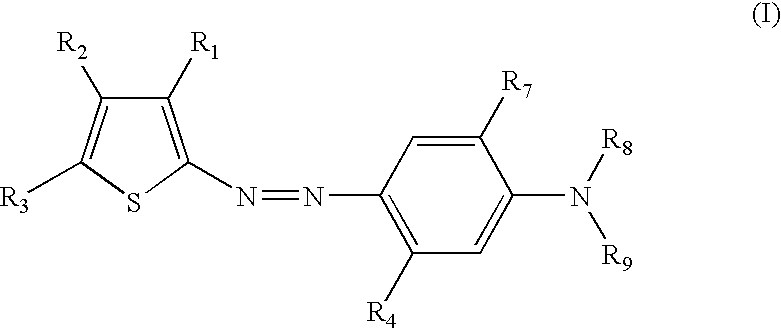
Figure 1
Abstract
Description
FIELD OF THE INVENTIONThis invention relates to individual compounds that provide effective toning (or bluing) to combat yellowing within polyester articles (such as bottles, containers, and the like). Such a novel toner permits effective neutralization of yellowness while also providing highly desirable low haze and increased brightness due to a sharp absorption peak within the needed range of wavelengths (e.g., from about 565 to 590 nm) and a narrow half-height band width. Furthermore, such an individual compound is preferably liquid in nature and may thus be incorporated within an added ultraviolet absorber solution or shelf-stable dispersion to facilitate addition within target polyesters at various stages of production. The particular WV absorbers desired as additives within target polyesters also tend to exhibit certain yellowing effects that require attention as well. The inventive single bluing agent compound thus also accords effective neutralization of such WV absorber yel...
Examples
example 1
The colorant listed as #1 from TABLE 1, above, was produced in accordance with the teachings of U.S. Pat. No. 4,507,407 and kept in a closed container. The colorant exhibited a violet shade and was liquid in nature, with a viscosity level of about 1300 cps at 32 degrees Celsuis.
example 2
14 parts of the colorant from EXAMPLE 1 were then admixed with 2000 parts of CLEARSHIELD® 400, a commercially available UV absorber solution from Milliken & Company. The resultant liquid was a stable homogeneous solution exhibiting a blue color.
example 3
10 parts of the colorant from EXAMPLE 1 were then admixed with 1000 parts of CLEARSHIELD® 390A, a commercially available UV absorber solution from Milliken & Company. The resultant liquid was a stable homogeneous solution exhibiting a blue color.